Short answer
Commercial ice machine troubleshooting starts with five checks: power and switch position, water supply (open valve, 20–80 psi or 1.4–5.5 bar, unclogged filter), drain flow, condenser airflow and scale on the evaporator. These cause most cases of no ice, low output, cloudy ice and leaks. Refrigerant, compressor and control-board faults need a qualified ice machine technician.
Key takeaways
- A dirty air-cooled condenser or a hot room can cut ice output by 15–25% before any part has failed.
- Commercial ice machines usually connect to a 3/8 in (9.5 mm) cold water supply line with a shut-off valve and a filter on the ice machine inlet.
- Cloudy, soft or small cubes usually point to scale, high dissolved minerals or low water flow rather than a refrigeration fault.
- Clean and descale at least every 6 months; scale is the most common cause of harvest problems and frozen-up evaporators.
- If a repair costs more than about half the price of a new machine and the unit is 7–10 years old, replacement usually makes more sense.
How do you troubleshoot a commercial ice machine?
Ice machine troubleshooting means narrowing a fault down from the symptom (no ice, slow ice, bad ice, leaks or noise) to the system that causes it: electrical supply, water supply, drain, airflow, scale or refrigeration. In most commercial kitchens and bars, the cause is one of the first four, and you can check them yourself in under 30 minutes.
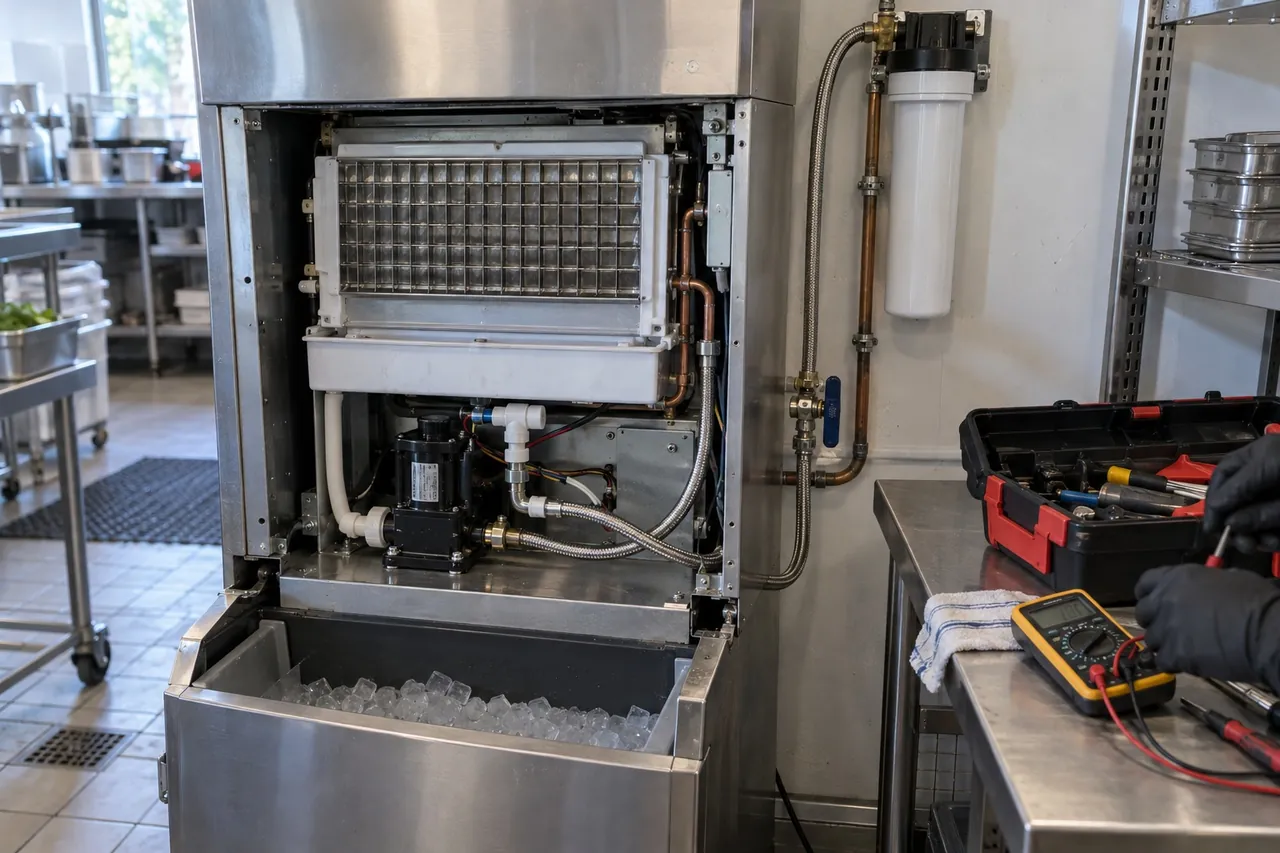
Every cube, nugget and flake machine works on the same principle. Water is pumped or fed over a refrigerated evaporator, freezes, and is then released by a harvest cycle (hot gas or an auger) into the bin. A sensor stops production when the bin is full. When any input to that cycle is wrong, the controller either produces poor ice or stops and shows an error.
Before you start, read the machine's error code table in the manual, switch off and isolate power before opening panels, and never open the sealed refrigeration circuit. Refrigerant work requires a certified technician in most countries. If you run commercial ice machines from Be There, send us the model, serial number and a photo of the display and we will help you identify the fault and the part.
The checks below follow the order an experienced ice machine technician would use: cheapest and most likely first, refrigeration last.
12 common ice machine problems at a glance
| # | Symptom | Most likely causes | First fix to try |
|---|---|---|---|
| 1 | No ice, machine silent | Power off, tripped breaker, switch on "clean" or "off", bin sensor reads full | Check supply, reset, clear bin sensor |
| 2 | No ice, machine running | Water valve closed, clogged filter, failed inlet valve | Open valve, change filter, check pressure |
| 3 | Low ice production | Dirty condenser, hot room, scale, low water pressure | Clean condenser, improve ventilation, descale |
| 4 | Small or thin cubes | Low water level, short freeze, partially blocked distributor | Descale, check water level and pump |
| 5 | Cloudy or soft ice | Hard water, scale, high dissolved solids | Descale, fit or upgrade the water filter |
| 6 | Ice stuck in slabs, won't harvest | Scale on evaporator, harvest valve or sensor fault | Descale; call technician if it persists |
| 7 | Evaporator frozen solid | Water starvation, failed pump, sensor fault | Defrost, check water flow and pump |
| 8 | Water leaking on floor | Blocked drain, loose supply fitting, cracked bin | Clear drain, tighten fittings |
| 9 | Water in bin, ice melting fast | Blocked bin drain, damaged bin insulation or gasket | Clear drain, check door seal |
| 10 | Bad taste or odour | Biofilm, slime, old filter, food stored in bin | Clean and sanitise, change filter |
| 11 | Loud noise or rattling | Fan blade hitting, loose panels, pump cavitation | Tighten panels, check fan and pump |
| 12 | Error code or flashing light | Long freeze or harvest time, sensor or board fault | Note code, reset once, then call service |
If a fix works but the problem returns within days, treat the first fix as a symptom treatment and look for the underlying cause, which is usually water quality or airflow.
Ice machine not making ice or making too little: what to check first
No ice and low production are the two most common service calls. Work through these steps in order:
- Check power and mode. Confirm the breaker, plug and isolator are on and the switch is set to "ice", not "clean" or "off". Some machines wait several minutes after a restart before filling.
- Check the bin sensor. Ice piled against the bin thermostat or level sensor, or a dirty optical sensor, tells the machine the bin is full.
- Check the water supply. Make sure the shut-off valve is fully open and the filter cartridge is not past its rated life. Low pressure slows filling and gives thin ice.
- Check the condenser and room. Clean dust from an air-cooled condenser and keep the intake and exhaust clear. For water-cooled units, confirm condenser water flow.
- Check for scale. White or grey deposits on the evaporator mean it is time to descale.
- Measure output. Weigh the ice from one full cycle and multiply by cycles per day. Compare with the rated capacity at your room and water temperatures.
Remember that output falls in heat. A machine rated at 100 lb (45 kg) at 90 °F (32 °C) air may only make 75–85 lb in a hot, enclosed space. If it is simply undersized, no repair will help; see our ice machine capacity guide.
Ice maker water line problems: size, supply line and connections
The ice maker water line is the pipe or tube that feeds cold potable water from your supply to the machine's inlet valve. Many problems blamed on the machine start here.
What size is an ice maker water line?
Household refrigerator ice makers usually use a 1/4 in (6.35 mm) OD tube. Commercial ice machines typically need a 3/8 in (9.5 mm) supply line, and some large heads or flake machines specify 1/2 in (12.7 mm). Always follow the installation manual; an undersized ice machine supply line starves the water pump and gives small, hollow cubes.
Pressure, valves and filters
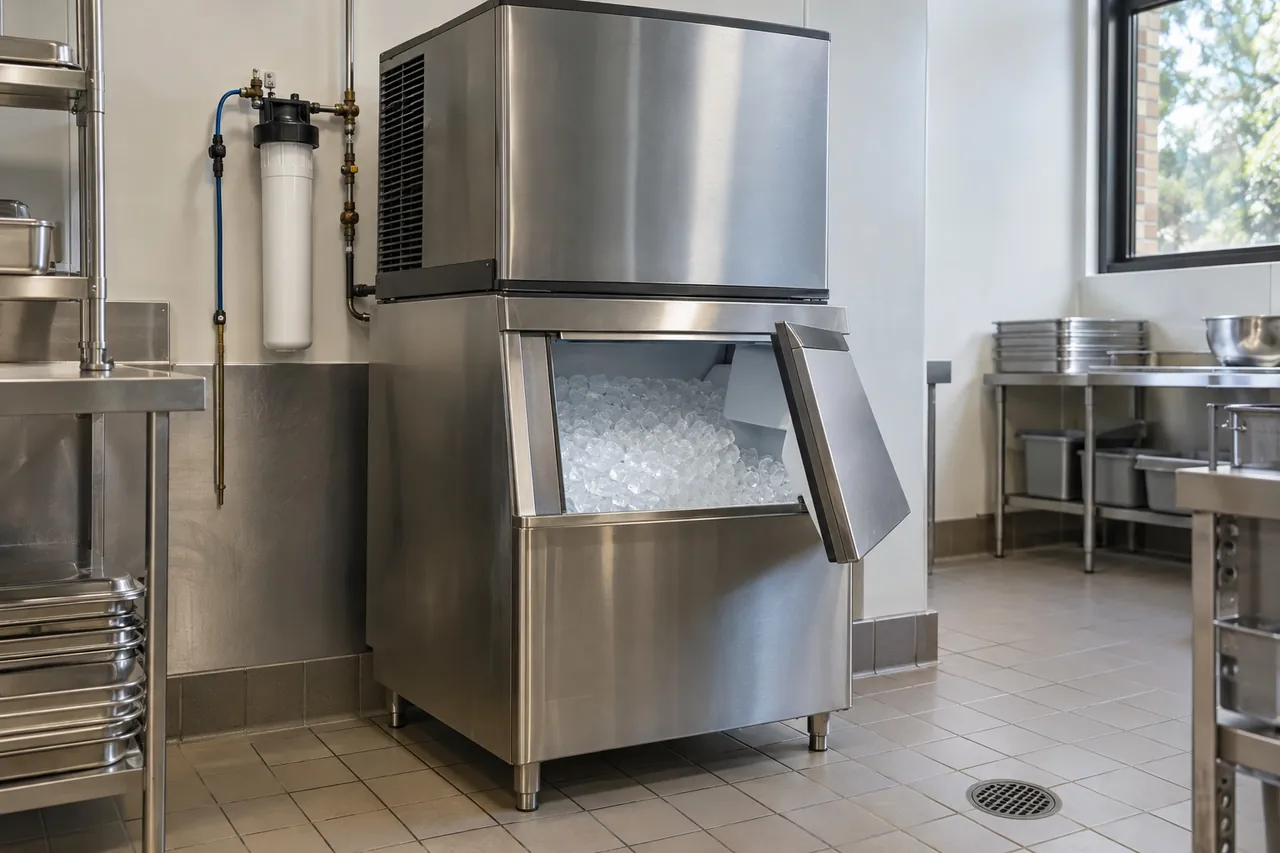
Most commercial machines need water pressure of roughly 20–80 psi (1.4–5.5 bar). Fit a dedicated shut-off valve, a backflow preventer where local code requires it, and a water filter sized to the machine's daily output on the ice machine line only. Our ice machine water filter guide explains sizing.
Which water line material should you use?
A plastic ice maker water line (polyethylene tubing) is cheap and common in homes but can kink, crack with age and is easily damaged behind equipment. For commercial sites, use rigid copper or food-grade braided stainless hose with proper compression or threaded fittings. A water line kit for an ice maker typically includes tubing, a saddle or tee valve and a line connector; saddle valves are best avoided because they clog and leak.
When hooking up an ice maker water line, flush it before connecting, use only cold water, and check every ice maker line connector for drips after 24 hours. The same rules apply to an ice maker and water dispenser with a water line, or a countertop ice maker with a water line connection.
Why is my ice cloudy, soft, small or hollow?
Ice quality problems are almost always water problems. Clear, hard cubes form when water flows steadily over the evaporator and the minerals stay in the circulating water rather than freezing into the cube.
- Cloudy ice: high dissolved minerals or scale. As the machine freezes pure water, minerals concentrate in the sump; if the sump is not flushed often enough, they end up in the ice. Descale, then check the purge or dump setting.
- Soft or wet ice: also caused by minerals, or by ice sitting in a bin with a blocked drain. Cube ice should feel hard and dry.
- Small, thin or hollow cubes: not enough water reaching the evaporator. Check pressure, the filter, the water pump and the distributor tube for scale.
- Uneven cubes (full at one end, empty at the other): blocked distributor holes, a machine that is not level, or low refrigerant. Level the machine first.
- Bad taste or smell: biofilm or yeast in the water system, an expired carbon filter, or food stored in the ice bin.
The fix for most of these is a full clean and sanitise followed by a fresh filter. Our step-by-step guide to cleaning a commercial ice machine covers the procedure and a cleaning log. In hard-water areas, clean every 3–4 months rather than every 6.
Leaks, harvest problems, frozen evaporators and error codes
Water on the floor
Leaks usually come from the drain, not the machine. Gravity drains need a downward fall, typically at least 1/4 in per foot (about 2 cm per metre), an air gap at the floor drain and no shared connection that can back up. Check that the bin drain and sump drain are not blocked with slime, and that supply fittings are tight.
Ice will not drop (harvest problems)
In a cube machine, ice is released by warming the evaporator briefly, often with hot gas. If cubes stay stuck or come off as one slab, scale is the most common cause because it grips the ice. A failed harvest valve, a faulty thermistor or a harvest-assist part can also be at fault; these need a technician.
Frozen-up evaporator
A block of ice across the evaporator means the machine kept freezing without enough water or without a harvest. Switch off, let it thaw naturally (never chip ice off the evaporator), then check water supply, pump and sensors before restarting.
Error codes and flashing lights
Most controllers log long freeze times, long harvest times, high discharge temperature or water faults. Write the code down, fix any obvious water or airflow issue, and reset once. If the same code returns, call for ice machine service and repair rather than resetting repeatedly, which can damage the compressor.
Ice machine parts and components that wear out
Knowing the main ice machine components helps you describe a fault and order the right commercial ice machine parts. Typical service lives vary with water quality and duty, so treat these as guides.
| Component | What it does | Typical sign of failure | User or technician? |
|---|---|---|---|
| Water filter cartridge | Removes sediment, chlorine, scale formers | Low flow, cloudy ice, bad taste | User, every ~6 months |
| Water inlet valve | Opens to fill the sump | No fill, or constant trickle | Technician |
| Water pump | Circulates water over the evaporator | Thin cubes, noise, freeze-up | Technician |
| Float or water level probe | Senses sump level | Overfill or no-fill errors | User can clean; technician replaces |
| Bin level sensor or thermostat | Stops production when bin is full | Stops early or overfills bin | Technician |
| Condenser fan motor | Moves air over the condenser | High-temperature error, low output | Technician |
| Evaporator | Freezing surface | Uneven cubes, damaged coating | Technician |
| Compressor and controller | Refrigeration and logic | No cooling, repeated error codes | Technician |
Bin parts also wear: door gaskets, hinges and scoops. An ice maker bin replacement is usually only needed if the liner is cracked or the insulation is wet. When you buy a new machine, ask for a recommended spare parts list and confirm parts availability for your market.
Repair or replace? Cost to fix an ice maker and next steps
The cost to fix an ice maker depends on the part, the technician's call-out rate in your area and whether refrigerant work is needed. As a rule, water-side parts (filter, inlet valve, pump, sensors) are low-cost repairs, while compressors, evaporators and refrigerant leaks are expensive. Labour and parts prices vary widely by market, so get a written quote before work starts.
Consider an ice machine replacement when:
- The repair costs more than about half the price of a new machine of the same capacity.
- The machine is 7–10 years old and has had several refrigeration repairs.
- It uses a refrigerant being phased out in your market, making service harder.
- Your business has grown and the machine is undersized, so it never catches up.
- Commercial repair is slow or parts are no longer available.
An ice maker replacement is also a chance to fix the root cause: add a correctly sized filter, move an air-cooled unit out of a hot corner, or choose a water-cooled or remote-condenser model.
If you are replacing a machine, send us the old model's capacity, ice shape, dimensions, power supply and room temperature. We will match a replacement from our ice machine range and quote on FOB, CIF or DDP terms. Send an inquiry and we reply within one working day.