Short answer
A commercial refrigerator is a fridge built for food businesses: it holds food at or below 41 °F (5 °C), recovers quickly after frequent door openings, works in kitchens up to about 38–43 °C (100–110 °F), and carries food-equipment listings such as NSF/ANSI 7. Choose by type (solid or glass door), door count (one to four), ambient rating, refrigerant and service support.
Key takeaways
- Commercial refrigerators must keep TCS food at or below 41 °F (5 °C) under the FDA Food Code; most are set to 34–38 °F (+1 °C to +3 °C).
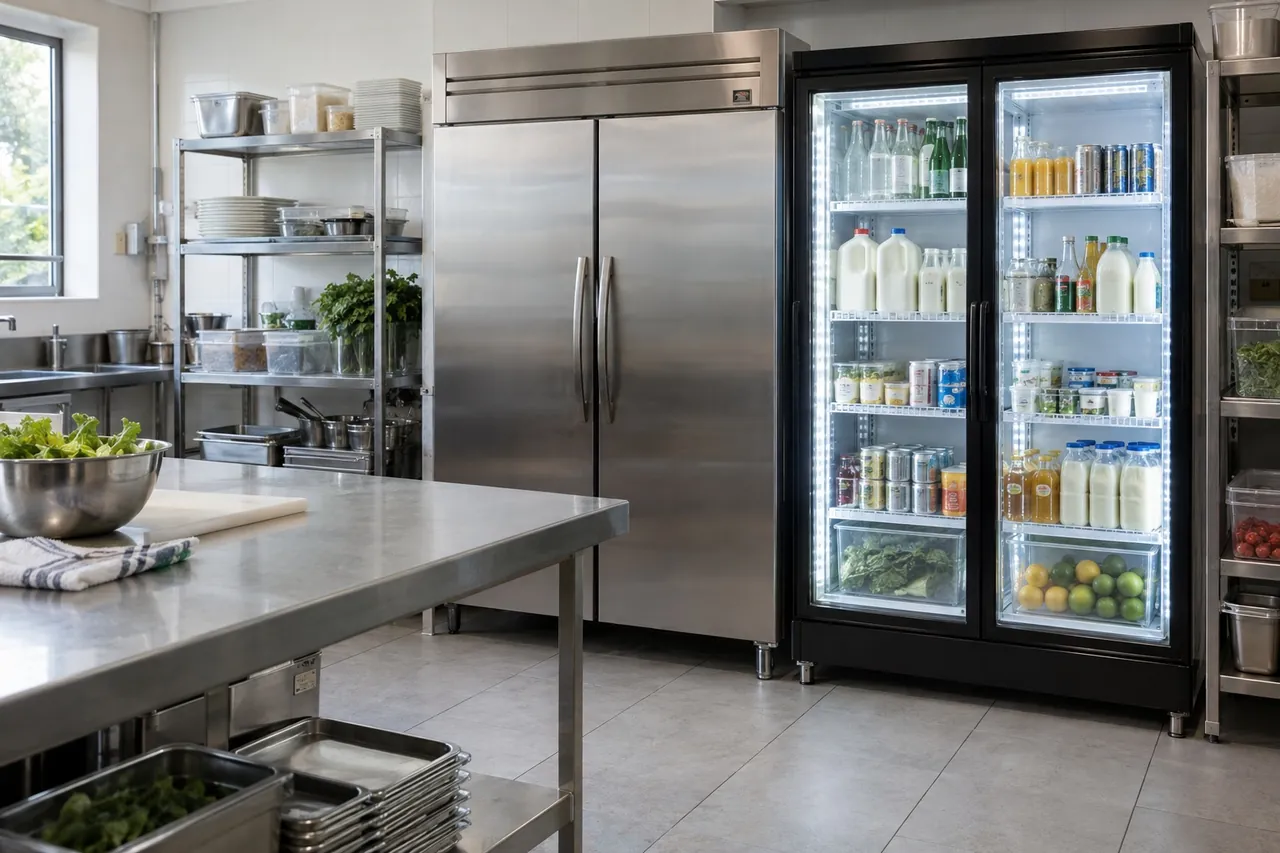
- Solid-door reach-ins suit kitchen storage; glass door refrigerators suit drinks and retail display but gain more heat through the glass.
- In the US, look for NSF/ANSI 7 plus UL or ETL safety listing; in Europe, CE marking and EN/ISO 23953 testing for display cabinets.
- R290 (propane, GWP about 3) is now the mainstream refrigerant for new plug-in commercial fridges in many markets.
- Dirty condensers, worn door gaskets and blocked airflow cause most commercial fridge repair calls.
What is a commercial refrigerator?
A commercial refrigerator is a refrigerator designed for food businesses rather than homes. It has to keep chilled food at or below 41 °F (5 °C), the FDA Food Code limit for cold-held TCS (time/temperature control for safety) food, while its doors open dozens or hundreds of times a day in a hot kitchen or busy shop.
To do that, commercial refrigeration differs from a household fridge in four ways:
- Fan-forced cooling. A fan blows air across the evaporator coil so the cabinet recovers quickly after each door opening and temperatures stay even top to bottom.
- Higher ambient rating. Most are built to work in rooms of 38–43 °C (100–110 °F); many home fridges are rated to about 32 °C (90 °F).
- Durable, cleanable build. Stainless steel or coated steel cabinets, food-safe liners, removable shelves and gaskets.
- Food-equipment listing. In the US, NSF/ANSI 7 for refrigerators and freezers used with food, plus UL or ETL electrical safety listing.
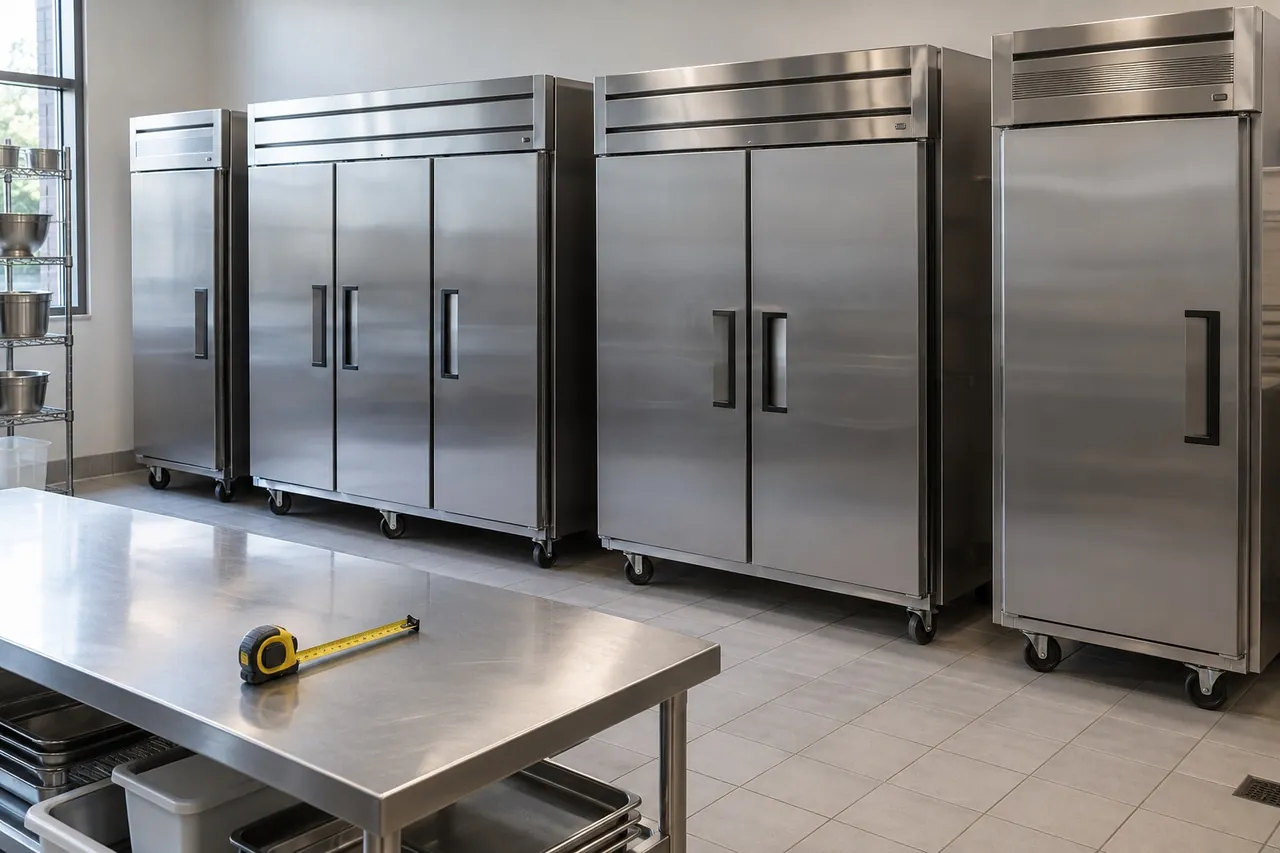
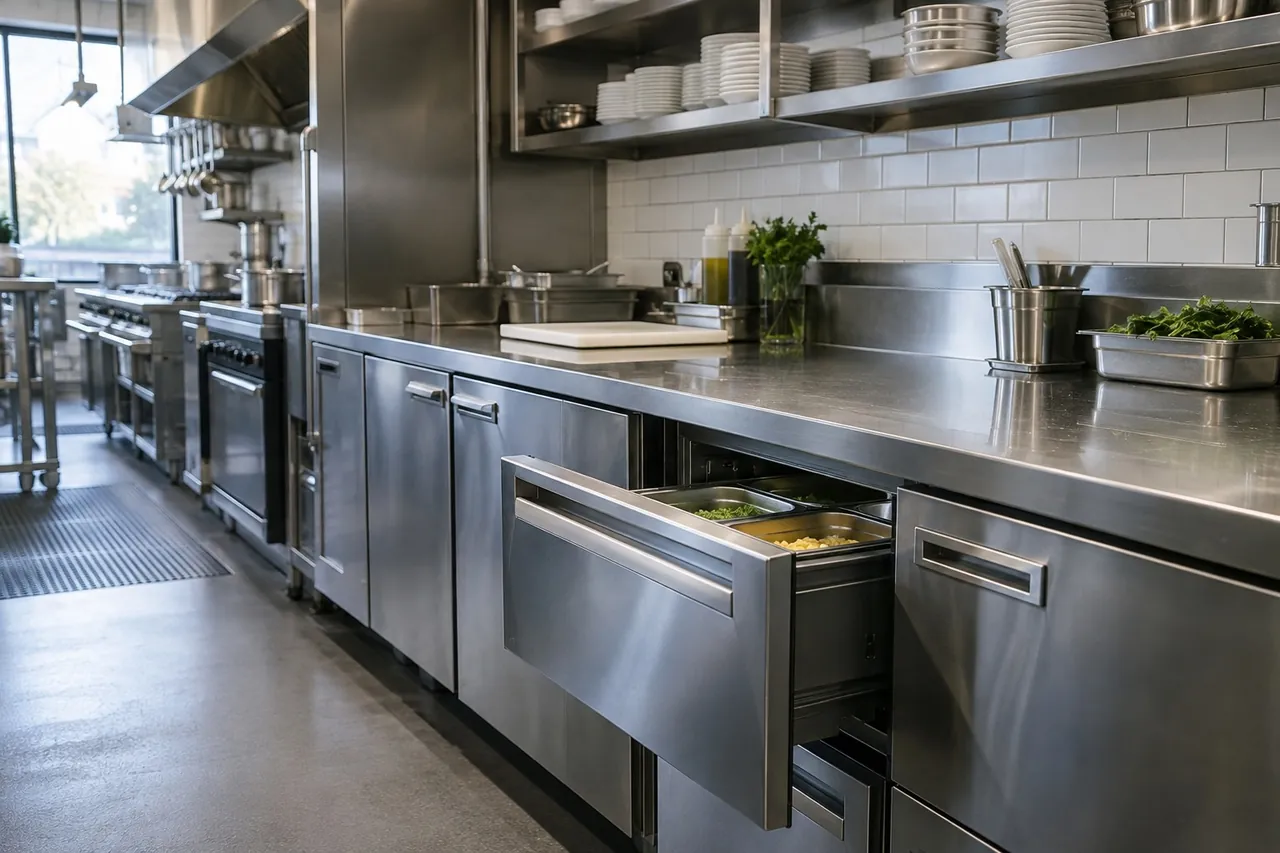
“Commercial refrigerators” covers reach-in fridges, glass door display fridges, undercounter units, prep tables, open merchandisers, display cases and walk-in coolers. This guide focuses on upright reach-ins and glass door models, the workhorses of restaurants, cafés, convenience stores and offices, and links to our other guides for the rest.
Types of commercial refrigerators and where each fits
Start by matching the type of fridge to the job.
| Type | Typical temperature | Best for |
|---|---|---|
| Solid door reach in refrigerator | +1 °C to +4 °C (33–40 °F) | Kitchen storage of raw and prepped food |
| Glass door refrigerator / display fridge | +2 °C to +8 °C (36–46 °F) | Drinks, dairy and packaged food in shops, cafés |
| Undercounter refrigerator | +1 °C to +4 °C | Cook lines and bars |
| Refrigerated prep table | +1 °C to +4 °C | Sandwich, salad and pizza stations |
| Open air merchandiser | 0 °C to +5 °C (32–41 °F) | Grab-and-go food in supermarkets |
| Meat cooler / deli display case | −1 °C to +4 °C (30–39 °F) | Butchers, delis, serve-over counters |
| Commercial fridge freezer (dual-temp) | Fridge +1 °C to +4 °C; freezer −18 °C (0 °F) or colder | Small kitchens needing both in one footprint |
| Ice merchandiser | −12 °C to −6 °C (10–21 °F) | Bagged ice at stores and fuel stations |
| Walk-in cooler | 0 °C to +10 °C (32–50 °F) | Bulk storage beyond about 2,000 L |
A reach-in cooler, reach in fridge, commercial cooler and commercial reach in refrigerator all mean the same upright cabinet you reach into; an industrial fridge usually means a larger, heavier-duty version or a walk-in. A display cooler or merchandiser fridge is the glass door version built to sell product. For bagged ice, a lockable ice merchandiser is a different machine from a drinks fridge; it runs below freezing and is designed for frequent door openings outdoors.
If you need dimensions for each door count, see our commercial refrigerator sizes guide.
Solid door vs glass door refrigerator: which do you need?
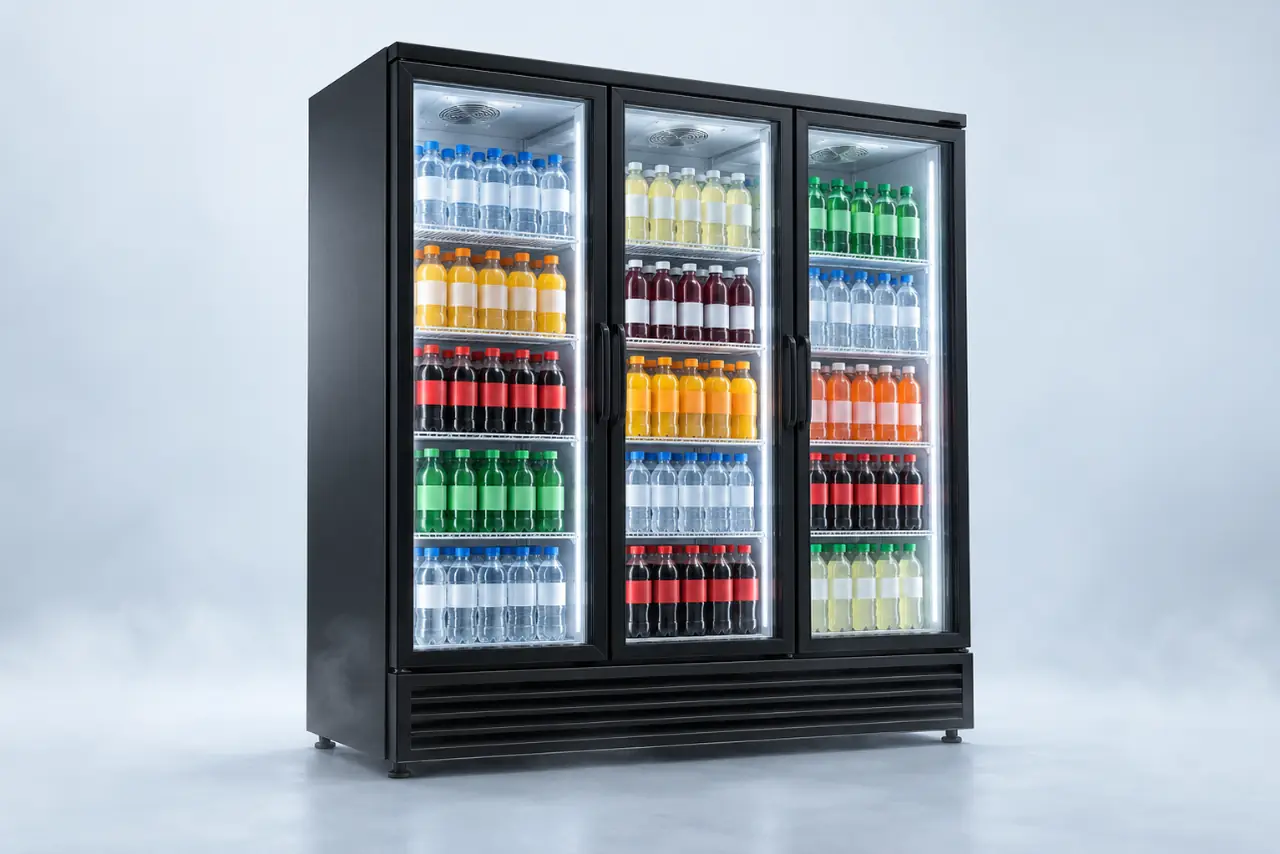
The second decision is the door. A glass door refrigerator (glass front fridge, see through refrigerator, clear door fridge) sells product; a solid door stores it.
| Factor | Solid door reach-in | Glass door refrigerator |
|---|---|---|
| Main use | Back-of-house storage | Front-of-house merchandising |
| Heat gain | Lowest | Higher; reduced by low-E or double/triple glazing |
| Lighting | Basic interior light | LED lighting to show product |
| Stock checks | Open the door | Visible at a glance |
| Typical depth | 30–35 in (762–889 mm), takes sheet pans | 0.6–0.75 m (24–30 in) |
| Door options | Full or half doors | Hinged or sliding glass doors |
Door count drives capacity. A single door refrigerator suits a café or small office; a double door refrigerator or 2 door commercial refrigerator is the most common restaurant size; a 3 door commercial refrigerator suits busy kitchens and convenience stores; a 4 door refrigerator is usually a long glass door merchandiser for drinks. (The “4 door refrigerator French” models sold for homes are a different product with a bottom freezer drawer.)
Sliding glass doors save aisle space; hinged doors usually seal better and are easier to replace. Some cafés use a glass door unit in the kitchen so staff can find items without opening doors. That works if the cabinet is rated for your kitchen's heat. Our glass door display refrigerators come in one- to four-door versions with LED lighting and low-E glass.
Stainless steel, insulation and compressors: what to look for in the build
Cabinet material
A stainless steel fridge is the standard for kitchens. Type 304 stainless resists corrosion best and is preferred for interiors and humid or coastal sites; type 430 is magnetic, cheaper and fine for dry exteriors. Many stainless refrigerators use stainless doors and fronts with aluminium or coated-steel sides and interiors to cut cost. Dark stainless steel and black finishes are coatings over steel; check they are rated for commercial cleaning chemicals.
Insulation
Look for foamed-in-place polyurethane about 50–80 mm (2–3 in) thick, free of high-GWP blowing agents. Thicker insulation lowers running cost and condensation risk.
Compressor position
A bottom-mounted compressor is easy to service and puts weight low, but draws in floor dust and kitchen heat. A top-mounted compressor stays cleaner and suits hot kitchens, and leaves more storage at the bottom. Glass door merchandisers often mount it at the base behind a grille.
Controls and extras
- Digital controller with display, high/low temperature alarm and automatic defrost.
- Self-closing doors with hold-open, replaceable magnetic gaskets.
- A locking refrigerator door for drinks, pharmacies or unattended areas.
- Adjustable, coated or stainless shelves, and castors with brakes for cleaning.
- Humidity control for produce or a vegetable fridge application.
Certification, refrigerant and where commercial fridges are made
Before comparing any commercial refrigerator for sale, check that it carries the listings your market requires; they matter more than brand or country of origin.
- US: NSF/ANSI 7 for food-equipment hygiene, plus UL or ETL safety listing to UL 471 or UL 60335-2-89. ENERGY STAR applies to many reach-in and glass door models and is often needed for utility rebates.
- Europe and UK: CE or UKCA marking, EN/IEC 60335-2-89 electrical safety and, for display cabinets, EN/ISO 23953 testing with a stated climate class.
- Other markets: national marks such as SASO in Saudi Arabia; check before you order.
Refrigerant rules are tightening. R290 (propane) has a global warming potential (GWP) of about 3 versus about 3,900 for R404A, and the EU, UK and US now restrict high-GWP refrigerants in new self-contained commercial cabinets. R290 units are built to IEC 60335-2-89 charge limits and usually use less energy. Our R290 vs R404A guide covers the details.
Some buyers search for an American made refrigerator or USA made freezers. If a public tender or grant requires domestic manufacture, an imported unit will not qualify, so check the rules first. Otherwise, judge any commercial fridge on its listings, components, warranty and parts availability. Our buyer's checklist for importing from China explains what to put on the proforma invoice.
How much does a commercial refrigerator cost to run?
Running cost depends on the cabinet's rated energy use, your electricity price and how the unit is used. Every spec sheet should give energy consumption in kWh per 24 hours under a stated test condition.
To estimate yearly cost: kWh per day × 365 × your price per kWh. For example, a cabinet rated at 3 kWh/day on a tariff of $0.15/kWh costs about 3 × 365 × 0.15 ≈ $164 a year. Two cabinets with a 1 kWh/day difference differ by about $55 a year at that tariff, and over a 10-year life that gap is often larger than the price difference between them.
Ways to cut energy use:
- Choose R290, an electronically commutated (EC) fan motor and LED lighting.
- Keep the condenser clean and the unit away from ovens, fryers and direct sun.
- Leave 2–4 in (50–100 mm) of clearance around the cabinet unless it is front-breathing.
- Replace torn door gaskets and do not prop doors open.
- Do not overfill; leave space for air to circulate between products.
- For display fridges, use night mode or lighting timers if the controller supports them.
Purchase price varies widely by size, specification, certification and market. Be There quotes each order FOB, CIF or DDP, so compare landed cost plus running cost rather than the ex-works price alone.
Commercial fridge for home, office or food truck: does it make sense?
Commercial refrigerators get bought for places that are not restaurants. Here is when that makes sense.
Commercial fridge for home
A commercial grade refrigerator holds temperature better and lasts under heavy use, but it is usually louder, uses more energy than an efficient home model, and may need its own circuit. A glass door refrigerator for home use (for drinks in a games room or garage) is reasonable if it is rated for the room's temperature. For everyday family food, a good home fridge is usually the better buy.
Office refrigerator and break room fridge
For a small office, a residential or small commercial refrigerator is enough. For 30+ staff or a canteen, a single or double door commercial unit with fan cooling copes with constant door openings much better. A small refrigerator with glass door helps people see what is inside and reduces door-open time.
Commercial refrigerator for a food truck
Food trucks need units that tolerate vibration, high ambient temperatures and generator power. Undercounter and prep table units are typical. Secure doors and shelves, and check the start-up current against your generator or inverter.
High end refrigerator vs commercial
Premium home refrigerators focus on looks, silence and built-in fit; commercial units focus on recovery and hygiene. Choose based on how often the door opens and what an inspector expects.
Commercial fridge repair and maintenance: the common problems
Most commercial fridge repair calls trace back to a short list of causes. Check these before calling a technician:
| Symptom | Likely cause | First check |
|---|---|---|
| Cabinet too warm | Dirty condenser, blocked airflow, overloading | Clean condenser, clear vents, reduce load |
| Runs constantly | Hot room, worn gasket, low refrigerant | Check ambient, test gasket with paper strip |
| Ice on evaporator | Failed defrost heater, timer or sensor | Run manual defrost, check controller alarms |
| Water on floor | Blocked drain line or tray | Clear drain, check tray heater |
| Condensation on glass | High humidity, failed door heater | Check heater circuit and gasket seal |
| Noisy | Fan blade hitting ice or debris, worn fan motor | Inspect fans, level cabinet |
Good commercial fridge maintenance is simple: clean the condenser every one to three months (monthly near fryers or in dusty sites), wipe gaskets weekly, and record temperatures every shift for HACCP. A leak, compressor fault or refrigerant recharge needs a qualified technician, and R290 units must be serviced by someone trained for flammable refrigerants. Our commercial refrigeration maintenance checklist has a full schedule. When buying, ask the supplier which spare parts (gaskets, fan motors, controllers, thermostats) ship with the order.
How to choose the best commercial refrigerator: checklist
There is no single best commercial refrigerator; there is a best fit for your site. Work through these points and get each one written on the quotation:
- Type and doors: solid or glass, one to four doors, hinged or sliding.
- Temperature: +1 °C to +4 °C (33–40 °F) for food storage, +2 °C to +8 °C (36–46 °F) for drinks display.
- Size and access: width, depth with handles, height on castors, door swing and the delivery route.
- Ambient rating: matched to your hottest room, or ISO 23953 climate class for display units.
- Power: voltage, frequency and plug type.
- Refrigerant: R290 where allowed.
- Certification: NSF/ANSI 7 and UL/ETL in the US, CE elsewhere, or your national mark.
- Service: warranty, spare parts and local technicians.
Be There supplies upright commercial display refrigerators with one to four glass doors, fan-forced cooling at +2 °C to +8 °C (36–46 °F), LED lighting, low-E glass and an R290 option, plus display freezers, ice merchandisers and walk-in cold rooms. Send your quantities, door counts, voltage and destination via our inquiry form and we will reply within one working day with a quotation (FOB, CIF or DDP).