Short answer
Common refrigerator sizes: a standard home fridge is 30–36 in (762–914 mm) wide, 66–70 in (1,676–1,778 mm) tall and 29–34 in (737–864 mm) deep, holding 18–28 cu ft. Commercial reach-ins are about 27–29 in wide for one door, 52–55 in for two and 77–83 in for three, all roughly 78–84 in (1,980–2,130 mm) tall.
Key takeaways
- The standard refrigerator width for homes is 30–36 in (762–914 mm); 36 in is the most common width for French-door and side-by-side models.
- A typical fridge height is 66–70 in (1,676–1,778 mm); commercial reach-ins are taller at about 78–84 in (1,980–2,130 mm) on castors.
- Commercial reach-in capacity is roughly 19–24 cu ft for one door, 43–49 cu ft for two and 69–72 cu ft (about 2,000 L) for three.
- Cubic feet = internal width × height × depth in inches ÷ 1,728; litres = internal dimensions in cm multiplied together ÷ 1,000.
- Always measure the delivery route: the narrowest doorway must clear the fridge's depth with doors and handles removed.
What are common refrigerator sizes?
Refrigerator sizes fall into two groups. Home (residential) fridges are usually 30–36 in (762–914 mm) wide, 66–70 in (1,676–1,778 mm) tall and 29–34 in (737–864 mm) deep including doors, with 18–28 cu ft (510–790 L) of storage. Commercial reach-in refrigerators are sold by door count: about 27–29 in (686–737 mm) wide for one door, 52–55 in (1,321–1,397 mm) for two doors and 77–83 in (1,956–2,108 mm) for three doors, all around 78–84 in (1,980–2,130 mm) tall.
Between and around those sit undercounter fridges (about 34 in, 864 mm, tall), compact and apartment fridges (20–24 in wide), glass door merchandisers (one to four doors) and, beyond about 2,000 L, walk-in coolers.
So the average fridge size for a full size fridge at home is roughly 33 × 68 × 32 in, while a medium refrigerator is closer to 28–30 in wide with 14–18 cu ft. Width is the number most people search for because it is fixed by the cabinet gap. Depth decides whether the doors stand proud of the counters, and height decides whether the unit fits under a soffit or through a doorway. For a business, the deciding number is often the delivery route: a three-door reach-in may fit the kitchen but not the corridor.
The tables below give typical ranges, not exact figures for any model. Always confirm the spec sheet, including whether the height is quoted on legs or castors and whether depth includes handles.
Standard refrigerator dimensions: width, height and depth by style
For home and office use, standard fridge dimensions depend on the layout:
| Style | Width | Height | Depth (with doors) | Capacity |
|---|---|---|---|---|
| Top freezer | 24–33 in (610–838 mm) | 61–68 in (1,549–1,727 mm) | 28–32 in (711–813 mm) | 10–21 cu ft (280–600 L) |
| Bottom freezer | 24–33 in | 67–70 in (1,702–1,778 mm) | 29–33 in (737–838 mm) | 12–22 cu ft (340–620 L) |
| Side-by-side | 33–36 in (838–914 mm) | 66–70 in | 29–34 in (737–864 mm) | 21–28 cu ft (590–790 L) |
| French door | 30–36 in (762–914 mm) | 68–70 in | 29–34 in | 20–30 cu ft (570–850 L) |
| Counter-depth (any style) | 30–36 in | 68–70 in | 24–27 in (610–686 mm) cabinet | 15–23 cu ft (420–650 L) |
| Built-in column / pair | 18–36 in each; pairs to 60 in (1,524 mm) | 80–84 in (2,032–2,134 mm) | 24–25 in (610–635 mm) | 8–23 cu ft each |
So the standard refrigerator width is 30, 33 or 36 in. A 36 inch fridge (36 wide fridge) is the most common size for French-door and side-by-side models; a fridge 32 inches wide or a refrigerator 33 inch wide usually means a top- or bottom-freezer model. A 30 refrigerator bottom freezer suits older kitchens built for 30 in units.
The standard depth of a refrigerator is about 29–34 in including doors for full-depth models and about 24–25 in for the cabinet of a counter-depth model. How tall is a fridge? Most are 66–70 in; tall refrigerators reach 72 in (1,829 mm) and built-ins 84 in (2,134 mm).
Commercial refrigerator dimensions: 1, 2 and 3 door reach-ins
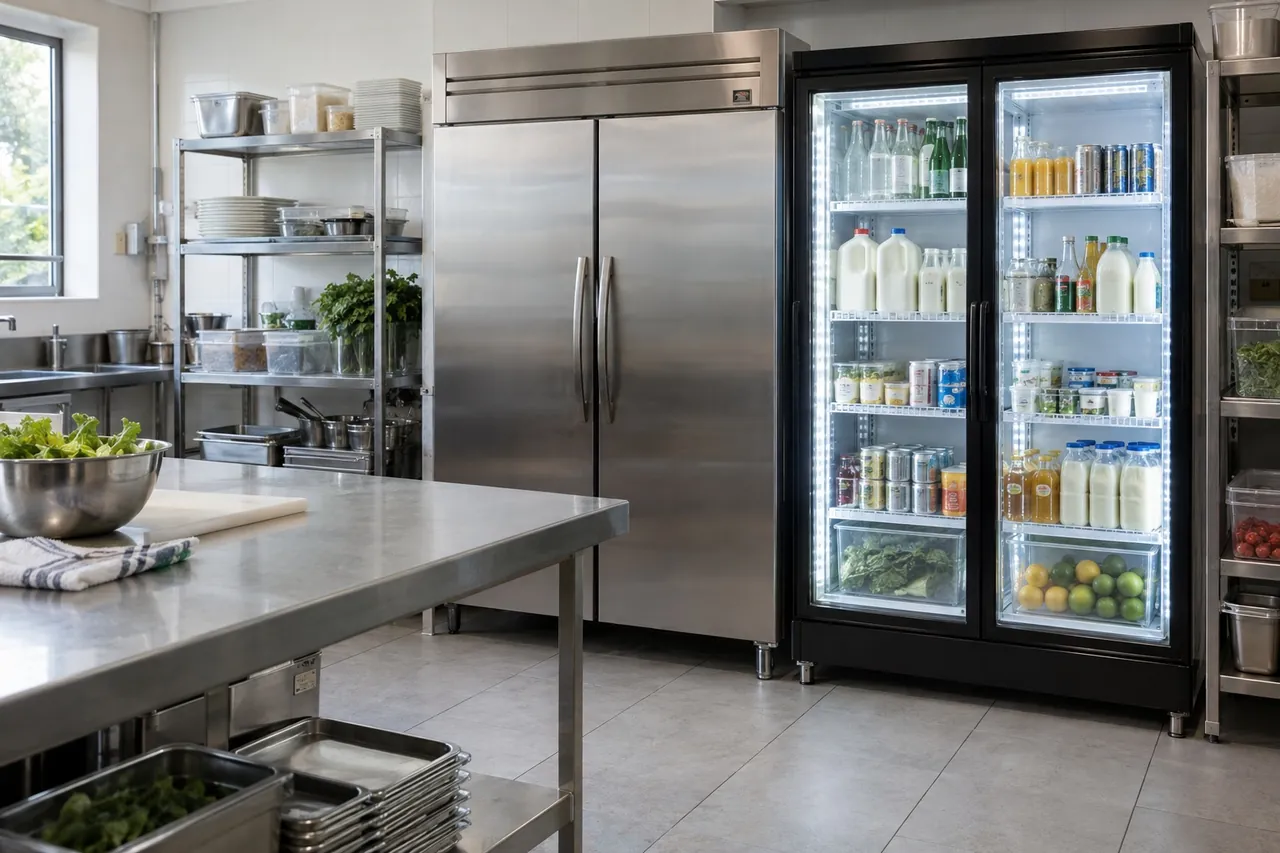
Commercial fridge dimensions are more standardised than home sizes because they are built around food pans, shelves and kitchen layouts.
| Type | Width | Height (on castors) | Depth | Typical capacity |
|---|---|---|---|---|
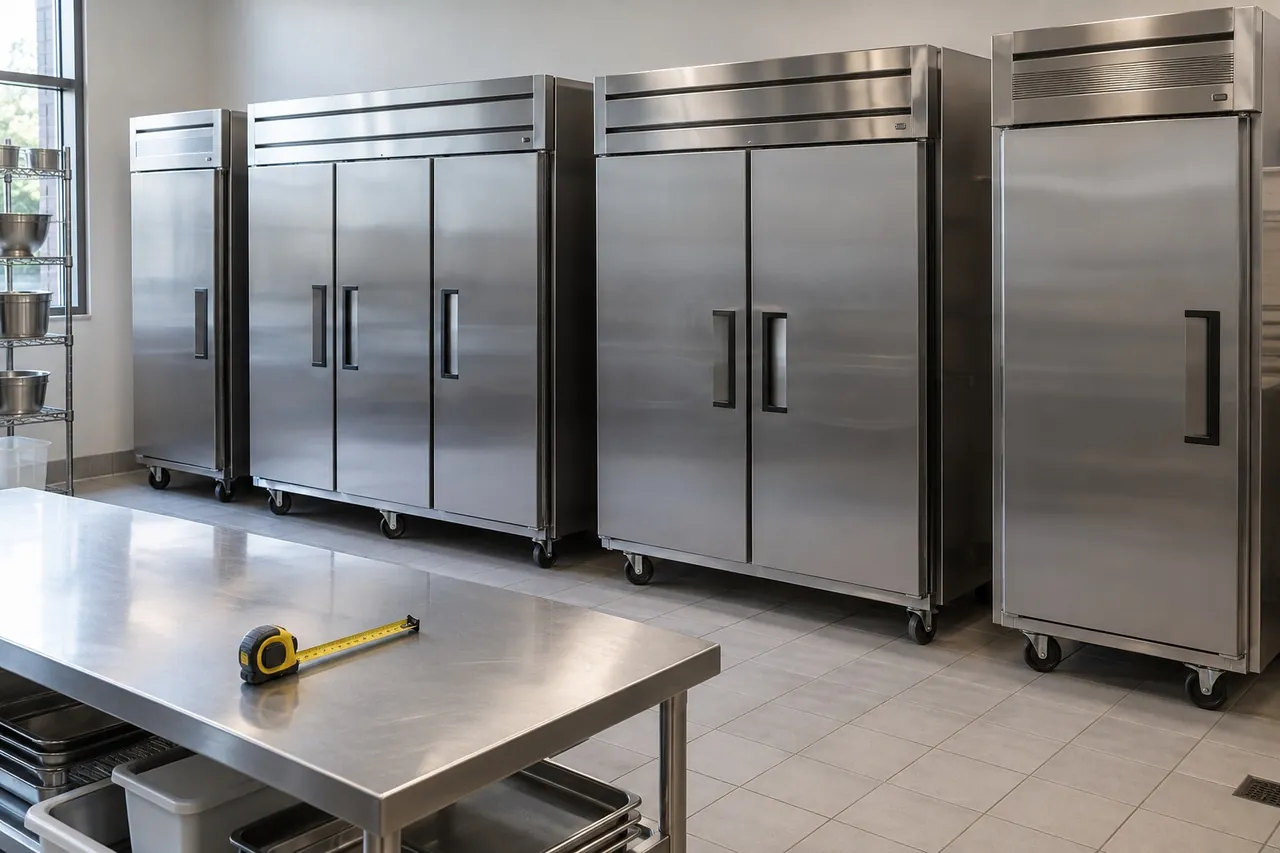
| 1-door reach-in | 27–29 in (686–737 mm) | 78–84 in (1,980–2,130 mm) | 30–35 in (762–889 mm) | 19–24 cu ft (540–680 L) |
| 2-door reach-in | 52–55 in (1,321–1,397 mm) | 78–84 in | 30–35 in | 43–49 cu ft (1,220–1,390 L) |
| 3-door reach-in | 77–83 in (1,956–2,108 mm) | 78–84 in | 30–35 in | 69–72 cu ft (1,950–2,040 L) |
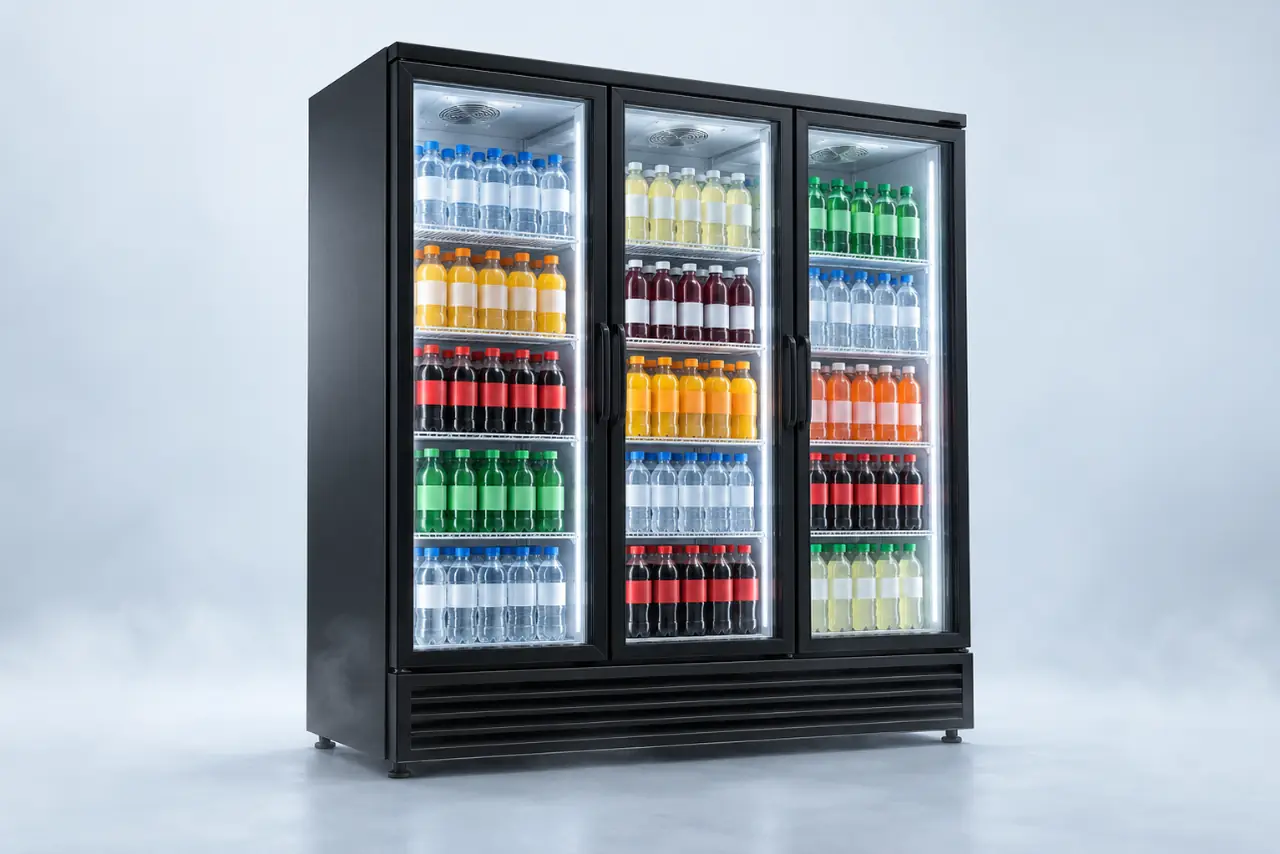
| 1-door glass display fridge | 0.6–0.7 m (24–28 in) | about 2 m (79 in) | 0.6–0.75 m (24–30 in) | typically 300–600 L (11–21 cu ft) |
| 2-door glass display fridge | 1.0–1.2 m (39–47 in) | about 2 m | 0.6–0.75 m | typically 700–1,100 L (25–39 cu ft) |
| 3-door glass display fridge | 1.6–1.9 m (63–75 in) | about 2 m | 0.6–0.75 m | typically 1,100–1,600 L (39–57 cu ft) |
| 4-door glass display fridge | 2.0–2.5 m (79–98 in) | about 2 m | 0.6–0.75 m | typically 1,400–2,000 L (49–71 cu ft) |
| Undercounter | 27–72 in (686–1,829 mm) | 30–34 in (762–864 mm) | 29–32 in | 6–20 cu ft (170–570 L) |
Reach-ins are deeper than glass door merchandisers because they take full-size sheet pans (18 × 26 in, 457 × 660 mm) or GN 2/1 trays. Height varies mainly with the castor or leg height (about 4–6 in, 100–150 mm) and whether the compressor is on top or at the bottom. Our glass door display refrigerators follow the one- to four-door widths above; exact dimensions are confirmed on each quotation.
Industrial refrigerator dimensions beyond three doors are usually met with a walk-in cooler rather than a bigger cabinet.
How to measure a refrigerator and the space for it
Fridge measurements go wrong in two places: the gap in the kitchen and the route to get there. Measure both before you order.
- Measure the width of the space. Measure the opening at the top, middle and bottom and use the smallest figure. Allow about 1 in (25 mm) each side, or the gap the manual specifies for airflow.
- Measure the height. Measure from the floor to the underside of any cabinet or soffit. Allow about 1 in (25 mm) above a home fridge and more for top-mounted compressors on commercial units.
- Measure the depth. Measure from the back wall to the front edge of the counters, then decide how far the doors may protrude. Remember the power socket and water line behind the unit.
- Check door swing. Measure the clearance needed to open the doors past 90° so shelves and drawers can come out. A single 27 in commercial door needs roughly 27 in (686 mm) of swing space.
- Measure the delivery route. Measure every doorway, corridor, stair turn and lift on the way in. The narrowest clear opening must be larger than the fridge's depth without doors and handles.
- Compare with the spec sheet. Check width, depth with and without handles, height on legs or castors, and required clearances against your numbers before you order.
For built-in installations, check the ventilation path too: rear-venting units need the gap the manufacturer specifies.
If the smallest opening on the route is a standard 36 in (914 mm) door, a one- or two-door reach-in about 30–33 in deep will usually pass once its doors are off. Three-door units and four-door merchandisers may need a wider service entrance.
How to measure a refrigerator in cubic feet (and litres)
Cubic feet is the storage volume inside the cabinet. To estimate it yourself:
- Imperial: internal width × height × depth in inches ÷ 1,728 = cubic feet.
- Metric: internal width × height × depth in centimetres ÷ 1,000 = litres. One cubic foot is 28.3 L.
Example: a reach-in with an interior of 24 × 58 × 26 in gives 36,192 in³ ÷ 1,728 ≈ 20.9 cu ft (about 590 L). Measure inside the liner, with the door shut position in mind, not the outside of the cabinet.
Manufacturers may quote gross volume (the empty cavity) or net/storage volume (after shelves, fans and evaporator housings). Net can be 10–20% lower, so compare like with like.
Size anchors that people search for:
- 29 cubic feet refrigerator: a large 36 in French-door home model.
- 35–36 cubic feet refrigerator: beyond the largest standard home models; in commercial terms, a two-door reach-in or two-door glass merchandiser.
- 48–49 cu ft: a full-size two-door commercial reach-in.
- 70+ cu ft: a three-door reach-in, or time to consider a small walk-in.
Remember that usable volume falls if air circulation is blocked. Leave about 2 in (50 mm) at the back and between packed shelves so the fan can move air.
What is the biggest fridge you can buy? Extra large and walk-in sizes
The biggest refrigerator for home use is normally a 36 in (914 mm) French-door model at about 28–30 cu ft (790–850 L), or a pair of built-in column units side by side reaching 48–60 in (1,219–1,524 mm) wide and 84 in (2,134 mm) tall. A 48 fridge freezer or 60 inch refrigerator in a home kitchen is almost always a built-in pair.
For businesses, the extra large fridge is a three-door commercial reach-in (about 72 cu ft, 2,000 L) or a four-door glass merchandiser (up to about 2.5 m, 98 in, wide). Beyond that, a walk-in cooler is cheaper per litre, easier to load with trolleys and more efficient.
| Walk-in size (outside) | Metric | Typical use |
|---|---|---|
| 6 × 6 ft | 1.8 × 1.8 m | Small café or bar |
| 8 × 8 ft | 2.4 × 2.4 m | Restaurant up to about 100 covers |
| 8 × 10 ft | 2.4 × 3.0 m | Busy restaurant, small grocery |
| 10 × 12 ft | 3.0 × 3.6 m | Large restaurant, catering, supermarket back room |
Walk-in heights are typically 7.5–8 ft (2.3–2.4 m) outside. Be There supplies complete walk-in cooler and freezer kits built to your dimensions with PU or PIR panels and matched refrigeration.
Freezer sizes: chest, upright and reach-in dimensions
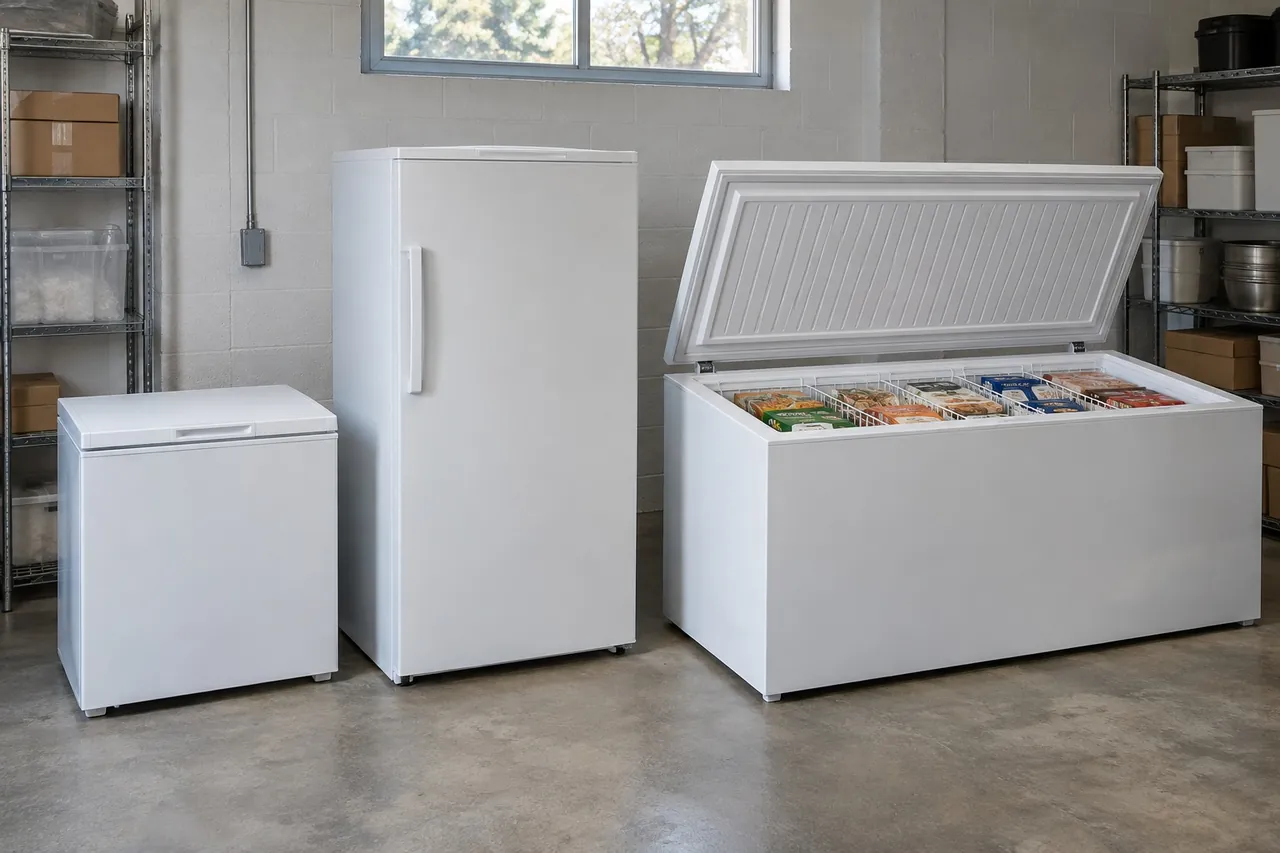
Freezer sizes follow similar rules. Typical ranges:
| Freezer type | Capacity | Typical width | Typical height |
|---|---|---|---|
| Small chest freezer | 5–7 cu ft (140–200 L) | 29–37 in (737–940 mm) | 33–34 in (838–864 mm) |
| Medium chest freezer | 10–15 cu ft (280–420 L) | 41–53 in (1,041–1,346 mm) | 33–35 in |
| Large chest / deep freezer | 20–25 cu ft (570–710 L) | 62–73 in (1,575–1,854 mm) | 34–36 in |
| Upright freezer | 13–21 cu ft (370–600 L) | 28–33 in (711–838 mm) | 60–72 in (1,524–1,829 mm) |
| Commercial reach-in freezer | 1–3 doors, 19–72 cu ft | 27–83 in | 78–84 in |
Chest freezer depth is usually 22–30 in (559–762 mm), and the lid needs about 20–30 in of clear space above. Upright freezer sizes match fridges of the same style, so a matching fridge and freezer pair usually lines up in height.
For the full breakdown of chest freezer sizes and dimensions from 3 to 30 cu ft, see our freezer sizes in cubic feet guide.
How to choose the right refrigerator size for a business
Work from use, not from the biggest fridge that fits.
- Estimate stock. List what you hold chilled between deliveries. A practical rule is to size for peak stock plus 20–30% free space for airflow and growth.
- Choose the format. Solid-door reach-ins for kitchen storage, glass door merchandisers for retail and drinks, undercounter units at the line. See our undercounter refrigerator guide for low-height options.
- Fit the footprint. Check width, depth with handles, door swing and height on castors.
- Check the route. Doorways, lifts and stairs decide what you can actually install.
- Check power and ventilation. Larger units may need a dedicated circuit; all need condenser airflow.
- Plan for the next size up. If you are between two-door and three-door, or three-door and walk-in, the larger option is often cheaper per litre.
For door-by-door dimensions and features of display fridges, read our glass door display fridge buying guide. When you are ready, send your space dimensions, temperatures and destination through our inquiry form; we will confirm the exact sizes of our commercial display refrigerators and quote FOB, CIF or DDP.