Short answer
A nugget ice maker freezes a thin layer of water inside a refrigerated cylinder, scrapes it off with a rotating auger and compresses the flakes through a die into soft, chewable pellets about 10–15 mm (0.4–0.6 in) long. Countertop units make about 11–20 kg (24–44 lb) a day; commercial nugget ice machines make roughly 150–500 kg (330–1,100 lb) per 24 hours.
Key takeaways
- Nugget, pebble, pellet and chewable ice are names for the same product: compressed flake ice extruded and cut into small, soft cylinders.
- Countertop nugget ice makers typically make 11–20 kg (24–44 lb) a day and store only 1–1.5 kg (2–3 lb) in an unrefrigerated basket.
- Be There commercial nugget ice machines produce 150–500 kg (330–1,100 lb) per day for cafés, quick-service restaurants and healthcare.
- Auger machines freeze continuously with no harvest cycle, so they typically use less energy per kilogram than cube machines of similar output.
- The auger, bearings and seals are the wear parts; descaling at least every 6 months and filtered water protect them.
What is a nugget ice maker?
A nugget ice maker is an ice machine that makes small, soft, chewable pellets by compressing flake ice rather than freezing solid cubes. Inside, water freezes on the wall of a refrigerated stainless steel cylinder; a rotating auger scrapes the ice off, pushes it up through a restricting head and squeezes it into a rope of ice that breaks into short nugget ice cubes.
The result, nugget ice, is also sold as pebble ice, pellet ice or chewable ice. It is porous, so it soaks up the flavour of the drink, packs tightly around a cup and is easy to chew, which is why customers often ask for it by name.
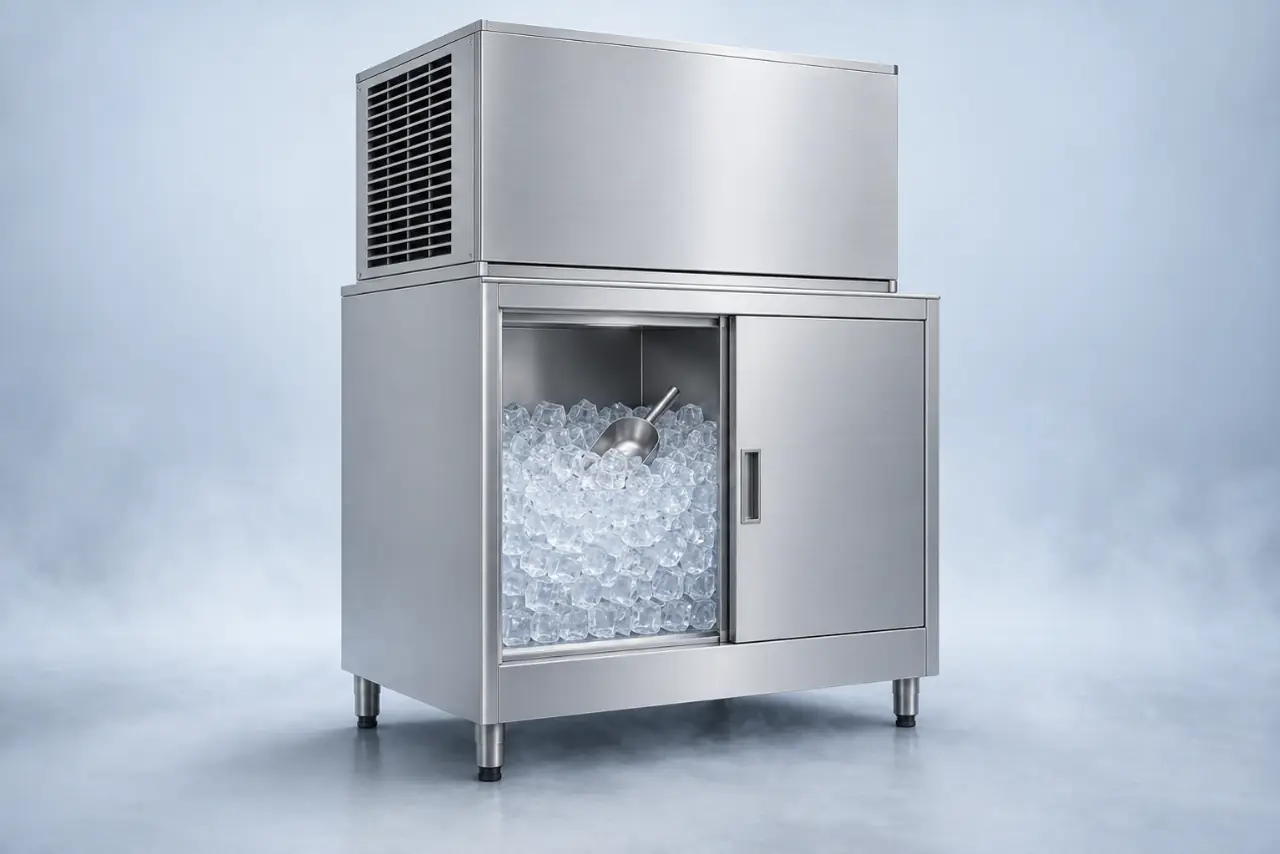
Machines range from small plug-in countertop appliances to plumbed commercial units. Be There commercial nugget ice machines produce 150–500 kg (330–1,100 lb) per day, air- or water-cooled, for cafés, quick-service restaurants, convenience stores and hospitals.
This guide explains how nugget ice is made, how pebble ice compares with cube and flake, the real difference between a countertop and a commercial machine, and what to check before you buy. For the full family of ice shapes, see our overview of types of ice machines.
How is nugget ice made?
Every nugget ice machine, from a countertop unit to an industrial model, follows the same auger process:
- Water feed: a float valve or sensor keeps water at a set level in a small reservoir that feeds the bottom of the freezing cylinder.
- Freezing: refrigerant evaporates in coils wrapped around the cylinder, so a thin film of ice forms continuously on the inner wall.
- Scraping: a slowly turning stainless steel auger, driven by a gear motor, shaves the ice off the wall as flakes.
- Compression: the auger pushes the flakes up into an extrusion head, which squeezes out excess water and compacts them into a dense column.
- Cutting: the column breaks or is cut into short pellets that drop down a chute into the bin or dispenser.
Because freezing never stops, there is no harvest cycle. A cube machine has to warm its evaporator to release each batch; an auger machine just keeps scraping. That is why nugget machines typically use less energy per kilogram, and almost all incoming water becomes ice instead of being purged.
What does nugget ice look like?
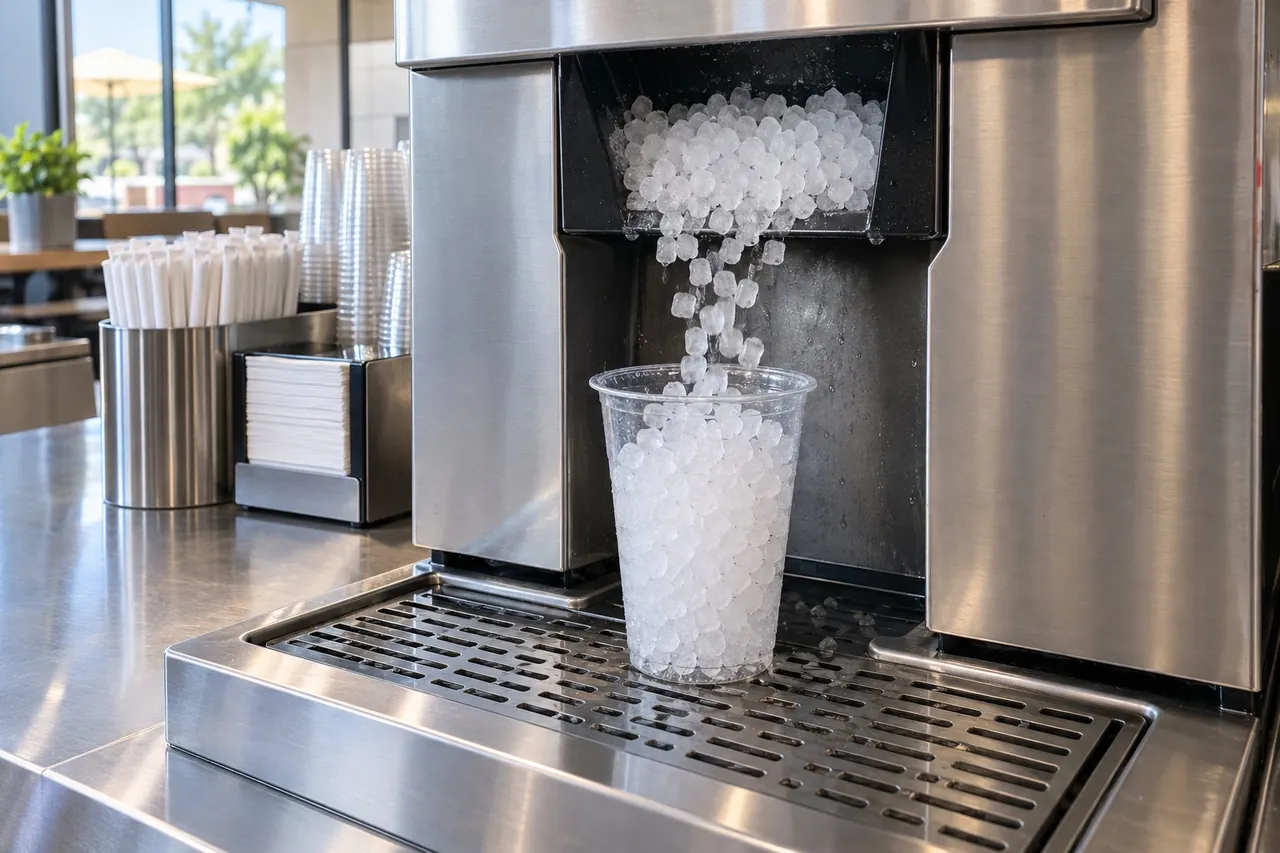
Nugget ice looks like small, opaque white cylinders roughly 10–15 mm (0.4–0.6 in) long, with a slightly rough, crumbly surface. It is whiter than cube ice because it contains tiny air pockets, and it feels softer because the pellets are compressed flakes rather than one solid crystal.
Pebble ice vs nugget ice vs other ice types
Pebble ice vs nugget ice is a question of naming, not of product: both are compressed auger ice. "Pellet ice" is the same thing again. Differences between machines are in pellet size and hardness, which the extrusion head controls. The useful comparison is with the other commercial shapes.
| Ice type | How it is made | Texture | Melt rate | Typical uses |
|---|---|---|---|---|
| Nugget / pebble / pellet | Auger flakes compressed and cut | Soft, chewable, porous | Medium–fast | Soft drinks, iced coffee, smoothies, healthcare |
| Full / half cube | Water frozen on a plate or cell evaporator, then harvested | Hard, clear, dense | Slow | Spirits, soft drinks, general bar use |
| Bullet / crescent | Frozen on fingers or a curved evaporator | Hard, curved or hollow | Medium | Dispensers, water, soft drinks |
| Flake | Thin ice scraped from a drum or auger, not compressed | Dry, mouldable flakes 1.5–2.2 mm thick | Fast | Food display, fish, meat processing |
A common comparison is nugget vs bullet ice maker. Bullet ice is still a hard, frozen piece; it cools fast but cannot be chewed comfortably. Nugget ice gives a more premium drink experience, while bullet or cube ice lasts longer in a glass. Many restaurants run a cube machine at the bar and a nugget machine at the drinks station.
Countertop nugget ice maker vs commercial nugget ice machine
Most search results for the best nugget ice maker are small appliances. A countertop nugget ice maker is a genuine nugget machine, but at a very different scale from a commercial nugget ice maker.
| Feature | Countertop nugget ice maker | Commercial nugget ice machine |
|---|---|---|
| Output per 24 h | About 11–20 kg (24–44 lb) | About 150–500 kg (330–1,100 lb) |
| Storage | 1–1.5 kg (2–3 lb), basket not refrigerated | Insulated bin or dispenser sized to demand |
| Water | Hand-filled reservoir; some with a water line | Plumbed potable water with inlet filter |
| Drain | Melt recirculates to reservoir | Gravity drain or pump |
| Duty | A few hours a day, home use | Continuous, commercial use |
| Certification | Household appliance | NSF/ANSI 12, UL/ETL or CE as required |
A nugget ice maker for home is fine for a household, a small office or a lounge using a few kilograms a day. A nugget ice maker with water line removes refilling but does not change the output. For a café or restaurant, even the largest nugget ice makers countertop models will run out at lunch.
Is there a nugget ice maker that keeps ice frozen?
Very few small units do. Most countertop baskets are insulated but not refrigerated, so the ice slowly melts and the water is recycled. Commercial bins are better insulated and drain continuously. For a deeper comparison of plug-in and commercial equipment, see countertop vs commercial ice makers.
Who needs a commercial pellet ice machine?
A pellet ice machine commercial buyers choose usually serves one of these settings:
- Quick-service restaurants and drinks bars: nugget ice is a draw in itself and fills cups efficiently for soft drinks, iced tea and lemonade.
- Cafés and juice bars: pellets blend faster and more smoothly than hard cubes, which saves blender time and wear.
- Hospitals, clinics and care homes: chewable ice is easier and safer for patients who struggle with hard cubes, and it is often dispensed hands-free for hygiene.
- Convenience stores and fuel stations: self-serve drink stations with a nugget ice dispenser.
- Cocktail bars: juleps, tiki drinks and swizzles that need packed, crushed-style ice.
- Food display: pellets mould around produce, salads and seafood, although flake ice is the more common choice for large displays.
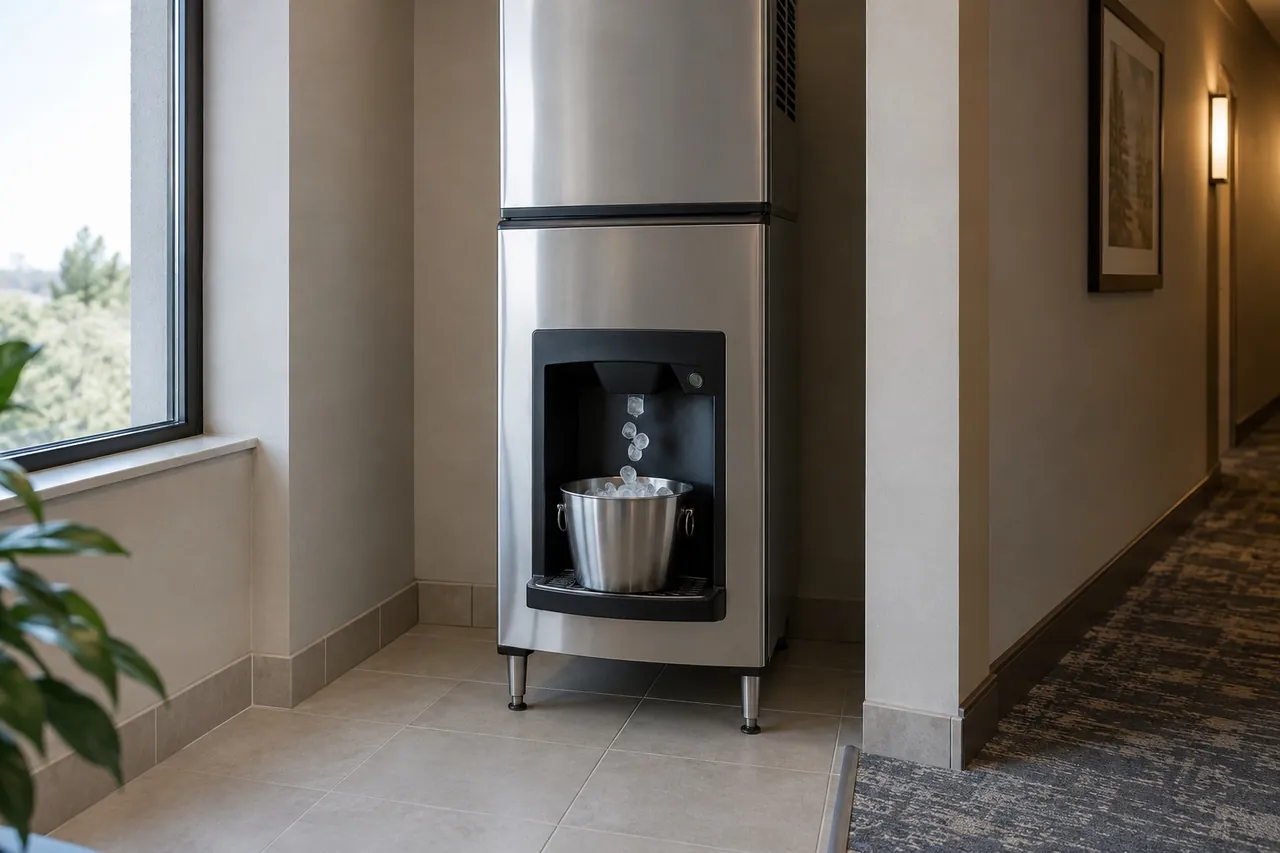
In healthcare and self-serve settings, pair a commercial nugget ice machine with a dispenser rather than an open bin, so nobody touches the ice. Our commercial ice and water dispenser guide compares hotel, countertop and drinks-station formats, including nugget ice and water dispenser units for offices and wards.
A pebble ice machine commercial kitchens buy should be sized for peak hours, because nugget ice melts faster in storage than cube ice and is best made close to when it is used.
Fridges with nugget ice and where to buy nugget ice
Two consumer questions come up often, and both have a business answer.
Is there a refrigerator that makes nugget ice?
Yes. Some residential models are sold as a fridge with nugget ice maker, a nugget ice refrigerator or a refrigerator with pellet ice. They use a small auger in the door or freezer and typically make only 1–3 kg (2–6 lb) a day. That is useful at home, but no household fridge can supply a café counter or a bar.
Where can I buy nugget ice?
Some restaurants and drinks chains that make nugget ice sell it by the bag, and a few ice suppliers offer it, but availability is patchy and it melts and clumps faster than cube ice in transport. If you are asking where to buy nugget ice for a business, a machine on site is almost always cheaper and more reliable after a few months of regular use. It also lets you sell bagged nugget ice yourself.
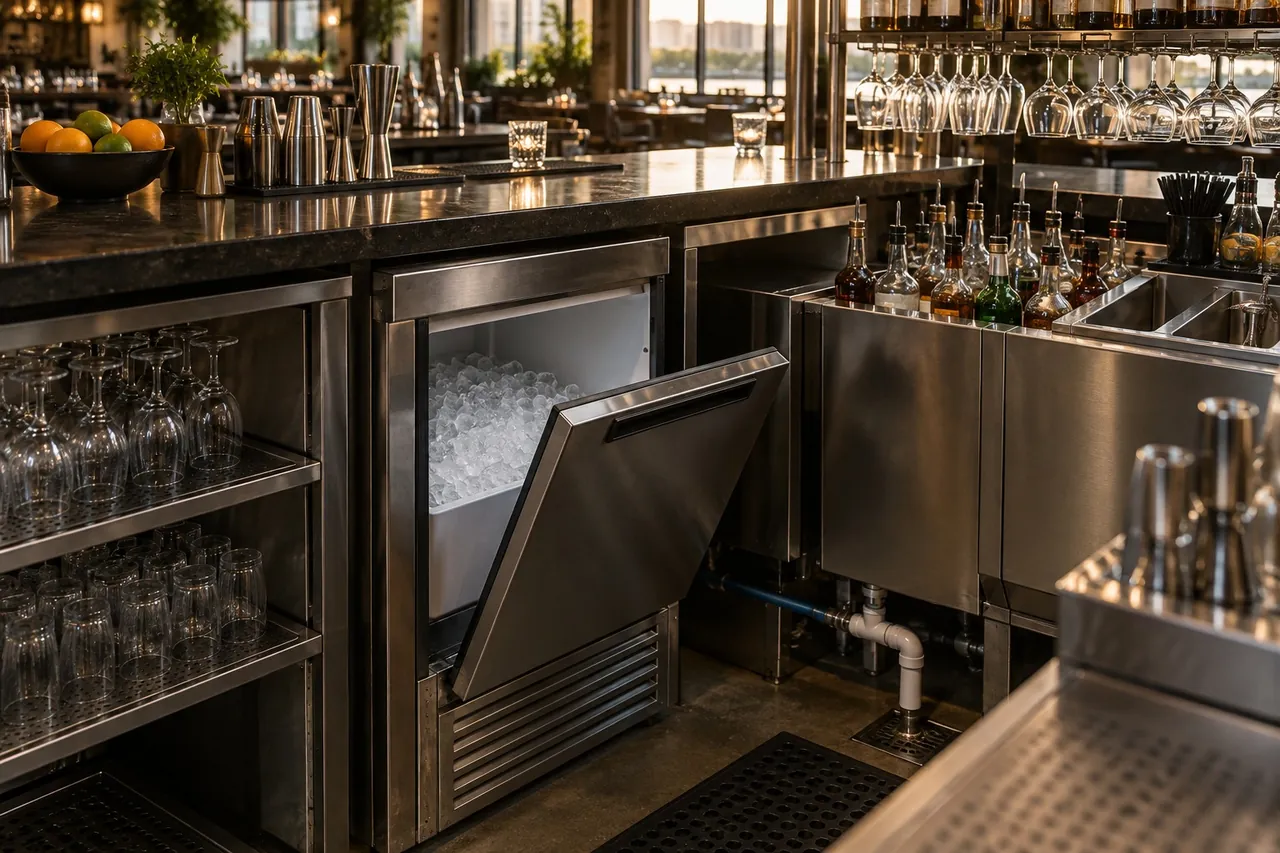
Other formats in the same family include the built in nugget ice maker for home bars, the freestanding nugget ice maker on its own bin, the portable nugget ice machine and the self dispensing nugget ice maker. For commercial service, the freestanding or dispenser-top layouts are the practical ones.
How to size and specify a commercial nugget ice maker
Start with daily demand. Typical planning figures are 1–1.5 kg (2.2–3.3 lb) per restaurant seat, 1.5–2 kg (3.3–4.4 lb) per bar seat and about 4.5 kg (10 lb) per hospital bed, plus 20% for peaks. Run your numbers through the ice machine size calculator, which also corrects for hot rooms.
| Daily demand | Typical site | Suggested setup |
|---|---|---|
| Under 20 kg (44 lb) | Office, small clinic, home bar | Countertop or undercounter nugget unit |
| 150–250 kg (330–550 lb) | Café, 100-seat restaurant, care home | Commercial nugget head on bin or dispenser |
| 250–500 kg (550–1,100 lb) | Quick-service restaurant, hospital ward block | Larger nugget machine, or two smaller heads for redundancy |
Then specify the details:
- Power: exact voltage and frequency, such as 115 V/60 Hz or 220–240 V/50 Hz.
- Condenser: air-cooled for ventilated rooms, water-cooled or remote for hot, enclosed spaces.
- Water: potable supply with a filter sized to the machine; augers are sensitive to scale.
- Storage: a bin holding at least half the daily demand, or a dispenser for self-serve.
- Certification: NSF/ANSI 12 and UL/ETL in the US, CE in Europe, or your local equivalent.
Nugget ice maker maintenance and repair
Auger machines have more moving parts than cube machines, so maintenance matters. Most nugget ice maker repair calls trace back to scale.
- Descale and sanitise at least every 6 months, or every 3 months with hard water. Our guide on how to clean a commercial ice machine covers the procedure and a cleaning log.
- Listen to the auger: squealing, grinding or a labouring gear motor usually means scale on the cylinder wall or worn bearings.
- Check the seal: water around the base of the freezing cylinder usually points to a worn water seal, which should be replaced before it damages the lower bearing.
- Inspect the extrusion head and bearings at each service; wear here produces wet, mushy pellets.
- Clean the condenser every 1–3 months and change the water filter every 6 months.
With this routine, a commercial nugget ice machine typically lasts 7–10 years. If you import, order a spares kit with the machine: water seal, bearings, float or level sensor and inlet valve.
How to choose a nugget ice machine: checklist
- Confirm the ice: do customers want soft, chewable pellets, or would cube or flake serve better?
- Calculate demand in kg or lb per day, add 20% for peaks and correct for room temperature.
- Choose the scale: countertop for under about 20 kg (44 lb) a day, commercial for anything open to the public.
- Choose storage: bin for back-of-house use, dispenser for self-serve and healthcare.
- Check the site: ventilation, water pressure, drain position and power supply.
- Plan maintenance: water filter, descaling schedule and wear parts on the shelf.
Be There supplies commercial nugget ice makers from 150 to 500 kg (330–1,100 lb) a day, quoted FOB, CIF or DDP. Send your daily demand, storage type, voltage and destination through the quotation form and we will reply within one working day.