Short answer
A countertop ice maker is a plug-in appliance that freezes bullet-shaped ice on chilled metal prongs, making 12–15 kg (26–33 lb) per day with a 0.5–1 kg (1–2 lb) basket that is not refrigerated. A commercial ice machine is plumbed, makes 25 kg (55 lb) to 20 t daily into an insulated bin. Upgrade once you need more than about 10 kg (22 lb) a day or serve the public.
Key takeaways
- Most countertop and portable ice makers make 12–15 kg (26–33 lb) of bullet ice a day, in batches of about 9 pieces every 6–15 minutes.
- Countertop baskets are insulated but not refrigerated, so stored ice slowly melts and the water returns to the reservoir.
- Commercial ice machines range from about 25 kg (55 lb) to 20 t (44,000 lb) per day, with insulated bins and food-contact certification.
- Countertop ice makers typically last 2–5 years; a maintained commercial ice machine typically lasts 7–10 years.
- A 30-seat café needs about 45 kg (100 lb) of ice a day, which is three or more countertop units, so it should buy one commercial machine.
What is a countertop ice maker?
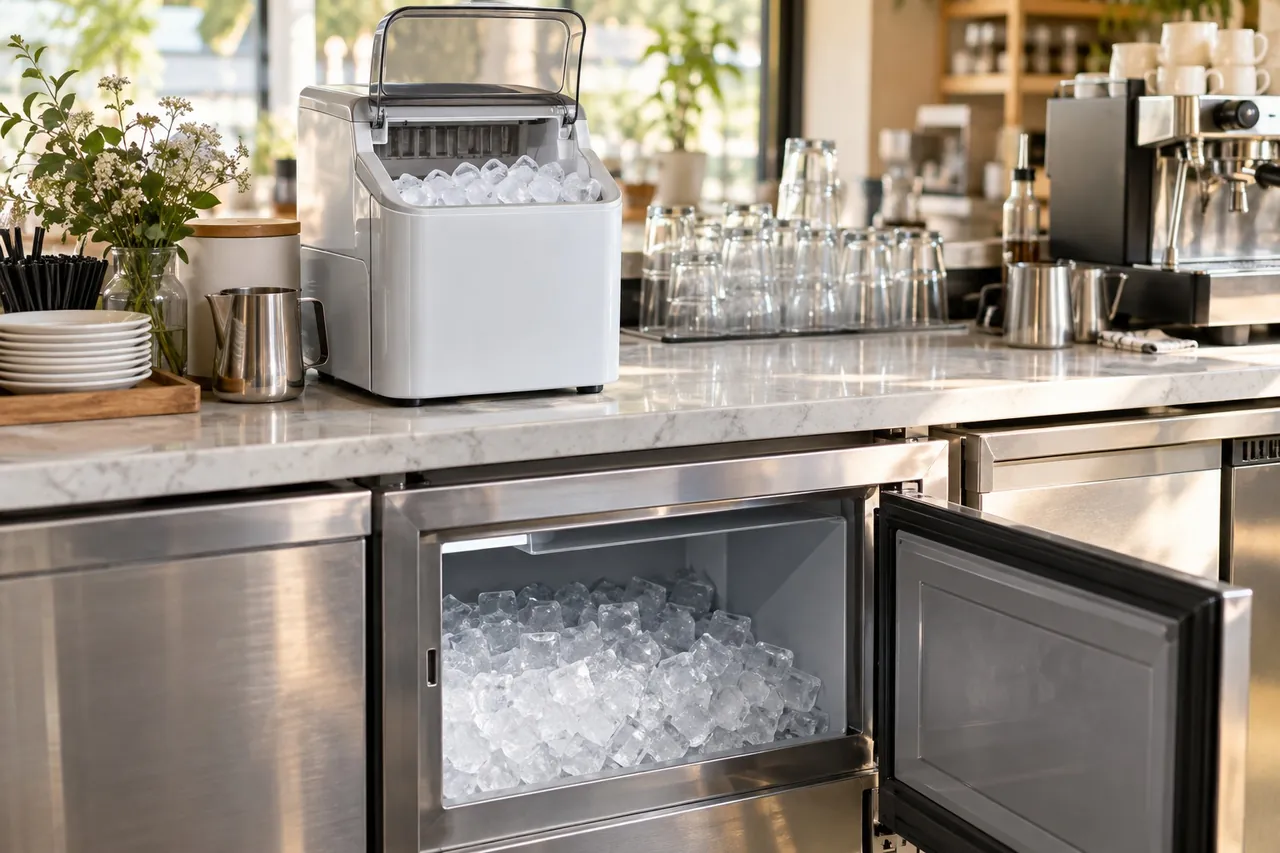
A countertop ice maker is a small, plug-in appliance with its own water reservoir that makes ice in a few minutes without a water line or drain. It is sold as a portable ice maker, tabletop ice machine or mini ice maker, and most models make about 12–15 kg (26–33 lb) of bullet-shaped ice per 24 hours.
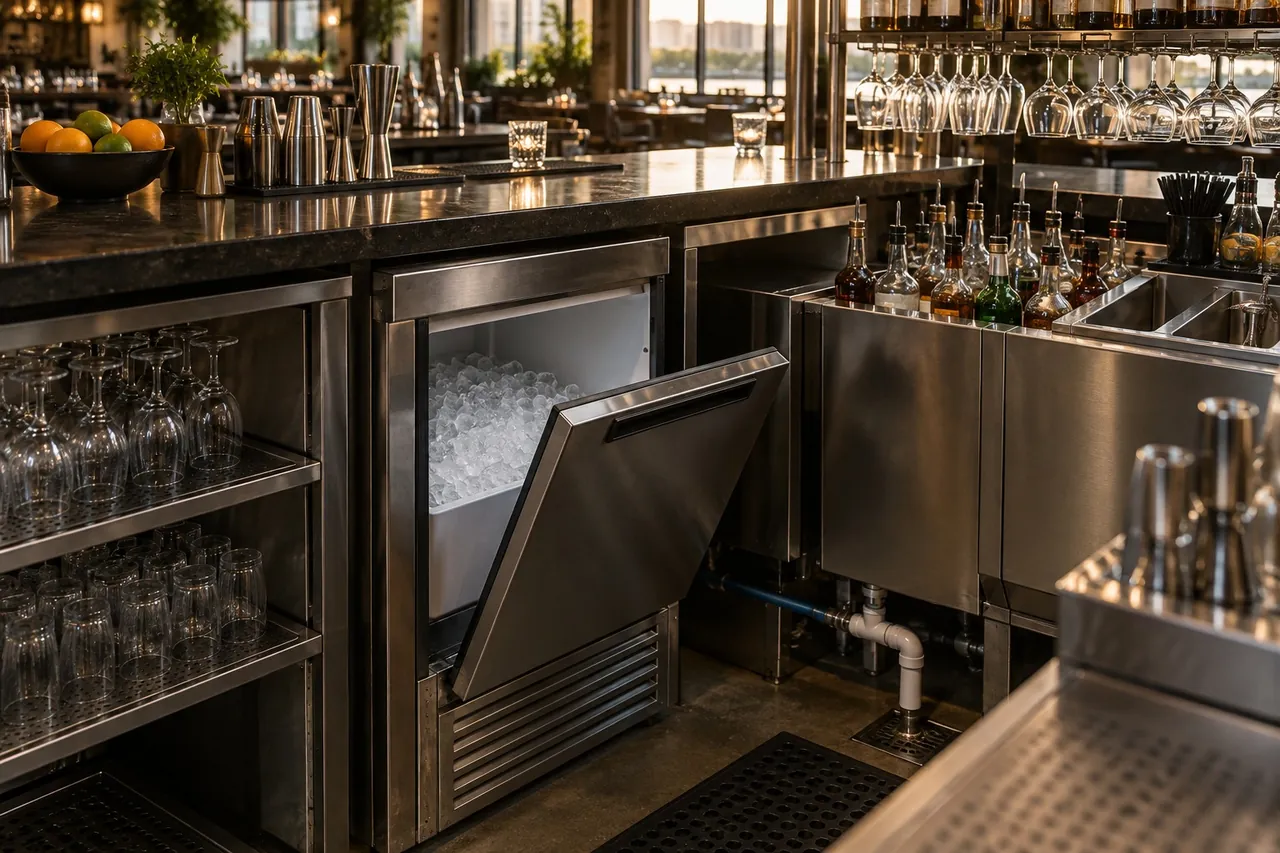
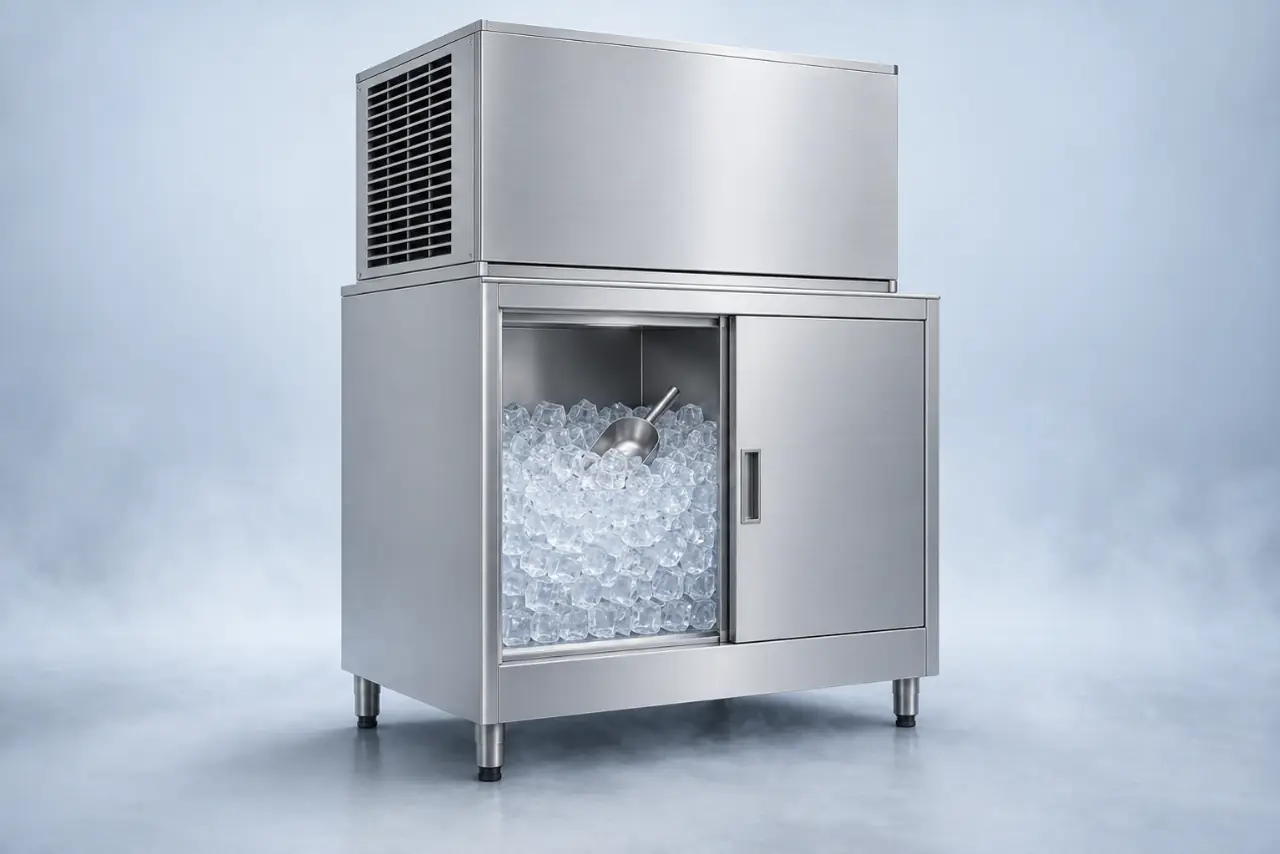
A commercial ice machine is a different class of equipment. It is connected to a potable water supply and a drain, freezes ice on a full-size evaporator, stores it in an insulated bin and is certified for food service. Commercial output starts around 25 kg (55 lb) a day for small undercounter units and reaches 20 t (44,000 lb) a day for industrial flake ice plants.
Be There supplies commercial ice machines from 25 kg to 20 t per day in cube, flake, nugget, snow, bullet and crescent ice. We do not sell household countertop units, but buyers often ask us whether one would be enough. This guide answers that honestly: how both types work, what ice they make, how they store it and the point at which a business should move to commercial equipment.
How do countertop ice makers work?
Most countertop ice machine designs use the same simple cycle:
- Fill: you pour water into a reservoir of about 1.5–3 L (0.4–0.8 US gal). A small pump lifts it into a tray under the freezing prongs.
- Freeze: a compact compressor chills a row of metal prongs (the evaporator) that dip into the water. Ice builds up around each prong.
- Harvest: after about 6–15 minutes, hot refrigerant gas briefly warms the prongs, the tray tips, and around 9 hollow bullets slide off.
- Store: a pusher moves the ice into a basket holding about 0.5–1 kg (1–2 lb). A sensor stops production when the basket is full.
- Recycle: meltwater from the basket drains back into the reservoir and is frozen again.
That last step is the main hygiene weakness: the same water circulates for days unless you empty and clean the unit regularly.
Other small formats
A countertop nugget ice maker uses a tiny auger instead of prongs, and a clear ice countertop ice maker freezes slowly in layers while water flows over the plate so air and minerals wash away. Both are slower than bullet machines. For commercial clear cubes and spheres, see our guide to clear ice and ice ball machines.
Countertop vs commercial ice maker: side-by-side
The table compares a typical countertop unit with the two most common commercial layouts. Values are typical ranges, not guarantees for any single model.
| Feature | Countertop / portable ice maker | Commercial undercounter | Commercial modular head + bin |
|---|---|---|---|
| Output per 24 h | 12–15 kg (26–33 lb) | 25–160 kg (55–350 lb) | 150–1,000 kg (330–2,200 lb) and up |
| Storage | 0.5–1 kg (1–2 lb), not refrigerated | 10–60 kg (22–130 lb), insulated | 100–400 kg (220–880 lb) bin |
| Ice | Hollow bullet, small cubes, some nugget | Full/half cube, crescent, nugget, flake | All shapes |
| Water | Hand-filled reservoir | Plumbed, filtered | Plumbed, filtered |
| Drain | None (recycles meltwater) | Gravity or pump | Gravity |
| Power | About 100–200 W, standard plug | Standard or dedicated circuit | Dedicated circuit; some three-phase |
| Typical life | 2–5 years | 7–10 years | 7–10+ years |
| Certification | Household appliance | NSF/ANSI 12, UL/ETL, CE | NSF/ANSI 12, UL/ETL, CE |
The gap is not only volume. A commercial machine is built to run most of the day, every day, and to be cleaned and inspected to food-safety standards. A small ice maker running non-stop in a hot café usually fails early and still runs out at the lunchtime peak.
Do countertop ice makers keep ice frozen?
Mostly no. A standard countertop ice maker that keeps ice frozen is rare, because the storage basket sits above the reservoir and is only insulated, not refrigerated. Ice made in the morning slowly melts, the water drains back and the machine makes fresh ice to refill the basket. That design keeps ice available, but it does not keep a stock of ice frozen.
A few models add compressor cooling to the storage area, sold as a countertop ice maker with freezer or an ice maker that keeps ice frozen. They hold the ice longer, but storage is still only about 1–2 kg (2–4 lb).
How commercial machines store ice
Commercial bins are thick, foam-insulated and drain continuously, so ice stays usable for many hours with only slow melting. They are not freezers either: the machine tops the bin up as ice is used. If you need to keep ice frozen for days, for example bagged ice for sale, use a freezer designed for it, such as an ice merchandiser held at −12 °C to −6 °C (10–21 °F).
A note on portable ice cream freezers
A portable ice cream freezer is a different product: a small chest or cooler that keeps frozen food below −18 °C (0 °F). It does not make ice. For commercial ice cream storage and display, see Be There display freezers and ice cream freezers.
Ice quality: bullet ice vs commercial cubes
Ice quality affects how fast drinks dilute, how they look and how safe the ice is.
- Shape and density: countertop bullets are hollow and thin-walled, so they cool quickly but melt fast and water down drinks. Commercial full cubes are solid and dense; a 22–28 mm (7/8–1 1/8 in) cube lasts far longer in a glass.
- Clarity: commercial cube machines run water continuously over a vertical evaporator, which washes out air and gives clear cubes. Most countertop bullets are cloudy.
- Size choice: ice maker small cubes settings on home units change only the freezing time, not the shape. Commercial machines offer full cube, half cube, crescent, nugget and flake.
- Hygiene: a countertop unit recycles standing water and has no filter, so it needs emptying, cleaning and drying every few days in use. Commercial machines use fresh, filtered water, purge minerals each cycle and are built for routine sanitising.
A portable ice maker crushed ice function is usually just a crusher attachment. In commercial service, crushed-style ice normally comes from a flake or nugget machine instead, which is faster and gives a more even texture.
For health inspections, ice is treated as food in most jurisdictions, including under the FDA Food Code in the US. Equipment that touches it should be food-contact certified, which household ice makers usually are not.
Water lines, dispensers and freestanding ice makers
Many buyers look for a halfway option between a hand-filled unit and a full commercial machine.
Countertop ice maker with water line
A countertop ice maker with water line connects to a 1/4 in supply so you never refill it, and some accept an ice maker that uses 5 gallon water bottle pump kit. This solves convenience, not capacity: output stays around 12–15 kg (26–33 lb) a day, and meltwater may still need a drain.
Countertop ice and water dispenser
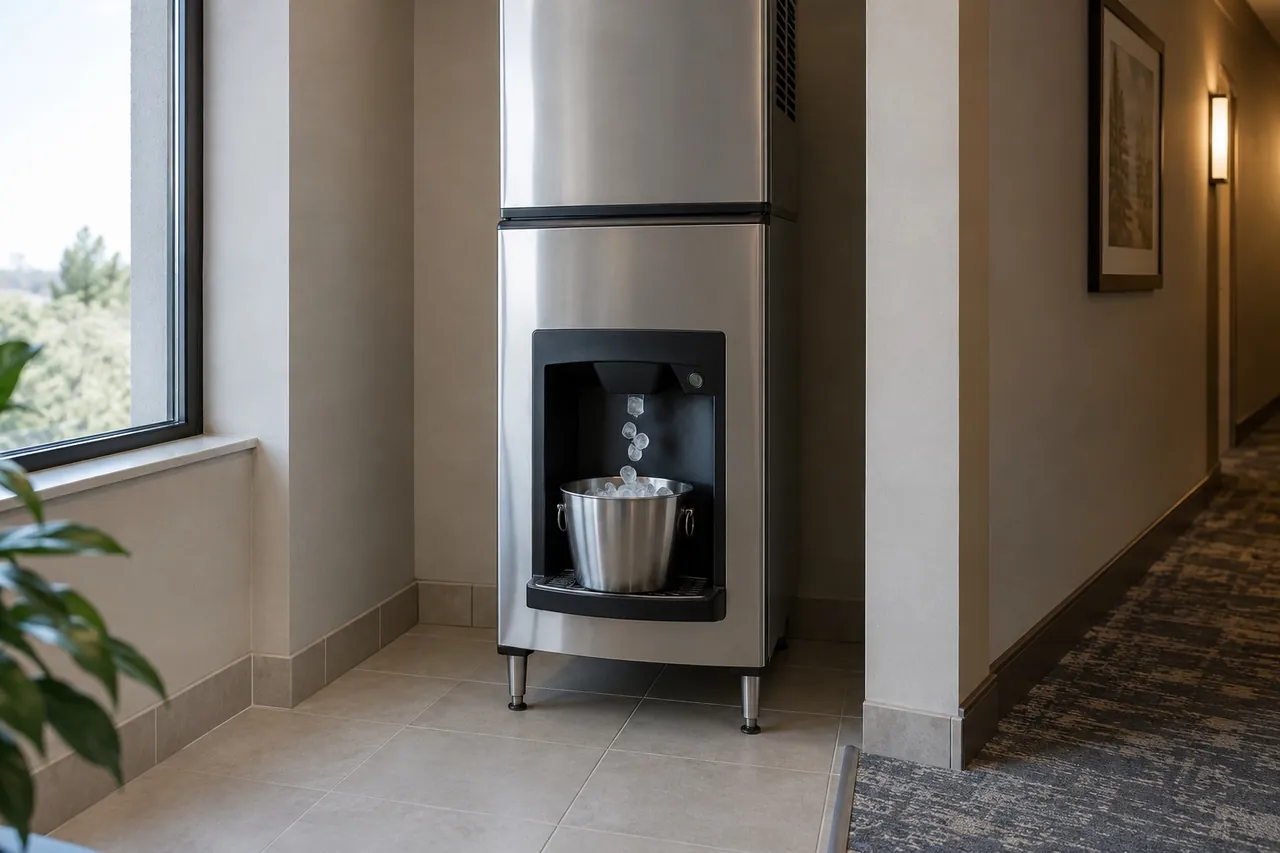
A countertop ice and water dispenser for offices and healthcare is a genuine commercial product: a compact nugget or flake machine with a sealed bin and a hands-free outlet, typically making about 100–200 kg (220–440 lb) a day. A countertop ice dispenser commercial unit is plumbed and drained like any other commercial machine. Our commercial ice and water dispenser guide compares formats.
Freestanding ice maker
A freestanding ice maker or freestanding ice machine usually means a self-contained cabinet that stands on the floor rather than a worktop, often the same machine as an undercounter model. In commercial terms it is a proper ice machine; see the undercounter ice machine guide for sizes, drains and clearances.
When is a countertop ice maker enough, and when should you upgrade?
A countertop ice machine is a sensible buy when all of these apply:
- You use less than about 10 kg (22 lb) of ice a day.
- The ice is for staff, a private office or a home bar, not paying customers.
- You can empty and clean the reservoir every few days.
Upgrade to commercial equipment when any of these applies:
- You serve the public and a health inspector will look at the ice.
- The basket runs empty at peak times, or you are running two or three units side by side.
- The room is hot, which cuts output by 15–25% or more.
- You need dense cubes, nugget or flake ice rather than hollow bullets.
A worked example
A 30-seat café using about 1.25 kg (2.75 lb) of ice per seat needs 30 × 1.25 × 1.2 for peaks = 45 kg (about 100 lb) a day. That is three or four countertop units, each with a tiny basket. One commercial undercounter machine making 50–70 kg (110–155 lb) with a 25 kg (55 lb) bin covers it with margin. Check your own figures with the ice machine size calculator.
How long do countertop ice makers last, and what do they cost to run?
Lifespan: countertop ice makers typically last about 2–5 years with home use; heavy daily use and scale shorten that. A commercial ice machine with filtered water and six-monthly descaling typically lasts 7–10 years, with replaceable pumps, valves and sensors.
Running cost: a countertop unit draws roughly 100–200 W, so its energy per kilogram of ice is reasonable but its output is tiny. Commercial machines are rated for energy per 100 lb (45 kg) of ice and, at scale, cost far less per kilogram. In the US, automatic commercial ice makers must meet federal energy conservation standards.
Noise: a quiet ice machine at home is one with a small compressor and a soft harvest. In a commercial bar, the quietest option is a remote condenser that moves the fan and its heat outdoors.
Purchase price: countertop units are cheap appliances, typically sold at retail for well under a few hundred US dollars. Commercial machines vary widely by output, ice type, condenser and certification; Be There quotes each order FOB, CIF or DDP, so you see the landed cost before you commit.
Fridges with ice makers
Buyers comparing the best ice maker refrigerator or the fridge with the best ice maker should know that domestic fridge ice makers typically make only 1–2 kg (2–4 lb) a day. They are a home convenience, not a business solution.
Next steps: choosing the right ice maker
- Estimate daily ice use in kg or lb, plus 20% for peaks.
- Decide who the ice is for: private use can be countertop; public service should be commercial and certified.
- Choose the ice type: cube for spirits and soft drinks, nugget for cafés and healthcare, flake for food display.
- Check the site: water line, drain, ventilation and power supply.
- Size the storage: a bin holding at least half the daily demand.
- Plan hygiene: a water filter and descaling and sanitising at least every 6 months.
Be There supplies commercial ice machines from 25 kg (55 lb) to 20 t per day for cafés, bars, hotels, supermarkets and fisheries. Tell us your daily demand, ice shape, voltage and destination through the quotation form and we will reply within one working day.