Short answer
XPS foam (extruded polystyrene) gives about R-5 per inch, compressive strength of 150–700 kPa (about 22–100 psi) and water absorption under 1% by volume. EPS (expanded polystyrene) gives about R-3.6 to R-4.2 per inch and 70–250 kPa in common grades, absorbs more water, and costs less. Choose XPS for freezer floors and wet, loaded locations; EPS for dry walls and budget roofs.
Key takeaways
- XPS is extruded as a continuous closed-cell board with a smooth skin; EPS is made by fusing expanded beads in a block mould and cutting it into sheets.
- Per inch, XPS gives about R-5 and EPS about R-3.6 to R-4.2, so 2 in XPS is about R-10 versus R-7.2 to R-8.4 for 2 in EPS.
- XPS compressive strength runs about 150–700 kPa, which is why it is the standard insulation under freezer room floors and loaded slabs.
- XPS absorbs under 1% water by volume in immersion tests, compared with roughly 2–4% for EPS, and keeps more of its R-value in wet ground.
- EPS is usually the lowest-cost rigid foam per R-value and uses a pentane blowing agent with very low global warming potential.
What is the difference between EPS and XPS foam board?
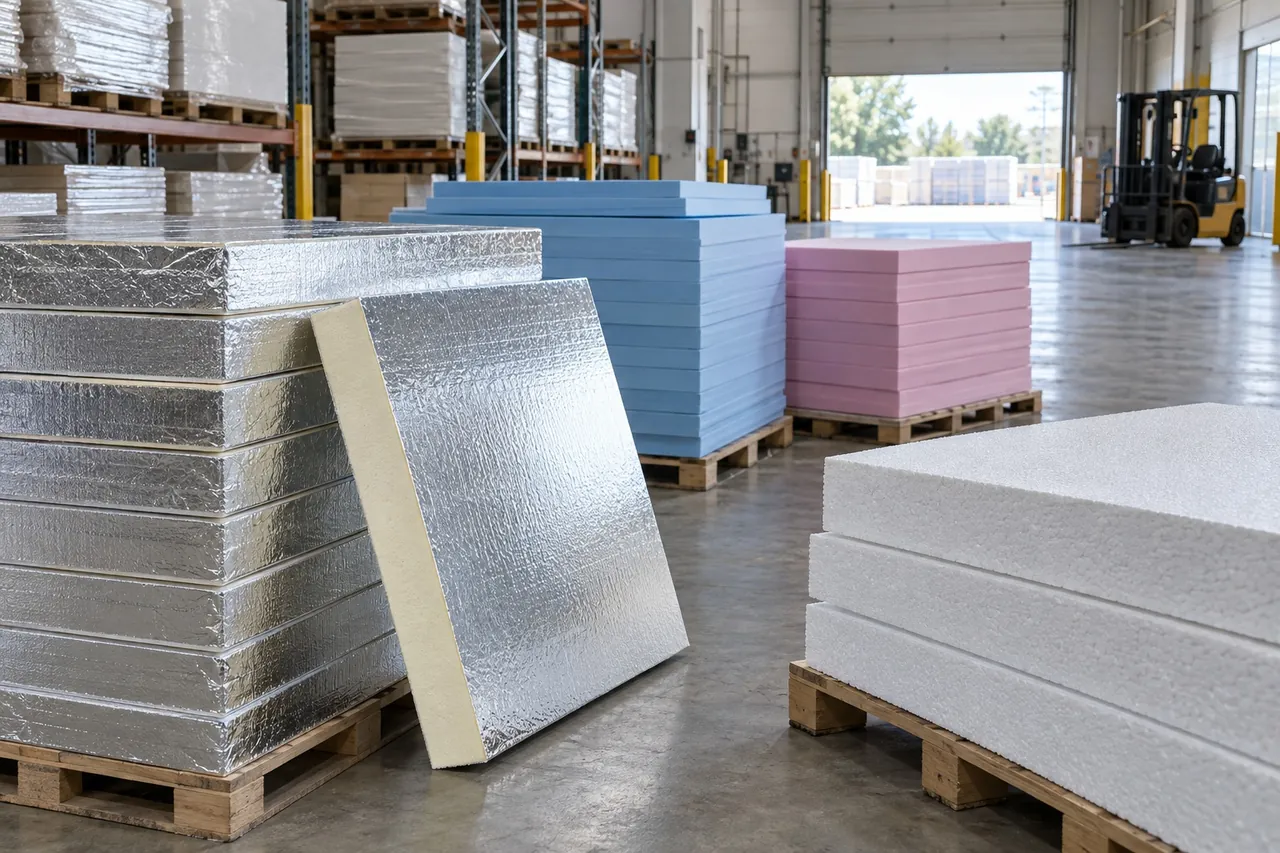
XPS foam (extruded polystyrene) and EPS (expanded polystyrene) are both rigid polystyrene insulation boards, but they are made differently, and that changes their strength, moisture resistance and R-value. Extruded polystyrene is melted, mixed with a blowing agent and pushed through a die as one continuous board with a uniform closed-cell structure and a smooth skin; it is usually colored (blue, pink, green, yellow or grey). Expanded polystyrene insulation is made from small beads that are pre-expanded with steam, then fused together in a large mould; the block is cut into white sheets, with tiny voids between the beads.
In practice:
- XPS insulation board is stronger, absorbs less water and has a higher R-value per inch (about R-5). It costs more.
- EPS insulation board is cheaper, comes in a wider range of densities and very large blocks, has a stable R-value, and absorbs more water (about R-3.6 to R-4.2 per inch).
Neither is “better” across the board. For cold store work, XPS is the standard under freezer floors because it carries racking and forklift loads without crushing and stays dry in contact with the slab. EPS is common in dry walls, external wall insulation systems, SIP cores and low-cost panels.
Be There supplies XPS foam board with compressive strength from 150 to 700 kPa, together with PIR boards and PU/PIR sandwich panels for cold rooms.
How are EPS and XPS boards made?
EPS board production starts with polystyrene beads containing a small amount of pentane. Steam softens the beads and the pentane expands them up to about 40 times their volume. After resting, the pre-expanded beads are put in a block mould and steamed again so they fuse into a solid block, typically about 1.2 m × 1.2 m × 5 m. Hot wires cut the block into sheets of any thickness, or shapes such as insulated concrete forms and geofoam. Density is set by how far the beads are expanded, typically from about 12 kg/m³ to over 30 kg/m³ (0.75–2 lb/ft³ or more).
XPS board is made continuously: polystyrene granules are melted in an extruder, a blowing agent is injected, and the foam expands as it leaves a slot die, forming a board with closed cells and a dense skin on both faces. Boards are cut to width and length and can be milled with shiplap or tongue-and-groove edges. Typical density is about 28–45 kg/m³ (1.7–2.8 lb/ft³).
Two related products often appear in searches:
- GPS insulation (graphite polystyrene) is EPS with graphite particles that reflect and absorb radiant heat, raising performance to about R-4.5 to R-4.8 per inch. It is grey and used mainly in external wall insulation.
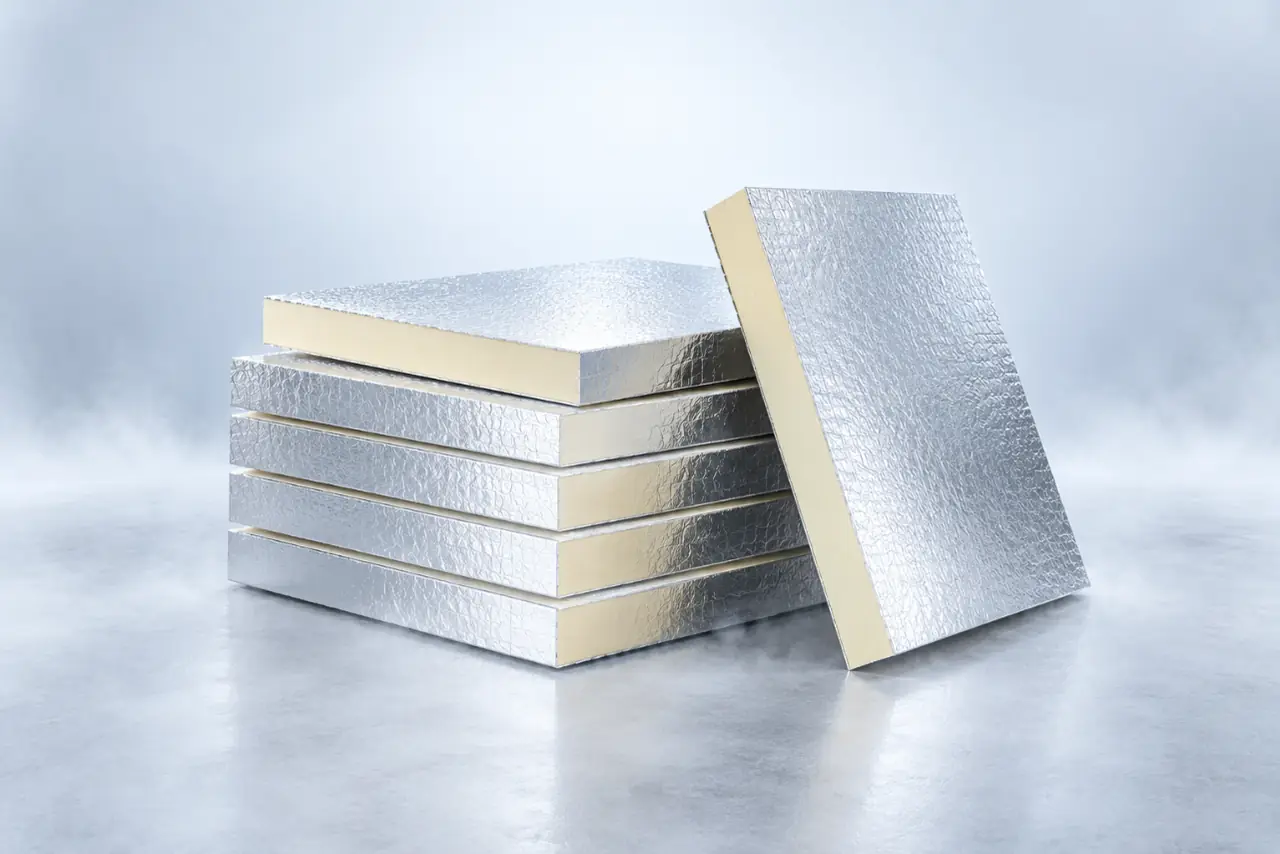
- Foil-backed polystyrene adds an aluminium facing for a radiant barrier or vapor control layer, used in garage doors and some walls.
XPS blowing agents have changed over time; many markets now restrict high-GWP HFCs, so ask suppliers which agent their XPS foam uses if your project has environmental targets.
EPS vs XPS insulation: side-by-side comparison
| Property | XPS (extruded polystyrene) | EPS (expanded polystyrene) |
|---|---|---|
| Structure | Continuous closed cells, smooth skin | Fused closed-cell beads with small voids |
| Typical color | Blue, pink, green, yellow or grey | White (grey for GPS) |
| Density | about 28–45 kg/m³ | about 12–35 kg/m³ |
| Thermal conductivity | about 0.028–0.030 W/(m·K) | about 0.033–0.040 W/(m·K) |
| R-value per inch | about R-5 | about R-3.6 to R-4.2 |
| Compressive strength (10% deformation) | about 150–700 kPa (22–100 psi) | about 70–250 kPa (10–36 psi) in common grades; higher-density grades up to about 400 kPa |
| Water absorption (long-term immersion) | under 1% by volume | roughly 2–4% by volume |
| Vapor permeance (1 in) | about 1 perm or less (a vapor retarder) | about 2–5 perms (vapor-semi-permeable) |
| Max service temperature | about 75 °C (165 °F) | about 75–80 °C (165–175 °F) |
| Fire | Combustible; flame-retarded; must be covered | Combustible; flame-retarded; must be covered |
| Typical sizes | 600 × 1200 / 1250 mm, 4 × 8 ft; 20–100+ mm | Any size cut from blocks; 4 × 8 ft common |
| Relative cost | Higher | Lower |
| Best uses | Freezer floors, foundations, inverted roofs, below grade | Dry walls, EIFS, SIP cores, roofs under membranes |
Both boards are sold under many names. An extruded polystyrene board may be called “blue board insulation” and “pink board” are XPS; “bead board”, an expanded polystyrene board, white foam sheets and most packaging foam are EPS.
XPS vs EPS R-value: which insulates better?
Per inch, XPS insulation insulates better: about R-5 compared with about R-3.6 (low-density EPS) to R-4.2 (high-density EPS).
| Thickness | XPS | EPS (R-3.6 to R-4.2) | GPS |
|---|---|---|---|
| 1 in (25 mm) | R-5 | R-3.6 to R-4.2 | R-4.5 to R-4.8 |
| 1½ in (38 mm) | R-7.5 | R-5.4 to R-6.3 | R-6.8 to R-7.2 |
| 2 in (51 mm) | R-10 | R-7.2 to R-8.4 | R-9 to R-9.6 |
| 3 in (76 mm) | R-15 | R-10.8 to R-12.6 | R-13.5 to R-14.4 |
| 4 in (102 mm) | R-20 | R-14.4 to R-16.8 | R-18 to R-19.2 |
So a 2 inch XPS foam board gives about R-10, and you would need about 2.4–2.8 in of EPS to match it.
Two nuances matter in real buildings:
- Aging. EPS is blown with pentane, which leaves the cells quickly; its rated value is already the long-term value. XPS holds its blowing agent longer; its declared value is an aged figure, and a small further decline over decades is possible.
- Temperature and moisture. Both polystyrenes insulate slightly better as they get colder, which helps in freezer floors. Both lose some R-value if they absorb water, which happens faster in EPS in wet ground.
If R-value per inch is your main constraint, PIR beats both at about R-6 to R-6.5 per inch; see PIR vs PU vs XPS vs EPS and the insulation R-value chart.
Compressive strength: which foam board carries loads?
Compressive strength is quoted at 10% deformation (or at yield if earlier), in kPa or psi. It decides whether a board can sit under a concrete slab, a parking deck or a freezer floor full of pallet racking.
| Board grade (typical) | Compressive strength | Typical application |
|---|---|---|
| EPS low density (about 15 kg/m³) | about 70 kPa (10 psi) | Walls, cavity, under-floor in houses with light loads |
| EPS medium (about 20–25 kg/m³) | about 100–170 kPa (15–25 psi) | Roofs, house slabs |
| XPS 150–250 kPa | 22–36 psi | Foundation walls, slab edges, walk-in floors with light trolleys |
| XPS 300–500 kPa | 44–73 psi | Cold store and freezer floors, inverted roofs, parking decks |
| XPS 700 kPa | about 100 psi | Heavy industrial floors, high-bay racking, airport and road applications |
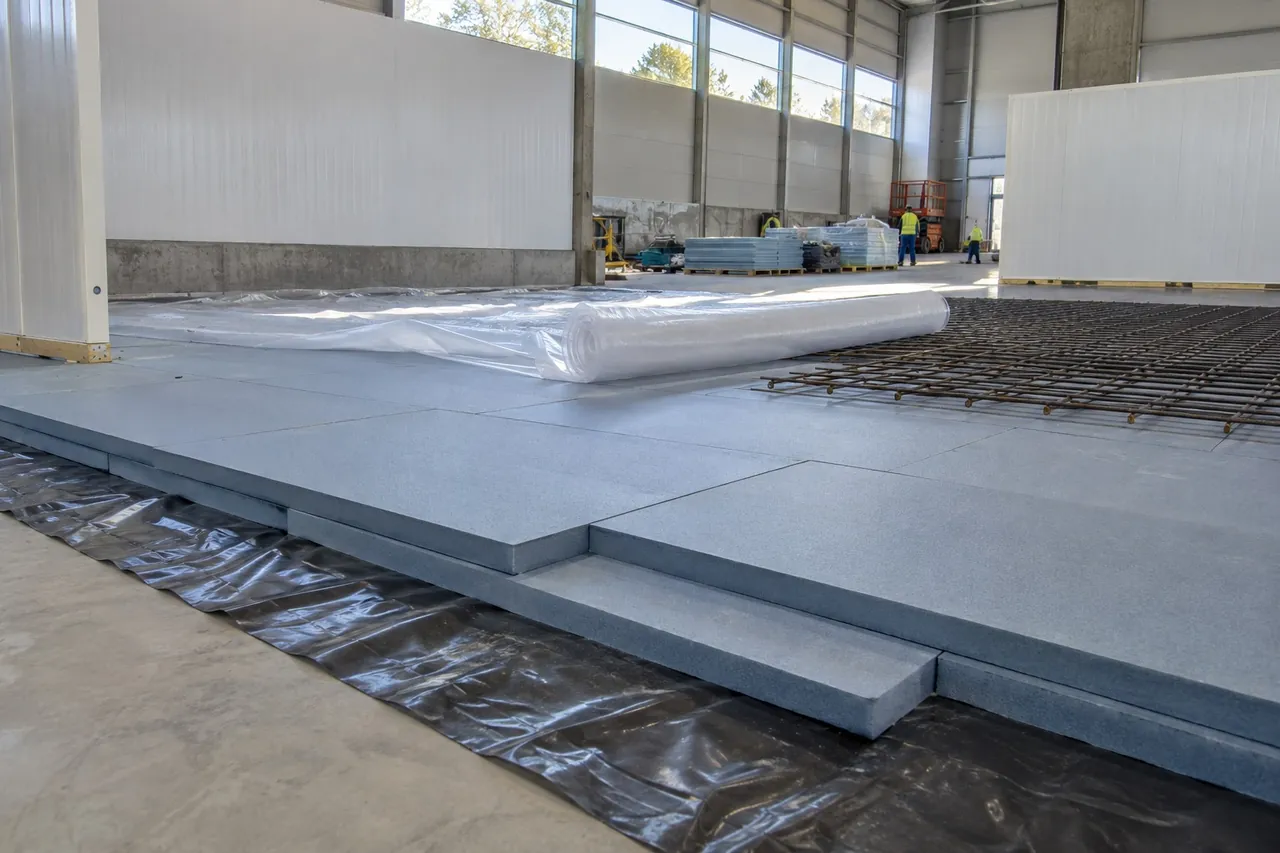
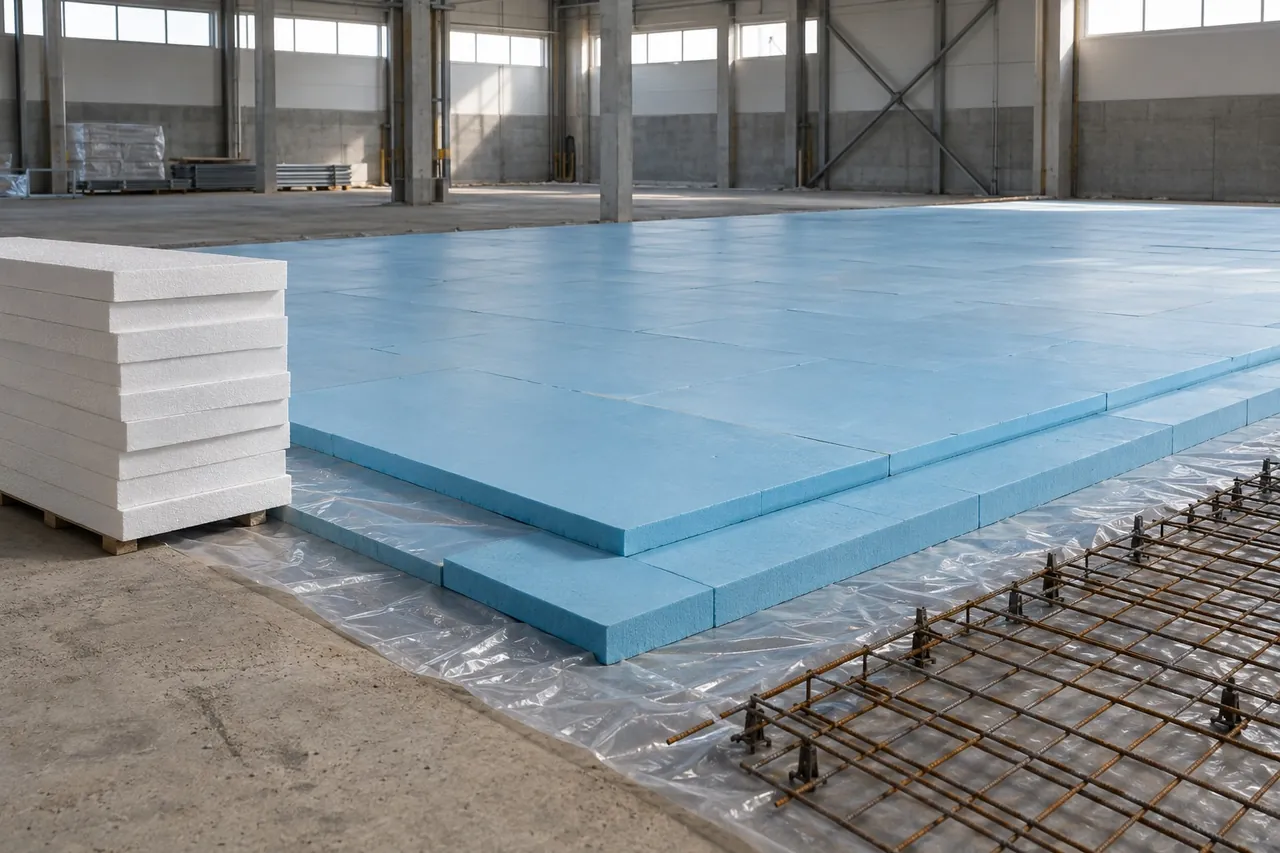
Designers usually limit the long-term load on foam to a fraction of its short-term strength (often around one-third) to control creep. That is why freezer rooms with racking and forklifts typically use 300–500 kPa XPS, laid in two staggered layers of 50–100 mm, under a reinforced wearing slab. For floor build-ups and frost heave protection, see walk-in cooler and freezer floors.
High density expanded polystyrene grades and structural polystyrene geofoam can reach the lower XPS range, but they are not common in freezer floors because of their higher water absorption over time in contact with a cold, damp slab.
Moisture: is XPS (blue board insulation) really waterproof?
XPS is often called waterproof, but the accurate word is water-resistant. Its closed cells and extruded skin keep water absorption under 1% by volume in long-term immersion tests, and its vapor permeance is low (about 1 perm or less at 1 in), so it acts as a vapor retarder. EPS absorbs roughly 2–4% by volume in the same tests because water can enter the channels between beads, and it lets vapor pass more easily.
Where that matters:
- Freezer and cold store floors: vapor is driven constantly from the warm ground towards the cold room. XPS stays drier and keeps its R-value; still, lay a vapor barrier beneath it.
- Below-grade and foundation insulation: XPS is the traditional choice in wet soil; EPS works where drainage is good and is sometimes specified at higher density.
- Inverted (protected membrane) roofs: boards sit above the waterproofing, wet and loaded by ballast, which is an XPS application.
- Walls: in some walls the vapor openness of EPS is actually helpful, allowing the wall to dry.
Neither board is a roof covering or a waterproof membrane, and both degrade in sunlight, so cover them within a few weeks of installation. If you need an insulation board that resists both moisture and fire better than polystyrene, look at foil-faced PIR insulation board.
Where to use XPS and where to use EPS
Use XPS insulation board for:
- Freezer and cold store floors, 100–200 mm in total, with heave protection.
- Foundation walls, slab edges and under heated slabs.
- Inverted and green roofs, terraces and plaza decks.
- Thin, strong layers where R per inch and stiffness count, such as van floors.
Use EPS foam board insulation for:
- External wall insulation with render (EPS or GPS), and cavity walls.
- Cores of SIPs and low-cost expanded polystyrene panels for dry buildings.
- Roof insulation under membranes, tapered roof schemes, and large blocks or custom shapes.
- Geofoam fill, where very large volumes of lightweight material are needed.
Common small jobs: garage door foam insulation kits are usually EPS panels cut to fit the door sections, typically R-4 to R-8; foil-faced EPS or PIR adds a radiant barrier. Polystyrene “foam house kits” are generally insulated concrete forms (ICFs) or EPS-cored panels and are sold by residential suppliers. People looking for large sheets of polystyrene foam for signage or crafts usually want expanded polystyrene foam sheets cut from blocks, which come in any size.
For refrigerated buildings, walls and ceilings are not built from loose boards: they use factory-made PU/PIR sandwich panels, with XPS only in the floor. Be There supplies both, so the floor and panels are matched in one order.
XPS foam board cost and buying tips
XPS foam board cost is typically higher than EPS per board and per R-value, because of the extrusion process, higher density and blowing agents. EPS is usually the cheapest rigid foam per R-value, which is why it dominates large, dry applications. Both are light but bulky, so freight is a big part of delivered cost on export orders: a 40 ft high-cube container holds roughly 70–75 m³ of board regardless of type.
Buying tips for XPS and EPS:
- Specify compressive strength, not just density, and say whether it is at 10% deformation.
- Ask for declared λ or R-value as an aged value and the test standard used (for example EN 13164 for XPS, EN 13163 for EPS, or ASTM C578 in North America).
- Check the fire class of the board (for example Euroclass E) and remember that foam must be covered by a thermal barrier in occupied spaces.
- Edge profile: square edges are fine for two-layer staggered floors; shiplap or tongue-and-groove reduces gaps in single layers.
- Board size and thickness tolerance: common sizes are 600 × 1200 mm, 600 × 1250 mm and 4 × 8 ft (1220 × 2440 mm), with 2 in, 1½ in and 1 inch XPS foam board widely used.
- Blowing agent for XPS, if your market restricts high-GWP HFCs.
Be There quotes XPS boards per order (FOB, CIF or DDP), with compressive strength, thickness and size confirmed on the quotation.
How to choose between EPS and XPS: quick checklist
- Will the board carry load? Floors, slabs, racking or vehicles: choose XPS at 300–500 kPa or more.
- Will it be wet or in the ground? Below grade, inverted roofs, freezer floors: choose XPS.
- Is thickness limited? XPS gives about 20–40% more R per inch than EPS; PIR gives more still.
- Is the location dry and the budget tight? Walls, cavity and roofs under membranes: EPS or GPS.
- Does the wall need to dry out? EPS is more vapor-open.
- Is fire performance critical? Neither polystyrene is ideal; consider PIR or rock wool.
For a cold room or cold store, the usual answer is: PU or PIR sandwich panels for walls and ceiling, and XPS in the floor – typically 100 mm for coolers where floor insulation is needed and 150–200 mm in two layers for freezers, plus floor heating or ventilation to stop frost heave.
Send your floor area, room temperature and expected loads through our inquiry form. Be There will propose the XPS grade and thickness and quote the boards together with matching panels within one working day.