
Short answer
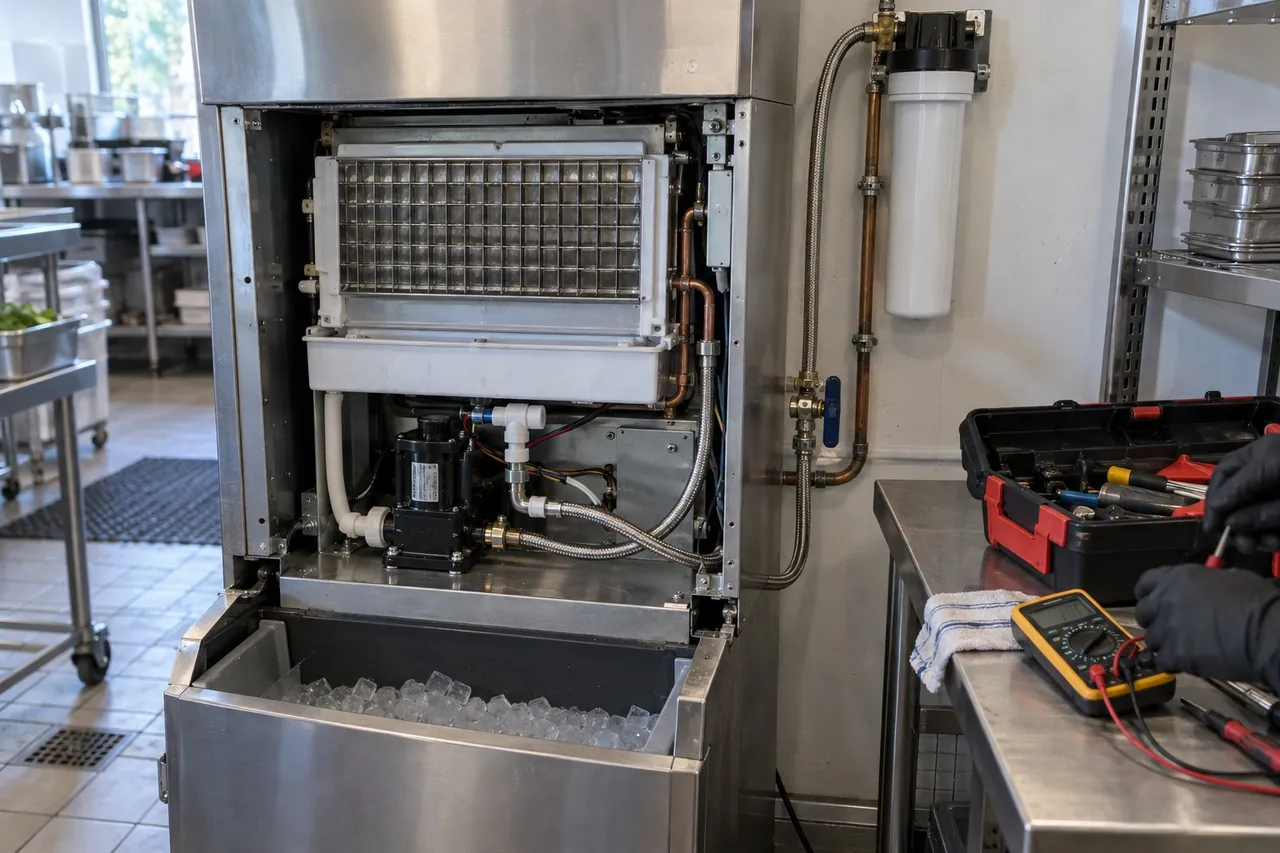
Ice maker parts fall into four systems: the water system (inlet valve, float or level sensor, sump, water pump, distribution tube), the refrigeration system (compressor, condenser, expansion device, hot gas valve, evaporator), the controls (board, ice thickness and bin sensors) and storage (insulated bin and drain, sometimes a drain pump). Water pumps and inlet valves typically need replacing every 3–7 years.
Key takeaways
- A cube ice machine has about 17–20 main parts in four systems: water, refrigeration, harvest and controls, and storage and drainage.
- Water-side parts such as the inlet valve, water pump, float and distribution tube wear fastest, mainly from scale; filtered water and cleaning every 6 months extend their life.
- The evaporator is the most expensive part after the compressor; its nickel or tin plating is damaged by harsh acid cleaners, so use only approved nickel-safe cleaners.
- Flake and nugget machines replace the cube evaporator with a refrigerated cylinder, an auger and a gearmotor, whose bearings and seals are wear items.
- A drain pump is needed when there is no floor drain below the machine; built-in pumps typically lift waste water about 2–3 m (7–10 ft).
- 'Self-cleaning' ice makers automate the descaling or sanitising cycle, but the bin, scoop, exterior and condenser still need manual cleaning.
What are the main parts of an ice machine?
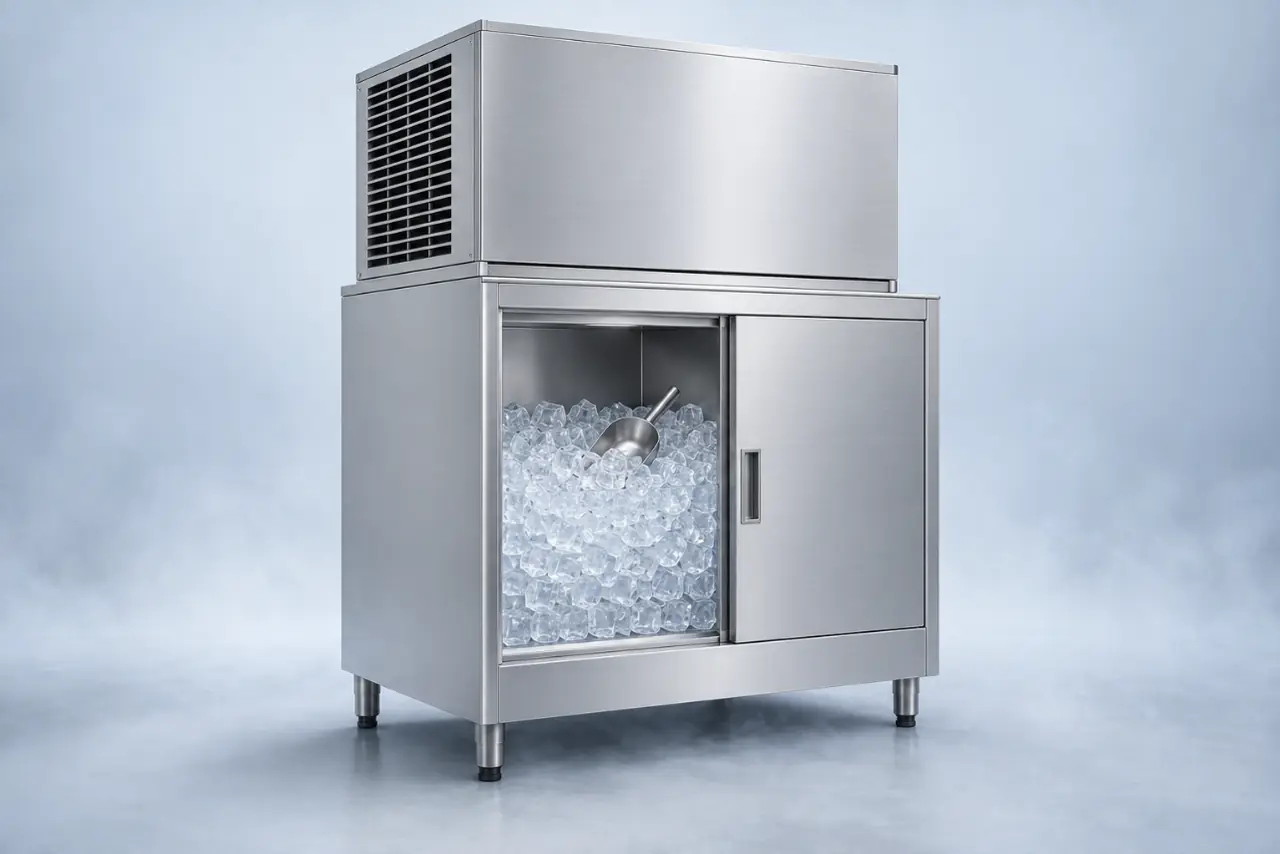
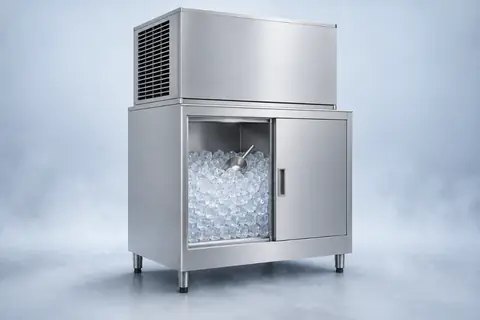
A commercial ice machine is built from four groups of parts: a water system that delivers and circulates water, a refrigeration system that freezes it, controls that decide when to freeze and harvest, and a storage bin with a drain. Every cube, flake and nugget ice maker has these groups, even though the freezing hardware differs.
Understanding the ice maker parts helps in three ways. You can describe faults precisely to a technician, keep the right spare parts on site or in your warehouse if you are a distributor, and judge build quality when comparing machines. If you are new to ice types, start with types of ice machines and ice shapes; this guide looks inside the cabinet.
| Ice machine part name | System | What it does | Typical sign of failure |
|---|---|---|---|
| Water inlet valve | Water | Solenoid valve that opens to fill the sump | No water, overflowing sump, slow fill |
| Float switch or water level probe | Water | Senses sump level to start freeze and stop fill | Machine will not start a cycle, or overfills |
| Water sump or trough | Water | Holds water for each freeze cycle | Scale, slime, cracks |
| Water pump | Water | Circulates water over the evaporator | Noise, thin or cloudy ice, no ice |
| Distribution tube or spray bar | Water | Spreads water evenly over the evaporator | Uneven, partial or hollow cubes |
| Water curtain or splash shield | Water | Keeps water in the freezing area; often acts as a harvest switch | Water in bin, machine stops |
| Purge or dump valve | Water | Drains mineral-rich water after each cycle | Fast scaling, cloudy ice |
| Compressor | Refrigeration | Pumps refrigerant through the circuit | Hums, trips, runs hot, no cooling |
| Condenser and fan motor | Refrigeration | Rejects heat to air or water | Long freeze times, high-pressure trips |
| Expansion valve or capillary tube | Refrigeration | Meters refrigerant into the evaporator | Thin ice on part of the plate |
| Hot gas valve | Refrigeration / harvest | Sends hot gas to the evaporator to release ice | Ice will not drop, or freezes into a block |
| Evaporator | Refrigeration | Plated copper or stainless grid where ice forms | Flaking plating, slow release, leaks |
| Ice thickness probe | Controls | Starts harvest when ice bridge reaches set thickness | Cubes too thick or too thin |
| Bin level sensor or thermostat | Controls | Stops production when the bin is full | Bin overflows, or machine stops early |
| Control board and thermistors | Controls | Run freeze, harvest, clean and safety logic | Error codes, erratic cycles |
| Storage bin, door and liner | Storage | Insulated, unrefrigerated ice store | Fast melt, cracked liner, mould |
| Bin drain and drain pump | Storage | Removes melt and purge water | Water on floor, standing water in bin |
How does the water system work?
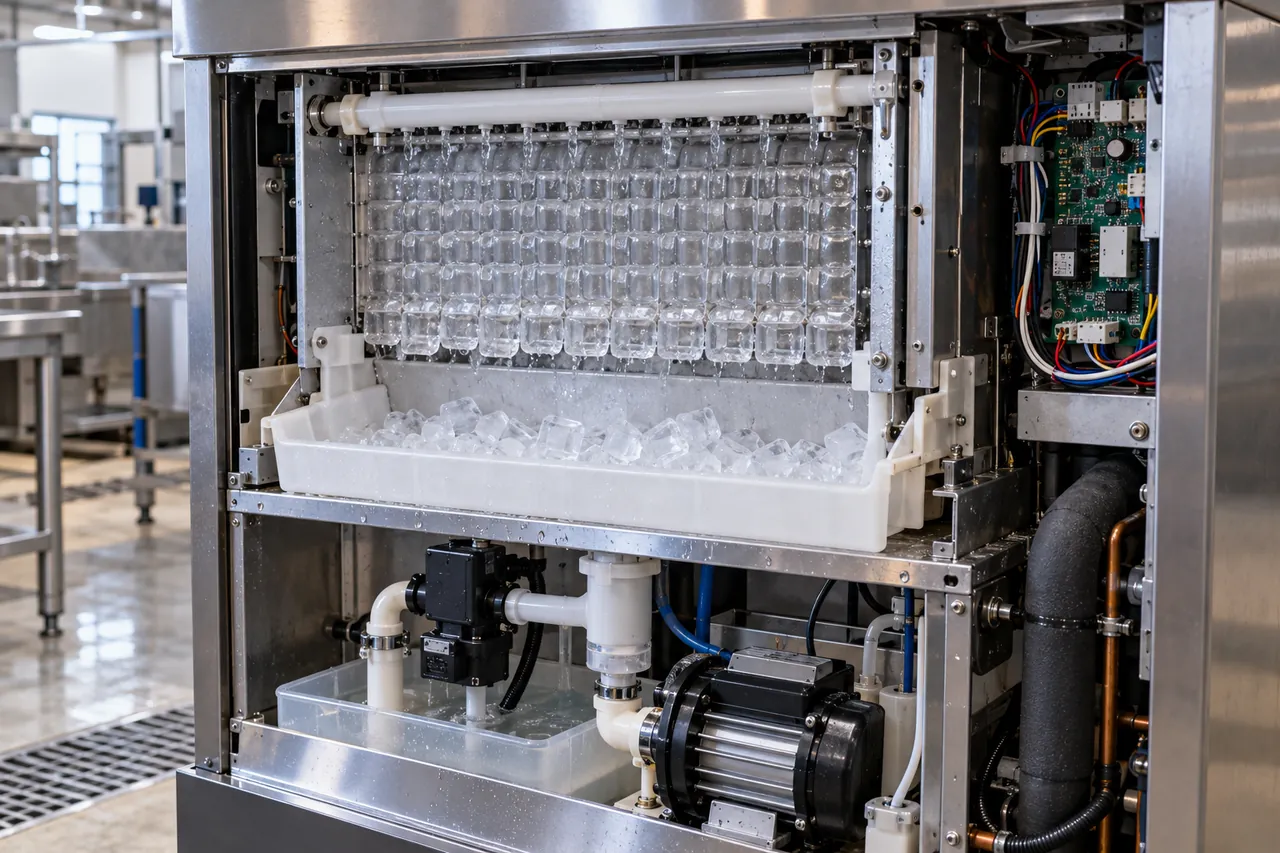
The water system fills the machine with exactly enough water for one batch of ice, circulates it over the evaporator while it freezes, then drains away what is left. It handles every litre of water, so it is the part most affected by scale and slime.
- The water inlet valve opens and fills the sump until the float or level probe signals full.
- The water pump lifts water to the distribution tube, which runs it evenly down the evaporator face.
- Water that does not freeze falls back into the sump and recirculates, so pure water freezes first and minerals stay in the remaining water. This is why cube ice is clear.
- At harvest, the purge or dump valve, or the pump itself, empties the mineral-rich water to drain before the next fill.
Hard water leaves scale on the valve, pump, distribution holes and evaporator. A correctly sized filter with scale inhibitor slows this down; see the ice machine water filter guide. Inlet water pressure should normally be about 1.4–5.5 bar (20–80 psi).
What refrigeration parts does an ice machine have?
An ice machine has the same refrigeration parts as any fridge, compressor, condenser, expansion device and evaporator, plus a hot gas valve that warms the evaporator to release the ice. That harvest valve is what makes it an ice machine rather than a freezer.
Compressor and condenser
Small and medium machines use a hermetic reciprocating or rotary compressor; large modular and flake machines may use scroll or semi-hermetic compressors. The condenser is air-cooled with a fan, water-cooled, or remote. A dirty air-cooled condenser is the single most common cause of slow ice production. Refrigerant repairs, including compressor, evaporator or valve replacement, must be done by certified technicians under local rules such as EPA Section 608 in the US or the F-gas regulation in the EU.
Evaporator
The evaporator is a grid of cells, or a set of vertical tubes or plates, with refrigerant tubing bonded to the back. On most cube machines it is copper with nickel or tin plating, or stainless steel, because it is a food-contact surface. Its plating can be stripped by strong acid descalers, so clean only with nickel-safe cleaners the manufacturer approves. A damaged evaporator is often costly enough that replacing the whole machine is considered.
Hot gas valve and harvest assist
When the ice reaches full thickness, the control opens the hot gas valve, diverting hot discharge gas from the compressor directly into the evaporator. The cubes' contact surfaces melt slightly and the slab falls into the bin, usually in 1–3 minutes. Some machines add a harvest-assist motor or air pump to push the ice off.
Which controls and sensors run the ice cycle?
A control board runs the ice cycle using inputs from a few sensors: water level, ice thickness, evaporator or suction temperature, and bin level. A typical cube machine completes a freeze and harvest cycle in about 12–25 minutes, depending on cube size and conditions.
- Ice thickness probe: a pair of metal fingers set a few millimetres from the evaporator; when water bridges the gap through the ice, the board starts harvest. Adjusting the gap changes cube size.
- Harvest switch: a curtain or magnetic switch that confirms the ice has dropped, ending harvest.
- Bin level control: a thermostat bulb, infrared sensor or ultrasonic sensor that stops production when the bin is full.
- Thermistors on the evaporator and discharge line for timing and safety.
- High- and low-pressure switches that protect the compressor.
Most modern machines show fault codes on a display. The ice machine troubleshooting guide explains the common ones and the checks to make before calling a technician.
How are flake and nugget ice machine parts different?
Flake and nugget machines replace the cube evaporator and hot gas harvest with a continuous system: a refrigerated cylinder, an auger that scrapes ice off the inside wall, and a gearmotor that turns the auger. There is no batch cycle; ice is produced continuously.
| Component | Cube ice machine | Flake or nugget ice machine |
|---|---|---|
| Freezing surface | Flat or cell-type plated evaporator | Refrigerated stainless cylinder (vertical) or drum (large flake machines) |
| Ice removal | Hot gas harvest | Rotating auger or scraper blade |
| Drive | None for ice removal | Gearmotor with reduction gearbox |
| Water supply | Batch fill, pump circulation | Constant gravity feed from a float reservoir |
| Shaping | Cell size | Breaker for flake; extrusion head that compresses pellets for nugget |
| Wear items | Water pump, inlet valve, probes | Auger bearings, seals, gearmotor, extrusion head |
| Typical service | Descale and sanitise every 6 months | Same, plus bearing and seal inspection about yearly |
Industrial flake machines of 1–20 t per day use a horizontal or vertical drum and a scraper instead of an auger; see the flake ice machine guide. Nugget ice machines are covered in detail in our nugget ice maker guide.
When do you need an ice maker with a drain pump?
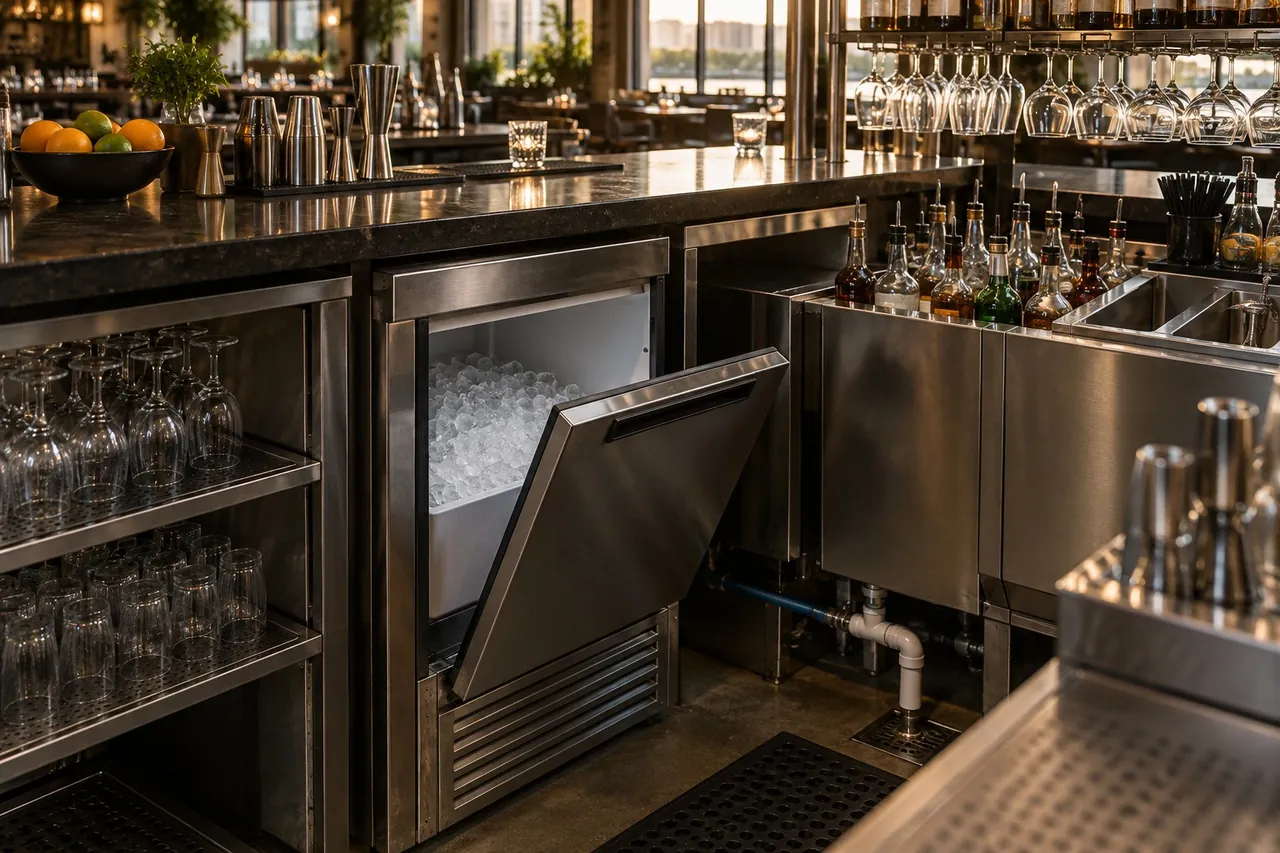
You need an ice maker with a drain pump when there is no floor drain or standpipe lower than the machine's drain outlet, so water cannot flow away by gravity. The pump collects melt water and purge water in a small reservoir and pushes it up and across to a sink or drain.
This is most common with an undercounter ice maker with drain pump fitted into an existing bar, office pantry or outdoor kitchen where plumbing would otherwise mean cutting into the floor. Built-in drain pumps typically lift waste water about 2–3 m (7–10 ft) vertically; check the model's head rating and the total horizontal run. Narrow 15 inch (380 mm) undercounter ice makers with drain pumps suit residential bars and small offices, while commercial machines from about 25 kg (55 lb) a day upwards usually offer the pump as an option or as an add-on kit. An undercounter nugget ice maker with drain pump is common in offices because nugget machines purge water continuously.
With a gravity drain, slope the line at least 20 mm per metre (1/4 in per ft), keep an air gap at the receiving drain, and never connect directly to a sewer line. A drain pump adds a moving part that can fail or clog, so include its check valve and reservoir in routine cleaning. For clearances and dimensions see the under counter ice maker guide.
What is a self-cleaning ice maker?
A self cleaning ice maker is a machine that runs its descaling and sanitising cycle automatically or at the press of a button, dosing cleaner and sanitiser and rinsing them away without the operator removing parts. Some machines add ozone generators or UV lamps that continuously reduce microbial growth in the water and bin.
Self-cleaning features save labour and make it more likely the cycle is done on time, but they do not remove the need for manual cleaning. The bin, scoop, door gasket, drain, exterior, air filter and condenser still need hands-on cleaning, and heavy scale or slime in the distribution tube and sump may need parts removed. Treat a self cleaning ice machine as an aid, not a replacement for a cleaning schedule: descale and sanitise at least every 6 months, or as the manual says, and log it. Our step-by-step ice machine cleaning guide includes a cleaning log.
How to choose spare parts and judge build quality
Look at the parts list as much as the output figure when comparing machines, and keep the fast-wearing parts in stock. Use this checklist:
- Ask for the exploded parts diagram and part numbers before you buy, and confirm parts are available in your country for at least 7–10 years.
- Check the evaporator material and plating, the stainless grade of panels and the bin liner material.
- Confirm the compressor type, refrigerant and the condenser option that suits your room.
- For distributors and remote sites, stock a spare parts kit: water pump, inlet valve, float or level sensor, thickness probe, hot gas valve coil, condenser fan motor, thermistors, bin sensor, drain pump, door gasket and water filter cartridges.
- For flake and nugget machines, add auger bearings, seals and a gearmotor for large fleets.
- Check whether a drain pump, self-cleaning cycle or UV/ozone module is standard or optional.
- Confirm voltage, frequency and certification for your market, and that the manual covers parts replacement.
Be There supplies commercial ice machines from 25 kg (55 lb) to 20 t per day, including cube ice machines and flake ice machines for freshwater or seawater. If you are importing, our import checklist explains what to confirm on the proforma. Send your model requirements, daily output, voltage and spares list through the inquiry form and we will quote FOB, CIF or DDP.