Short answer
Industrial ice machine capacity is the weight of ice made in 24 hours, usually stated at standard test conditions of 90 °F (32 °C) air and 70 °F (21 °C) water. Common sizes run from 50 lb (23 kg) undercounter units to 1,000 lb (454 kg) modular heads. Expect 15–25% less output in hot rooms, and pair the machine with a bin holding half of daily demand.
Key takeaways
- Capacity ratings are lb or kg per 24 hours, and a rating quoted at 70 °F air and 50 °F water can be 20–30% higher than one quoted at 90 °F and 70 °F.
- 50–200 lb (23–91 kg) machines are usually self-contained undercounter units with 15–60 kg of built-in storage.
- 300–1,000 lb (136–454 kg) machines are usually modular heads that sit on a separate bin of 100–400 kg.
- Beyond about 1,000 kg (2,200 lb) a day, buyers move to flake ice machines that scale from 300 kg to 20 t per day.
- Divide your daily demand by 0.85 for a warm room or 0.75 for a hot room before choosing a capacity.
What does industrial ice machine capacity mean?
An industrial ice machine's capacity is the weight of ice it produces in 24 hours of continuous running, stated in pounds (lb) or kilograms (kg) per day. A "500 lb ice machine" is designed to make about 500 lb (227 kg) every 24 hours under the conditions the manufacturer used to test it.
Those conditions matter more than most buyers realise. In North America, commercial ice makers are normally rated at 90 °F (32 °C) room air and 70 °F (21 °C) inlet water, which reflects a busy kitchen. Some catalogues also print a figure at 70 °F (21 °C) air and 50 °F (10 °C) water. That "ideal" number can be 20–30% higher, so always compare machines at the same conditions.
Capacity is also not the same as storage. A production figure tells you how fast ice is made; a storage figure tells you how much finished ice the bin holds. A listing for an "ice maker with 100 lb storage" may only produce 60–80 lb a day. You need both numbers: production to cover a full day's use, storage to cover your peak hour.
Be There supplies commercial ice machines from 25 kg (55 lb) to 20 t (44,000 lb) per day in cube, flake, nugget, snow, bullet and crescent ice. Every quotation states output at a defined air and water temperature so you can compare like with like.
Ice machine sizes from 20 lb to 1,000 lb: who uses each?
Most commercial and industrial ice makers fall into a handful of capacity bands. The table below shows typical formats, built-in or matched storage and the businesses that usually buy each size. Kilogram values are rounded.
| Rated capacity per 24 h | Metric | Typical format | Typical storage | Typical users |
|---|---|---|---|---|
| 20–30 lb | 9–14 kg | Countertop or fridge ice maker | 1–3 kg | Homes, small offices |
| 50 lb | 23 kg | Undercounter, self-contained | 10–15 kg | Small café, office pantry |
| 100 lb | 45 kg | Undercounter, self-contained | 15–25 kg | Café, small bar, 40-seat restaurant |
| 150–200 lb | 68–91 kg | Large undercounter or small modular | 30–60 kg | Busy bar, 80–100 seat restaurant |
| 250–300 lb | 113–136 kg | Modular head on bin | 100–200 kg | Hotel floor, fast-casual chain |
| 400–500 lb | 181–227 kg | Modular head on bin | 150–300 kg | Hotel, banquet kitchen, hospital ward |
| 1,000 lb | 454 kg | Large modular head on bin | 250–400 kg | Large hotel, supermarket, stadium |
| 2,200 lb and up | 1 t and up | Industrial cube or flake plant | Ice room or silo | Fisheries, food plants, ice sellers |
These bands overlap. A 200 lb ice machine can be an undercounter unit or a compact modular head depending on the design, and a 300 lb ice machine may suit either a large restaurant or a small hotel. Use the table to shortlist a band, then run your own numbers in the ice machine size calculator.
50 lb, 100 lb and 200 lb ice makers: small-business sizes
A 50 lb ice maker (about 23 kg a day) is the smallest true commercial machine. It suits a coffee shop that only ices drinks, an office pantry or a small clinic. A 100 lb ice machine (about 45 kg) is the most common entry size for cafés, small bars and restaurants of around 40 seats.
Both are normally self-contained: compressor, evaporator and insulated bin in one cabinet that fits under an 86–91 cm (34–36 in) counter. They need a cold water supply, a floor drain or drain pump, and side or front ventilation if air-cooled. Built-in storage is small, often 15–25 kg, so the machine refills the bin slowly during service.
A 150 lb or 200 lb ice machine (68–91 kg) is where many busy bars land. At this size, check whether the unit is a wide undercounter model or a small modular head; the second gives you more bin choice.
What about a 26 lb countertop ice maker or a refrigerator with a large ice maker?
A 26 lb ice maker (about 12 kg a day) is a portable countertop unit that makes hollow bullet ice and stores only 1–1.5 kg. A refrigerator with a large ice maker usually produces a few pounds a day. Both are fine at home or for occasional office use. They are a poor fit for a business: low output, no drain connection on many units and, typically, no food-equipment certification such as NSF/ANSI 12. Our guide to countertop vs commercial ice makers explains when to upgrade.
300 lb to 500 lb: what is a modular ice machine head?
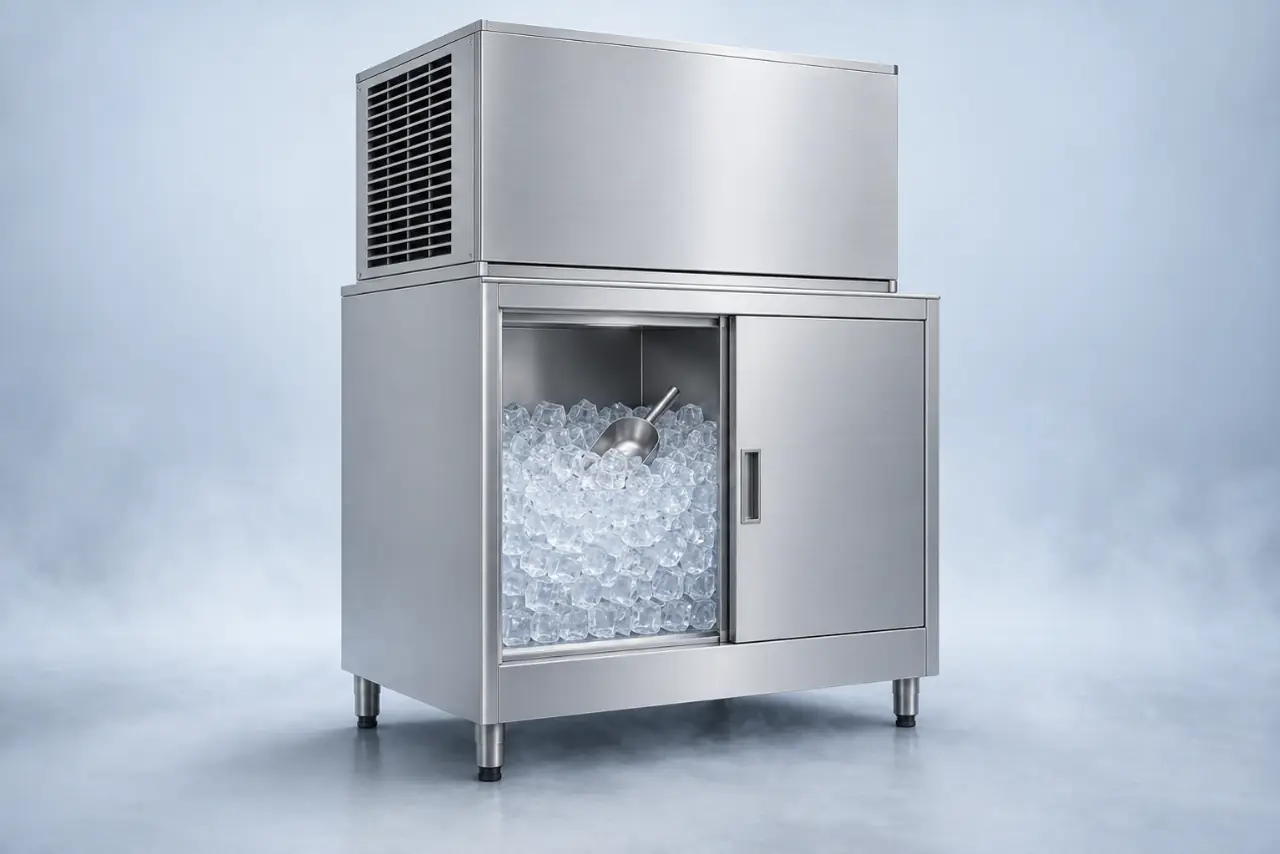
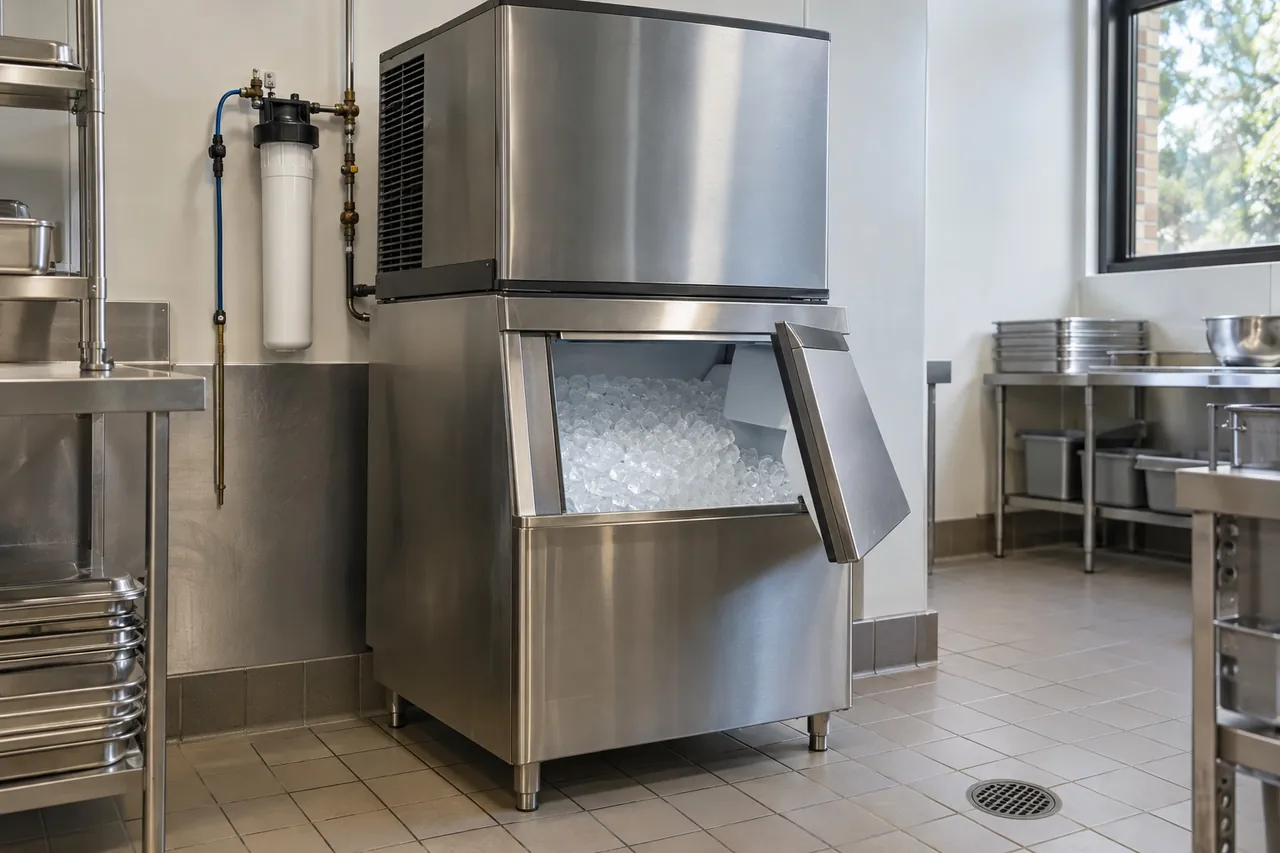
From about 300 lb (136 kg) per day, most cube machines are sold as a modular ice machine: a "head" that contains the refrigeration system and evaporator, mounted on a separate insulated storage bin. You may see this listed as an "ice machine head only" or "ice machine head unit", because the bin is bought separately.
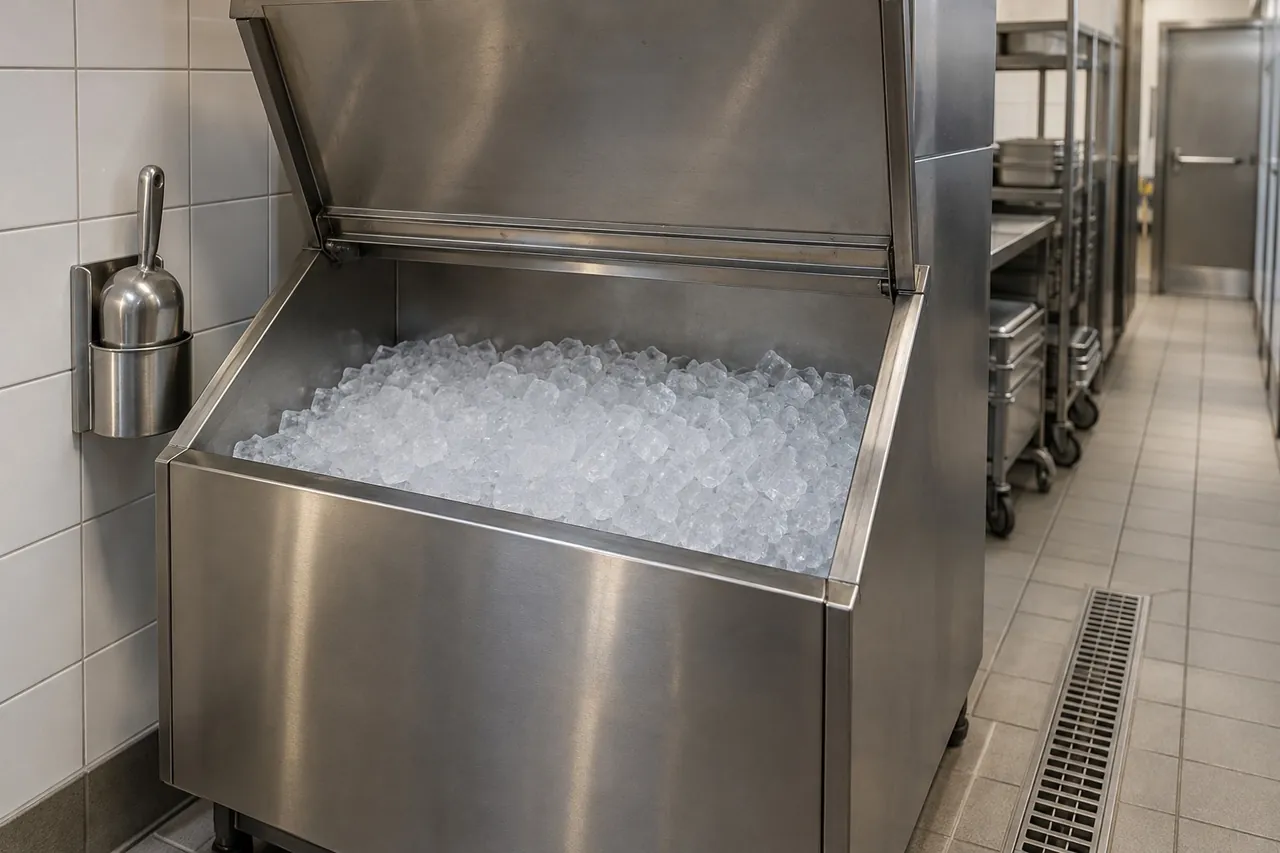
The modular design lets you match production and storage independently. A 500 lb ice machine head can sit on a 200 kg bin for a restaurant or a 300–400 kg bin for a hotel banquet kitchen that needs a large stock before an event. Some bins also accept two heads stacked, or a head on top of an ice dispenser.
| Head capacity | Hourly production (approx.) | Suggested bin (≥ half of daily output) |
|---|---|---|
| 300 lb (136 kg) | 5.7 kg (12.5 lb) | 70–150 kg (150–330 lb) |
| 400 lb (181 kg) | 7.6 kg (16.7 lb) | 100–200 kg (220–440 lb) |
| 500 lb (227 kg) | 9.5 kg (20.8 lb) | 120–250 kg (260–550 lb) |
| 1,000 lb (454 kg) | 18.9 kg (41.7 lb) | 230–400 kg (500–880 lb) |
Check the bin's top opening matches the head's footprint, and that the head's harvest drops into the bin without spilling. Be There cube ice machines run from 50 kg to 1,000 kg (about 100–2,200 lb) per day, with modular heads matched to bins of 100–400 kg.
1,000 lb ice machines and larger industrial ice makers
A 1,000 lb ice machine (454 kg per day) is the largest size most hotels, supermarkets and stadium concessions buy as a single cube head. Above that, an industrial ice maker is usually specified by tonnes per day rather than pounds.
At these sizes, think about three things beyond capacity:
- Redundancy. Two 500 lb heads instead of one 1,000 lb head cost more, but a single failure leaves you with half your ice instead of none.
- Utilities. Large heads typically need 208–230 V supply, sometimes three-phase, a dedicated water line with a filter sized for the flow, and a drain that can handle harvest water. Confirm voltage and frequency (50 Hz or 60 Hz) before ordering.
- Ice type. Cube ice is best for drinks. For fish counters, food processing and concrete cooling, flake ice is cheaper to make per kilogram and easier to pack around product.
If you need several tonnes a day, an industrial ice maker machine for flake ice is often the better route. Be There flake ice machines run from 300 kg to 20 t per day, including seawater models for boats and ports. Large ice machines like these are usually installed with an insulated ice room or storage bin and, for remote sites, a remote condenser or water-cooled condenser.
A "large ice machine for home" or "extra large ice maker" sold to consumers is normally a 50–80 lb undercounter unit; anything bigger is commercial equipment that needs proper drains and ventilation.
How much ice will a 100 lb ice machine really make in a hot room?
Rated output falls as room air and inlet water get warmer, because the condenser rejects heat less efficiently and the water takes longer to freeze. Air-cooled machines are affected most. A 100 lb ice maker rated at 90 °F/70 °F will exceed 100 lb in a cool room and fall short in a hot one.
| Installation condition | Planning factor | 100 lb machine delivers about | 500 lb machine delivers about |
|---|---|---|---|
| Cool, ventilated room, below 21 °C (70 °F) | 1.00 | 100 lb (45 kg) | 500 lb (227 kg) |
| Warm kitchen or bar, 27–32 °C (80–90 °F) | 0.85 | 85 lb (39 kg) | 425 lb (193 kg) |
| Hot, enclosed space, above 32 °C (90 °F) | 0.75 | 75 lb (34 kg) | 375 lb (170 kg) |
These planning factors are conservative rules of thumb that we also use in our calculator; the exact figure depends on the model's capacity curve, so ask for it. To size correctly, divide your daily demand by the factor. If you need 90 kg (200 lb) a day in a hot kitchen, look for about 120 kg (265 lb) of rated capacity, which in practice means a 250–300 lb machine.
Two other ways to protect output: give air-cooled machines the clearances in the manual (typically 15–20 cm, 6–8 in, at the air intake and exhaust), or choose a water-cooled or remote-condenser model. Our ice machine sizing guide covers demand per seat, room and bed in more depth.
Industrial ice machine price: what drives the cost?
Price rises with capacity, but not in a straight line. A 1,000 lb head does not cost ten times a 100 lb undercounter unit, because the cabinet, controls and certification costs are shared. What moves the price most:
- Capacity and ice type. Nugget and crescent machines cost more per kg than full cube; flake ice costs less per kg at large scale.
- Condenser type. Air-cooled is cheapest; water-cooled and remote air-cooled add components and installation work.
- Bin and accessories. Bins, stands, water filters, drain pumps and dispensers are often extra.
- Electrical and certification. 60 Hz versions for the Americas, specific plugs, and UL/ETL, NSF or CE marking for your market.
- Freight and duties. FOB, CIF and DDP prices differ by thousands of dollars on a container.
Because these vary by size, spec and destination, Be There quotes each order individually on FOB, CIF or DDP terms. If you are looking at an industrial ice maker for sale on the second-hand market, check compressor hours, scale build-up, refrigerant type and whether parts are still available. A used industrial ice machine that has lost 30% of its output is not a bargain. Our used vs new commercial refrigeration guide, linked below, lists what to inspect.
How to choose the right ice machine capacity: checklist
- Estimate daily demand. Count seats, rooms, beds or kg of product to chill, multiply by ice per unit, and add 20% for peaks.
- Correct for the room. Divide by 0.85 for a warm room or 0.75 for a hot one.
- Pick the capacity band. Round up to the next standard size, for example 100, 200, 300, 500 or 1,000 lb.
- Size storage. Choose built-in storage or a bin holding at least half of daily demand, more if you have one big peak.
- Choose ice type. Cube for drinks, nugget for healthcare and soft drinks, flake for food display and processing.
- Check utilities. Voltage, frequency, phase, water pressure, drain and ventilation clearances.
- Plan for growth and redundancy. Consider two smaller heads for critical sites.
Send us your daily demand, room temperature, power supply and preferred ice shape and we will recommend a matched machine and bin from our ice machine range, with output stated at your conditions. Request a quote and we reply within one working day.