Short answer
An ice ball maker shapes ice into spheres of about 50–65 mm (2–2.5 in) using a mold, a heated metal press or an automatic sphere machine. For clear ice, water must freeze in one direction or flow over the freezing surface so air and minerals are pushed out. Bars typically pair a clear cube ice machine with clear blocks cut into large cubes or pressed into spheres.
Key takeaways
- Ice turns cloudy when it freezes from all sides and traps dissolved air and minerals in the centre; directional freezing or flowing water makes clear ice.
- A sphere has about 19% less surface area than a cube of the same volume, so it melts and dilutes a drink more slowly.
- One 5 cm (2 in) cube has half the surface area of the eight 2.5 cm (1 in) cubes holding the same ice.
- An ice press melts a clear block into a sphere with a heavy aluminium or copper mold, typically in about 30–90 seconds.
- Commercial cube ice machines that run water over a vertical evaporator already produce clear full and half cubes.
What is clear ice, and what does an ice ball maker do?
Clear ice is ice with no trapped air bubbles or white mineral core, so it looks like glass in the drink. An ice ball maker is any mold, press or machine that shapes ice into spheres, usually 50–65 mm (2–2.5 in) across, for whisky, Old Fashioneds and other spirit-forward cocktails.
The two ideas overlap but are not the same. A cheap silicone ice ball mould makes spheres that are usually cloudy; a clear ice ball maker or press makes spheres that are also transparent ice. Clarity depends on how the water freezes, and shape depends on the tool.
For a bar, clear ice does three jobs: it looks premium, it melts slowly and evenly, and it has no off-flavours from minerals concentrated in a cloudy core. That is why cocktail ice programmes now use several formats: clear standard cubes for mixing, large cubes and spheres for serving, and sometimes long spears for highballs.
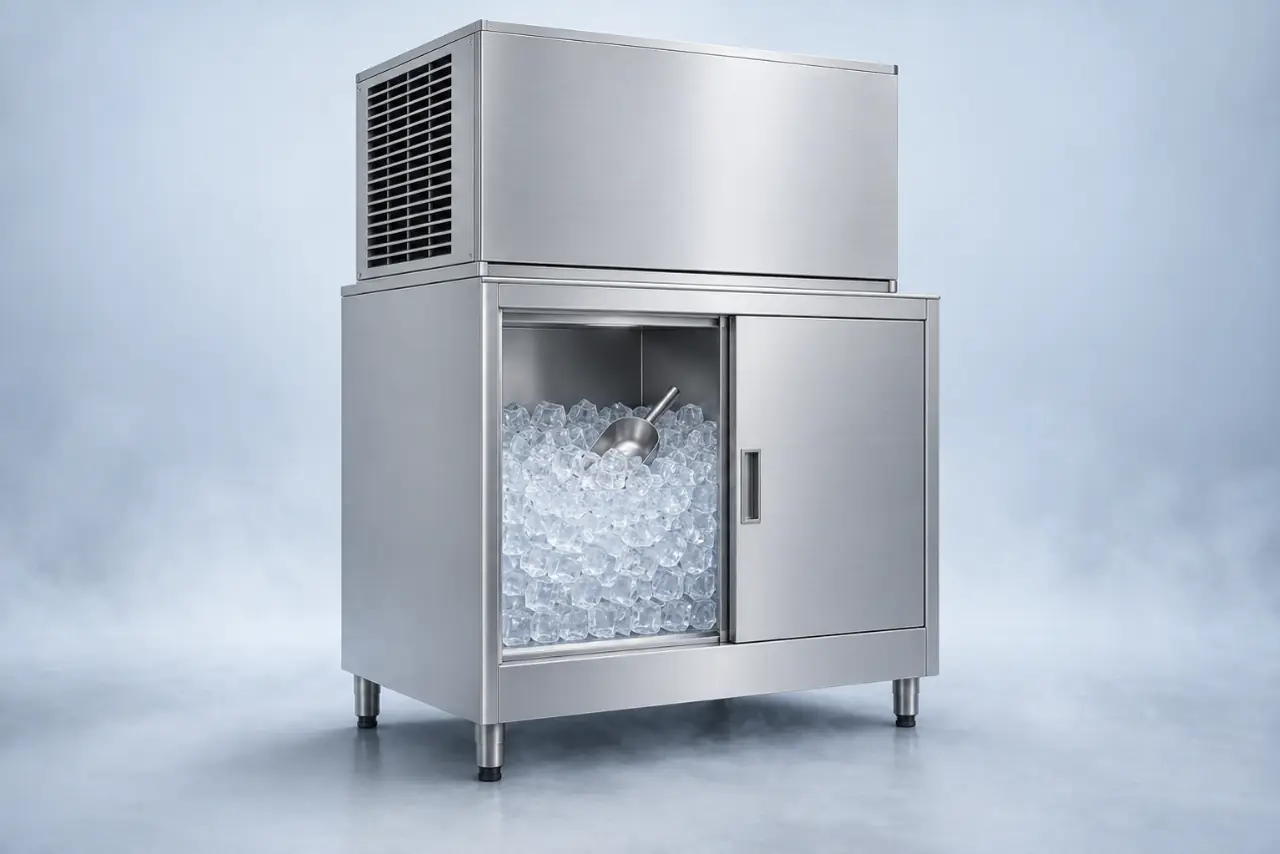
Be There supplies cube ice machines that make clear full and half cubes from 50 to 1,000 kg (about 100–2,200 lb) per day. This guide explains how clear ice forms, compares the ways to make ice balls and large cubes, and shows how a cocktail bar can produce them at volume.
How to get clear ice cubes
Water contains dissolved air and minerals. When an ice tray freezes from the top, bottom and sides at once, the ice front closes in from every direction and traps those impurities in the centre, which turns white. That is the cloudy core in ordinary freezer cubes.
To make clear ice cubes, freezing must move in one direction so impurities are pushed ahead of the ice front into water that is either discarded or never freezes. There are two practical ways:
- Directional freezing: insulate the sides and bottom of a container so water freezes only from the top down. Stop before it freezes solid and discard the cloudy bottom layer. This is how a home cooler for clear ice works, and how large clear block makers work at commercial scale.
- Moving water: run water continuously over a cold vertical plate or into cells, as a commercial cube machine does. The flowing water carries away air and minerals, and the machine purges that water each cycle.
What is the best water for clear ice?
Filtered water with low mineral content helps, and it reduces scale in machines. Boiling water removes some dissolved air, but it does not make ice clear on its own. Freezing direction matters far more than the water source. In a commercial machine, an inlet filter sized to the daily output, as explained in our ice machine water filter guide, keeps cubes clear and the evaporator clean.
Cocktail ice formats: sizes and why big ice melts slower
Melting happens at the surface, so the less surface area per gram of ice, the slower a drink dilutes. That is the whole case for large ice cubes and spheres.
| Format | Typical size | How it is made | Typical drinks |
|---|---|---|---|
| Standard full cube | 22–28 mm (7/8–1 1/8 in) | Cube ice machine | Shaking, stirring, highballs |
| Large cube ("old fashioned ice cube") | 50 mm (2 in) | Cut from clear block, large cube mold or large-cube machine | Old Fashioned, Negroni, neat spirits |
| Sphere / ice ball | 50–65 mm (2–2.5 in) | Press, mold or sphere machine | Whisky on the rocks, premium serves |
| Collins spear | About 30 × 30 × 120 mm | Cut from clear block | Highballs, Collins drinks |
| Top hat ice (gourmet ice) | About 30 mm, cylindrical with a dimple | Spray-type cube machine | Hotels, upscale soft drinks |
| Clear block | Commonly about 130–140 kg (around 300 lb) | Directional block freezer | Raw material for cutting |
The geometry is easy to check. One 5 cm cube holds 125 cm³ of ice and has 150 cm² of surface. Eight 2.5 cm cubes hold the same 125 cm³ but have 300 cm² of surface, twice as much. A sphere of the same 125 cm³ volume has about 121 cm² of surface, roughly 19% less than the cube. That is why a whiskey ice ball lasts longer than a pile of small cubes.
Ice ball maker options: molds, presses and machines
There are four common ways to make an ice sphere, with very different labour, clarity and output.
| Method | Clarity | Labour | Practical output | Best for |
|---|---|---|---|---|
| Silicone sphere ice ball mold | Usually cloudy | Fill, freeze, unmold | Limited by freezer space; 12–24 h freeze | Home, casual bars |
| Directional (insulated) clear ice ball maker | Clear | Fill, freeze, trim | A few spheres per set per day | Home, small bars |
| Ice ball press (aluminium or copper) | As clear as the block used | Cut blocks, press each sphere | About 30–90 s per sphere | Cocktail bars, hotels |
| Automatic ice ball maker machine | Varies by design | Low; machine freezes and releases | Depends on mold count and cycle time | Bars wanting spheres without block work |
How an ice press works
An ice ball press is two heavy halves of a high-conductivity metal, usually aluminium or copper, with a spherical cavity. Placed over a cube of clear ice, the warm metal melts the ice into the cavity shape under its own weight. A spherical ice press gives a perfect, clear sphere when you start with clear block ice; it does nothing to clarify cloudy ice. Presses cool down with use, so busy bars rotate two or rinse them in warm water between batches.
An automatic ice ball maker or ice sphere machine freezes water in sphere-shaped molds and releases the balls in cycles. Ask any supplier for clarity, sphere size and output per 24 hours at your room temperature before you buy.
How cocktail bars produce clear ice at volume
Most high-volume cocktail bars run a simple three-part system rather than one do-everything machine.
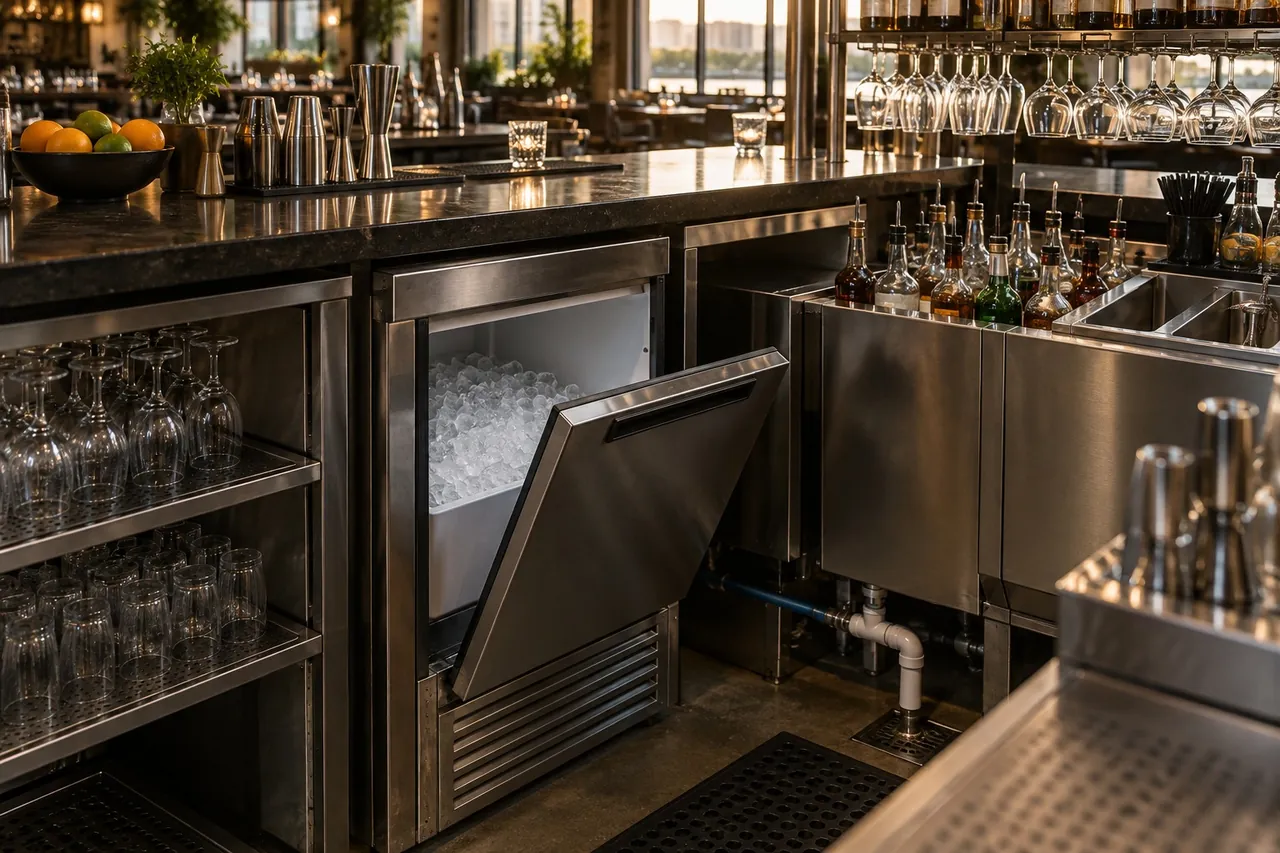
- Daily cubes from a cube machine. A commercial clear ice maker machine, in practice a cube machine with a vertical evaporator, makes clear full cubes for shaking, stirring and most serves. Size it first, because it covers 80–90% of ice use.
- Large formats from clear blocks. Clear blocks, frozen directionally on site or bought from an ice producer, are cut with a food-safe band saw or chisel into 5 cm (2 in) cubes, spears and press blanks.
- Spheres from a press. Bartenders press spheres from pre-cut blanks during prep, then store them frozen.
Storage and tempering
Store finished large cubes and spheres in a freezer at about −18 °C (0 °F), separated on trays or bagged to stop them fusing and picking up odours. Ice that comes straight from a very cold freezer can crack when spirit is poured over it, so temper it for a few minutes until the frosty surface turns glossy before serving.
Hygiene
Ice is food under the FDA Food Code and most national codes. Use food-contact cutting tools, gloves or tongs, clean storage containers, and never use ice that has cooled bottles or produce as drink ice.
Craft ice refrigerators, countertop clear ice makers and home gadgets
Many searches for the best clear ice maker lead to household products, and they have their place.
- Craft ice refrigerator: some domestic fridges include a craft ice maker that freezes slow, clear spheres in the freezer. A fridge that makes ice balls is convenient at home, but it makes only a small number of spheres a day.
- Countertop clear ice maker: a plug-in clear ice cube maker freezes cubes in layers. Output is low, typically a few kilograms a day, and the cubes are small.
- Whiskey ice ball maker kits: insulated molds or small presses for home use. A whiskey ice ball maker machine for home is usually a mold set, not a production machine.
For a bar, these are useful for testing a drinks menu, not for service. A busy night can use more spheres than a home device makes in a week.
Old fashioned ice cream freezers are a different product
An old fashioned ice cream freezer is a hand-crank or electric bucket that churns ice cream in a salt-and-ice bath; it does not make cocktail ice. If you are making ice cream commercially, Be There supplies batch freezers, soft serve and popsicle equipment; see our commercial ice cream machines.
How much clear ice does a cocktail bar need?
Size the two streams separately.
Standard cubes
Bars typically use about 1.5–2 kg (3.3–4.4 lb) of ice per seat per day, including shaking, stirring, chilling glassware and serving. Add 20% for peaks and correct for room temperature with the ice machine size calculator. A 60-seat cocktail bar at 1.75 kg per seat needs 60 × 1.75 × 1.2 = about 126 kg (280 lb) a day, before any hot-room correction.
Large cubes and spheres
Count large-format serves instead of weight. If the menu sells 150 spirit-forward drinks on a busy night, prep about 180 pieces to cover breakage and peaks. A 5 cm (2 in) cube weighs about 115 g (4 oz), so 180 cubes is roughly 21 kg (46 lb) of finished ice, plus offcuts from block cutting. Plan freezer space for one to two nights of stock.
| Bar type | Cube ice per day | Large-format pieces per night |
|---|---|---|
| Small cocktail bar, 30 seats | About 60–75 kg (130–165 lb) | 50–100 |
| Busy cocktail bar, 60 seats | About 110–145 kg (240–320 lb) | 120–250 |
| Hotel bar plus banqueting | 200 kg (440 lb) and up | 200+ |
These are planning figures; your menu and volume decide the real numbers.
Choosing a commercial clear cube ice machine
The clear ice cube machine is the workhorse of the programme, so specify it carefully.
- Cube shape: full cube for stirring and serving, half cube for shaking and blending. Crescent and bullet ice are clear but less suited to stirred drinks.
- Evaporator type: vertical plate or cell evaporators with flowing water give clear, dense cubes. Ask for photos of cubes from the exact model.
- Format: an undercounter unit storing 15–60 kg for a single bar station, or a modular head on a 100–400 kg bin for a central ice room. Our undercounter ice machine guide covers sizes, drains and clearances.
- Condenser: air-cooled where the room is ventilated, water-cooled or remote where the bar back is hot and enclosed.
- Water treatment: filtration and a descaling routine at least every 6 months keep cubes clear.
- Certification: NSF/ANSI 12 and UL/ETL in the US, CE in Europe.
For the differences between cube, nugget, flake and other shapes, see our overview of types of ice machines.
Next steps: building your clear ice setup
- List your ice formats: standard cubes, large cubes, spheres, spears.
- Size the cube machine by seats or covers, plus 20% for peaks.
- Count large-format serves per night and plan block supply, cutting and freezer space.
- Choose sphere tools: presses for bars with prep time, an automatic ice ball machine where labour is scarce.
- Decide on large cubes: cut them from clear blocks, or ask about a large ice cube maker if cutting labour is the bottleneck.
- Set hygiene rules: food-contact tools, gloves, labelled storage and a tempering step.
Be There supplies clear full and half cube ice machines for bars and hotels, quoted FOB, CIF or DDP. If you also need sphere or large-format production, describe your daily volume and we will tell you what we can supply. Send the details through the quotation form; we reply within one working day.