Short answer
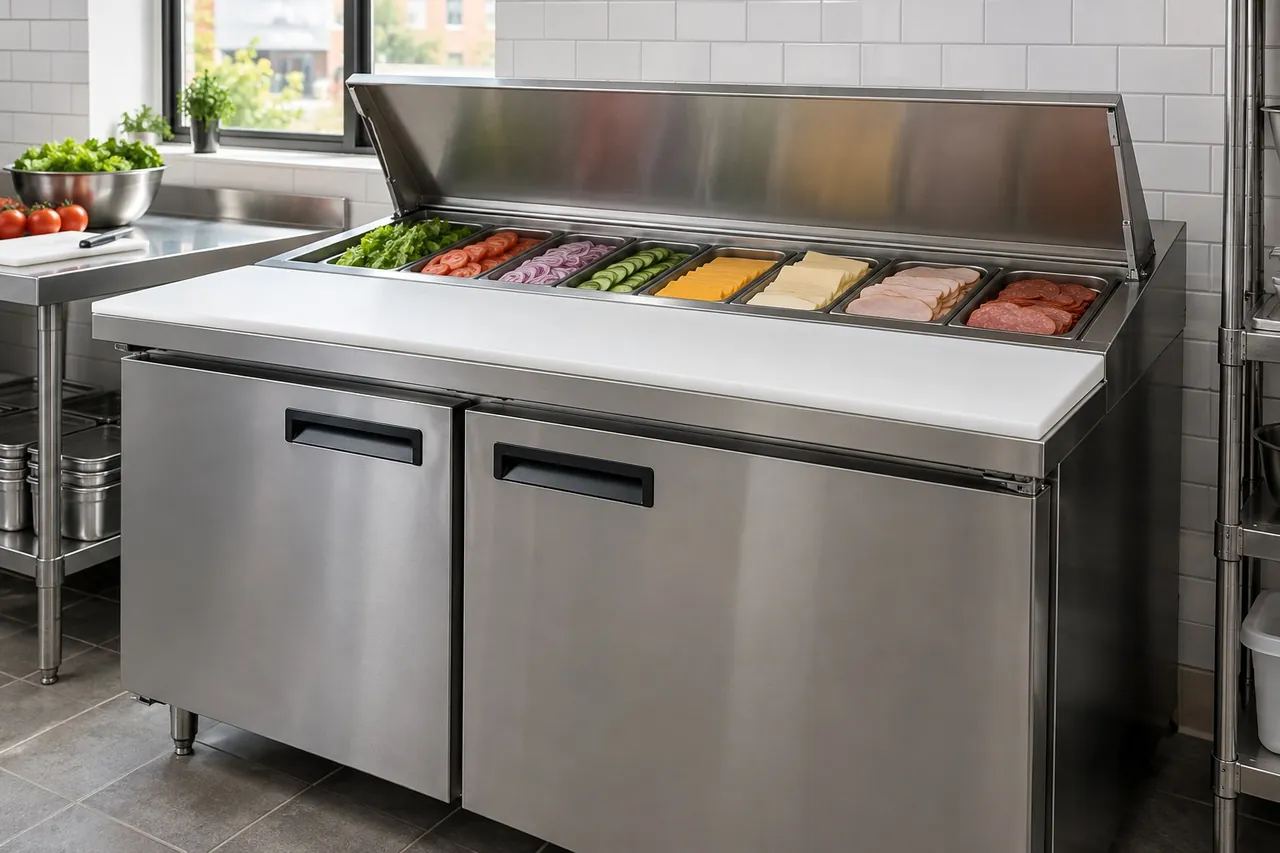
A prep table refrigerator is a refrigerated base cabinet with a cutting board and a chilled rail of food pans on top, used to assemble sandwiches, salads and pizzas. It must hold food at 5 °C (41 °F) or below. Common widths are 27–29 in (1 door), 48 in (2 doors) and 60–72 in (2–3 doors), with 8 to 30 sixth-size pans.
Key takeaways
- Prep table refrigerators must keep food in the pans at 5 °C (41 °F) or below to meet the FDA Food Code and NSF/ANSI 7 performance expectations.
- A 48 in (1,220 mm) sandwich prep table typically holds 12 sixth-size pans, or about 18 in a mega-top version.
- Pizza prep tables run about 44–119 in (1,120–3,020 mm) wide, with deeper worktops and third-size pans for toppings.
- European under worktop fridges are usually 600 or 700 mm deep and 850–900 mm high; the 700 mm version takes full GN 1/1 (530 × 325 mm) pans.
- US dealer prices typically run from about $2,500 for a small sandwich unit to $9,000 or more for large mega-top or pizza tables, varying by size, spec and market.
What is a prep table refrigerator?
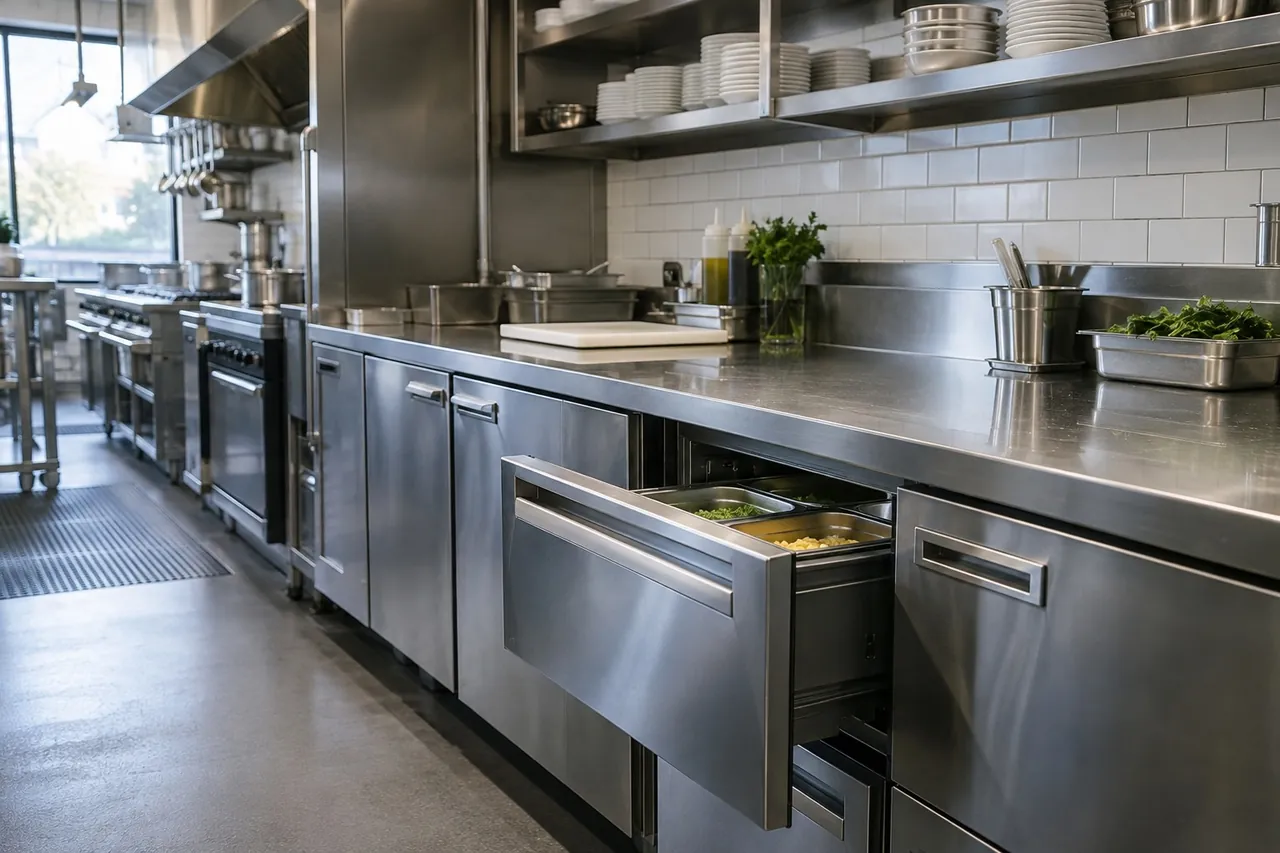
A prep table refrigerator is a commercial refrigerator built as a work station: a refrigerated base cabinet with doors or drawers, a cutting board along the front and a refrigerated rail of food pans above it. Cooks build sandwiches, salads, burritos, bowls or pizzas on the board while every ingredient sits within reach and stays cold.
It goes by many names. A sandwich prep table, sandwich refrigerator, sandwich fridge, sandwich preparation fridge, sandwich prep refrigerator, sandwich prep cooler, prep table cooler, prep refrigerator, prep fridge and refrigerated table all describe the same basic design. In Europe and the UK, a counter without a pan rail is usually called an under worktop fridge or worktop refrigerator.
Every version has the same job: hold food at 5 °C (41 °F) or below while the lid is open for hours during service. That is harder than it sounds, because the pans in the rail are exposed to warm kitchen air, radiant heat from grills and the cook's hands. The rail is where most prep tables fail inspections, so most of this guide is about how to choose one that keeps the top pans as cold as the cabinet below.
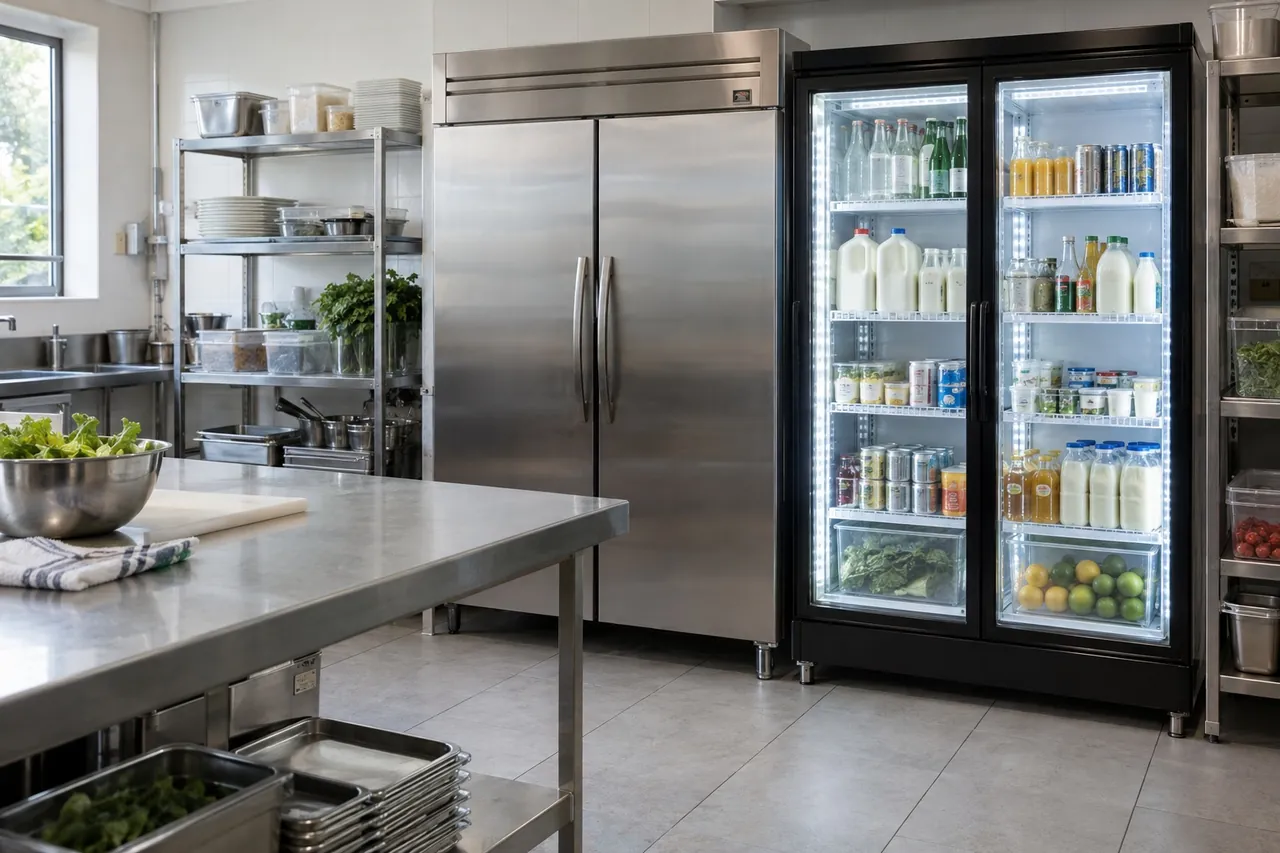
Prep tables are back-of-house equipment. If you also sell ready-made sandwiches and salads front of house, a glass door display fridge is the usual partner unit.
Types of refrigerated prep tables compared
Choose the type by what you assemble and how many ingredients you need on the rail.
| Type | Rail and pans | Typical width | Best for |
|---|---|---|---|
| Standard sandwich / salad prep table | One row of sixth- and third-size pans; cutting board about 8–12 in (200–300 mm) deep | 27–72 in (690–1,830 mm) | Delis, cafés, sandwich shops |
| Mega-top prep table | Two or more rows of pans, about 50% more capacity | 27–72 in | Burrito, bowl and salad concepts with many toppings |
| Pizza prep table | Third-size pans; deep worktop of about 19–20 in (480–510 mm) | 44–119 in (1,120–3,020 mm) | Pizzerias, flatbread and bakery lines |
| Under worktop fridge and freezer (worktop counter) | No pan rail; flat stainless top | 900–2,300 mm (35–91 in) | General prep, kitchens with limited space |
| Refrigerated table top rail (topping rail) | Pan rail only, sits on an existing counter | 36–72 in | Adding cold toppings to a line |
| Refrigerated salad bar | Open cold wells with a sneeze guard | 1.2–2.4 m (47–94 in) | Self-service buffets, canteens |
Drawers in the base cost more than doors but let cooks reach backup pans without bending into a deep cabinet. Doors are cheaper and hold full sheet pans or dough trays, which is why pizza tables usually have doors.
Prep table sizes and pan capacity
Width sets the number of pans and the number of cooks who can work at once. Allow roughly 24–30 in (610–760 mm) of board per cook.
| Width | Doors | Sixth-size pans (standard top) | Sixth-size pans (mega-top) | Base volume (approx.) |
|---|---|---|---|---|
| 27–29 in (690–740 mm) | 1 | 6–8 | 9–12 | 6–7 cu ft (170–200 L) |
| 36 in (915 mm) | 1–2 | 8–10 | 12–15 | 9–10 cu ft (255–285 L) |
| 48 in (1,220 mm) | 2 | 12 | 18 | 12 cu ft (340 L) |
| 60 in (1,525 mm) | 2 | 16 | 24 | 15–16 cu ft (425–455 L) |
| 72 in (1,830 mm) | 3 | 18 | 30 | 18–19 cu ft (510–540 L) |
US units are typically about 30 in (760 mm) deep for a standard top and 34 in (860 mm) for a mega-top, with a working height of about 36 in (915 mm) to the board. A US sixth-size pan measures about 6⅞ × 6¼ in (175 × 160 mm) and a third-size pan about 12¾ × 6⅞ in (325 × 175 mm), which match GN 1/6 (176 × 162 mm) and GN 1/3 (325 × 176 mm) closely. Pans come in 4 in (100 mm) and 6 in (150 mm) depths; deeper pans hold more but the food at the bottom is further from the cold air.
Check that the rail accepts the pan mix you want. Most rails are adjustable with divider bars, so one third-size pan can replace two sixth-size pans for bulky items such as lettuce.
Under worktop fridge and freezer: gastronorm counters
An under worktop fridge and freezer is a low commercial refrigerator with a flat stainless steel top that doubles as a prep bench. It has no pan rail, so it is simpler and cheaper than a sandwich prep table and fits under a pass, beside a range or in a small café kitchen. Some call it a worktop fridge, commercial worktop refrigerator or prep table with fridge.
| Spec | Typical values |
|---|---|
| Height | 850–900 mm (33½–35½ in), with adjustable legs |
| Depth | 600 mm (23½ in) snack size or 700 mm (27½ in) for full GN 1/1 pans |
| Width | About 900–2,300 mm (35–91 in), two to four doors or drawer banks |
| Fridge range | About −2 °C to +8 °C (28–46 °F), set to +1 °C to +4 °C (34–39 °F) for prep |
| Freezer range | About −18 °C to −22 °C (0 °F to −8 °F) |
A combined under worktop fridge and freezer has separate compartments in one counter, each with its own evaporator and thermostat, often with a shared condensing unit. Check the climate class as well: kitchen counters next to fryers and grills need a unit rated for at least 32 °C (90 °F), and ideally 38–43 °C (100–110 °F). Our undercounter refrigerator guide covers counter sizes and ventilation in more detail.
How do prep coolers keep food at 41 °F (5 °C)?
The cabinet of a prep cooler is easy to keep cold; the open rail is not, and this is where prep coolers differ most. Manufacturers use two main designs:
- Forced-air rail: a fan pushes cold air from the evaporator around and under the pans. It pulls down fast and recovers well, but strong airflow can dry exposed food.
- Cold-wall or refrigerated-well rail: refrigerant tubes or a cold plate surround the pan well. It is gentler on food and quieter, but recovers more slowly.
NSF/ANSI 7, the US standard for commercial refrigerators, tests food-preparation units in a warm test room to show they can hold product at 41 °F (5 °C) or below. Look for that listing in the US, or CE plus a stated climate class in Europe.
Habits that keep the rail safe
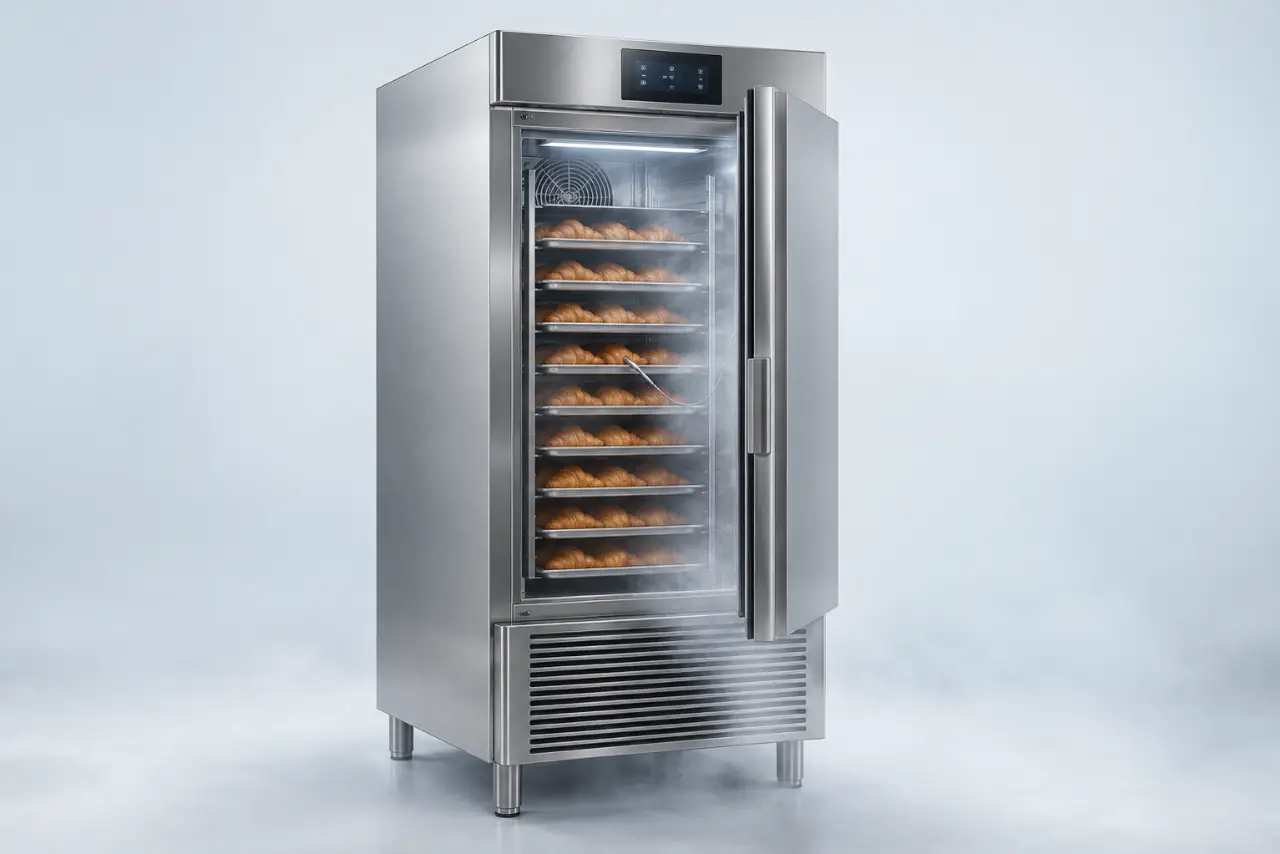
- Pre-chill every ingredient before it goes in the rail; the rail holds temperature, it does not cool hot food. Use a blast chiller or the 2-stage cooling method for cooked items.
- Do not overfill pans above the rail's fill line.
- Close the lid during quiet periods and overnight, or move the pans into the cabinet.
- Check pan contents with a probe thermometer at least every 2–4 hours and log the readings.
- Keep the condenser clean and the front grille clear, especially near grills and fryers.
If your local code allows time as a public health control, ready-to-eat food may be held without temperature control for up to 4 hours, then discarded, but that needs a written procedure.
Pizza prep table: what is different?
A pizza prep table is a prep table refrigerator scaled for dough. The worktop is deeper, about 19–20 in (480–510 mm), so a pizza can be stretched and topped on it, and the overall depth is typically 32–36 in (810–915 mm). The rail usually takes third-size pans because toppings are used in larger volumes than sandwich fillings.
- Worktop: stainless steel, a food-safe composite board or stone. Stone stays cooler and is preferred for dough; composite is lighter and easier to replace.
- Base: doors rather than drawers, sized for dough trays. Measure your trays before you order.
- Width: common sizes run from 44 in (1,120 mm) with one door to 119 in (3,020 mm) with three doors.
- Raised rail: a rail set above the worktop keeps toppings off the stretching area.
- Temperature: the base holds dough at about +2 °C to +4 °C (36–39 °F), which slows fermentation until use.
Pizza lines are hot places. The table often stands opposite or beside an oven running at 300–450 °C (570–840 °F), so ask for the ambient rating and plan at least the side clearance the manufacturer specifies. Dough can also be retarded overnight in a reach-in or a small walk-in cooler when a busy pizzeria outgrows the base.
Refrigerated salad bar and commercial salad bar refrigeration
A refrigerated salad bar is the self-service cousin of the salad prep table. It holds pans of salad, fruit and toppings in open cold wells at the customer side of the counter, so guests serve themselves. The temperature target is the same, 5 °C (41 °F) or below, but the setting is harder because the food is open to the dining room for hours.
Commercial salad bar refrigeration uses one of three methods:
- Refrigerated cold wells with refrigerant coils around the pan well, the most common and controllable method.
- Forced-air wells that blow cold air under and around the pans for faster recovery.
- Ice wells with no refrigeration, filled with crushed or flake ice. They are cheap and portable but need constant draining and refilling.
The FDA Food Code requires food on self-service displays to be protected from contamination, which in practice means a sneeze guard or food shield over the wells. Use shallow pans of 2½–4 in (65–100 mm), keep them pre-chilled, replace rather than top up, and check temperatures every couple of hours. For buffets with a hot side, combine the cold wells with heated wells in one counter. If you run a canteen, size refrigerated back-up storage too: a reach-in or a walk-in cold room keeps replacement pans ready.
Refrigerated prep table price and buyer's checklist
Among commercial refrigerated prep tables, the refrigerated prep table price depends mainly on width, top type and certification. As a rough guide at US dealer prices in 2026, a 27–48 in commercial sandwich prep table typically costs about $2,500–5,000, while 60–72 in mega-top units and pizza prep tables commonly run about $4,000–9,000 or more; list prices are often higher. Imported units have lower ex-works prices, but add freight, duty, certification and installation before you compare. Prices vary by size, spec and market.
Checklist before you buy a commercial prep fridge
- Menu and pans: how many ingredients, and in sixth- or third-size pans?
- Width and cooks: about 24–30 in (610–760 mm) of board per cook.
- Top: standard, mega-top, pizza worktop or flat worktop counter.
- Base: doors or drawers; fridge, freezer or both.
- Rail cooling: forced-air or cold-wall, with an insulated lid.
- Ambient rating: at least 32 °C (90 °F), more beside grills and ovens.
- Approvals and power: NSF/ANSI 7 and UL/ETL in the US, CE in Europe; correct voltage, frequency and plug.
- Refrigerant: R290 where your market allows it.
Be There manufactures commercial display refrigerators, blast chillers and walk-in cold rooms for food businesses. If you also need prep tables or under worktop counters, send widths, pan layout, voltage, certification and quantity through the inquiry form; we will confirm what we can supply and quote FOB, CIF or DDP.