Short answer
Commercial popsicle molds are 304 stainless steel trays, usually with about 40 cavities of 50–120 ml (1.7–4 fl oz) each, that sit in a brine tank at −25 °C to −30 °C (−13 °F to −22 °F). A filled mold freezes in roughly 15–25 minutes, then a stick holder lifts all pops out at once. Plastic popsicle molds are for home freezers.
Key takeaways
- Commercial popsicle molds are usually food-grade 304 stainless steel with around 40 cavities per mold.
- In a brine-tank machine at −25 °C to −30 °C (−13 °F to −22 °F), a mold freezes in about 15–25 minutes; in a home freezer, pops take 4–8 hours.
- Common cavity sizes run from about 30–50 ml for mini popsicles to 100–120 ml for large bars.
- Standard wooden sticks are about 93 × 10 × 2 mm (3.7 in) or 114 × 10 × 2 mm (4.5 in) for jumbo pops.
- Plan about 1.5–2 molds per machine slot so one set freezes while another is filled and released.
What are commercial popsicle molds?
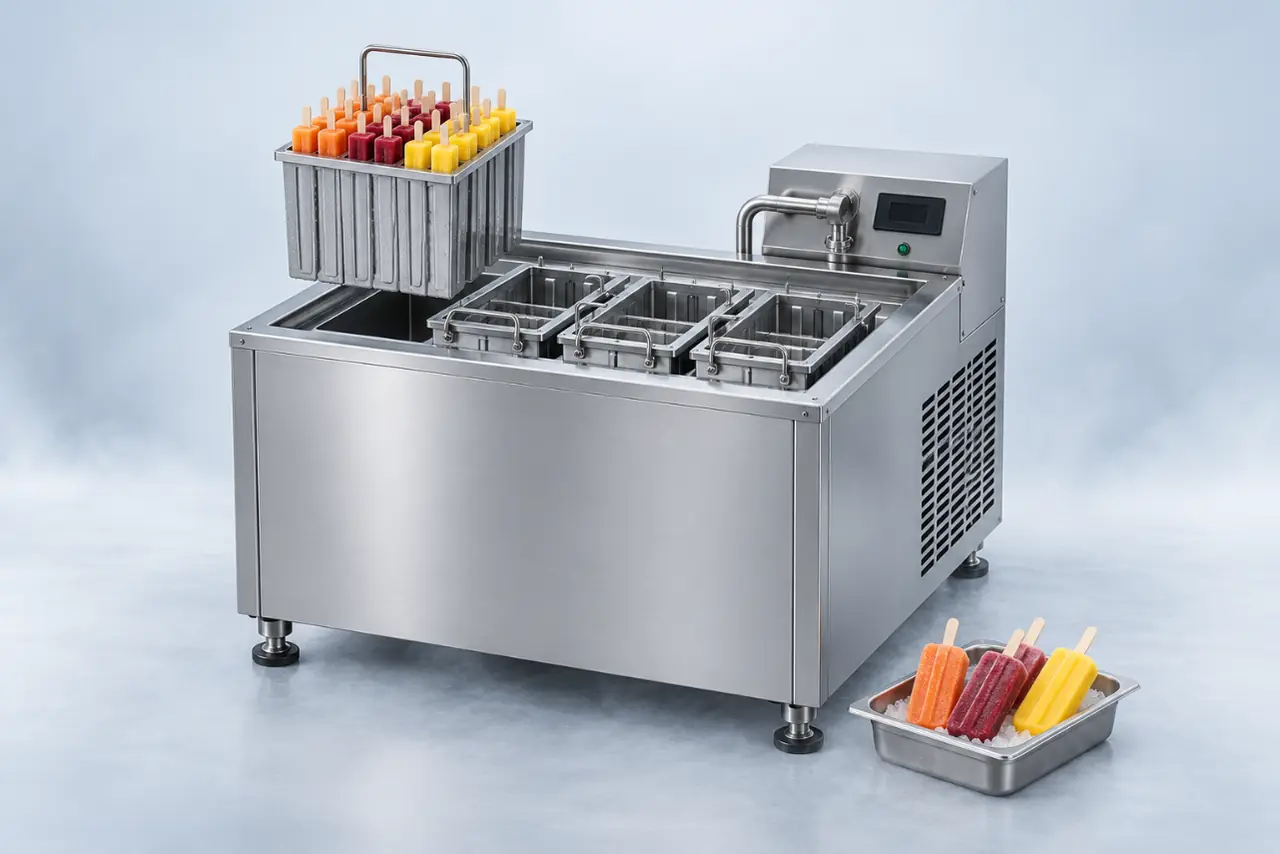
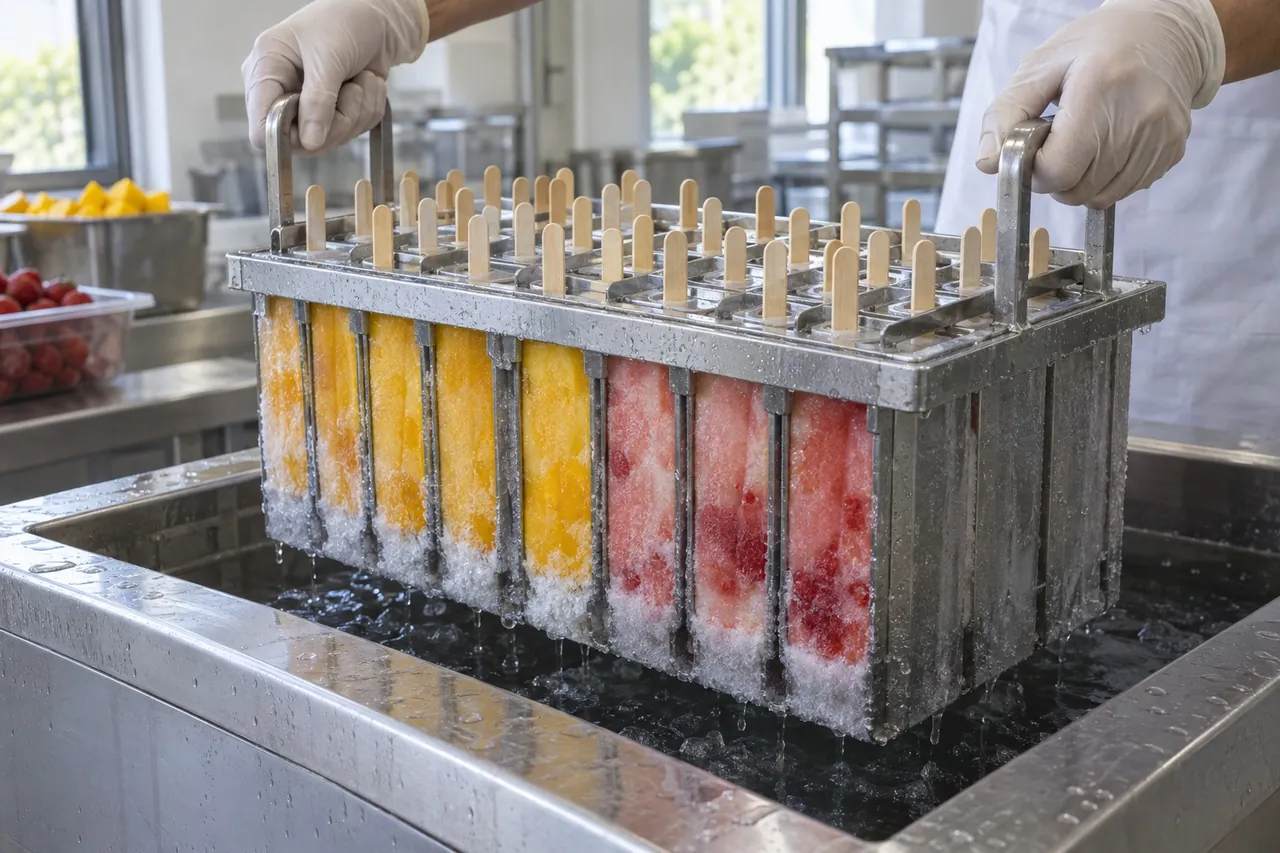
Popsicle molds for commercial use are rigid trays of food-grade stainless steel, usually 304 grade, with a row-by-row grid of pressed or welded cavities. Each mold typically holds about 40 pops. You fill the cavities with juice, ice cream mix or yogurt, lower the mold into a refrigerated brine tank, insert sticks, and lift the frozen pops out together with a stick holder.
Stainless steel is used because it conducts heat well, which shortens freezing time, and because it survives years of daily dipping in calcium chloride brine, hot-water release baths and washing. Plastic popsicle molds and silicone molds are sold for home freezers; they insulate the mix, freeze slowly and do not fit commercial machines.
A commercial popsicle machine, also called an ice pop maker machine or ice lolly machine, is built around these molds. Be There's commercial popsicle machines hold molds in brine at about −25 °C to −30 °C (−13 °F to −22 °F). Each 40-stick mold freezes in roughly 15–25 minutes, so a 4-mold machine makes about 400–600 popsicles per hour.
The mold is therefore not an accessory. It decides the shape and size of your product, your output per hour and, through its fit in the tank, whether the machine works at all.
Stainless steel vs plastic popsicle molds
The right material depends on whether you are freezing in a brine tank or a freezer.
| Material | Typical use | Freezing time | Pros | Cons |
|---|---|---|---|---|
| 304 stainless steel (commercial) | Brine-tank popsicle machines | About 15–25 min in brine | Fast heat transfer, durable, sanitisable, many shapes | Higher cost; must fit the tank |
| Stainless steel (home, 6–10 cavities) | Home or café freezer | About 4–6 h | Durable, no plastic contact | Slow without brine |
| Plastic | Home freezer, kids' pops | About 6–8 h | Cheap, light | Slow, can crack, hard to release |
| Silicone | Home freezer | About 6–8 h | Easy release, flexible | Floppy, slow, low output |
| Glass | Home freezer | About 6–8 h | Inert, easy to clean | Breakable, very slow |
For a business, metal popsicle molds in brine are the only practical choice beyond a few dozen pops a day. Small cafés sometimes start with steel home molds in a deep freezer, but the 4–6 hour freeze ties up freezer space and limits sales to whatever you made the day before. Once demand is steady, a brine machine with commercial ice pop molds pays back in labour and freezer space.
Popsicle mold sizes and shapes
Commercial molds come in a wide range of shapes, from classic rounded bars to flat, oval, square and novelty outlines. Size is set by cavity volume.
| Size | Cavity volume (typical) | Uses |
|---|---|---|
| Mini popsicle molds | About 30–50 ml (1–1.7 fl oz) | Kids' portions, tasting packs, catering |
| Standard | About 60–90 ml (2–3 fl oz) | Fruit pops, everyday retail |
| Large popsicle molds | About 90–120 ml (3–4 fl oz) | Premium dipped ice cream bars, big fruit pops |
A 40-cavity mold of 80 ml cavities holds about 3.2 L (0.85 gal) of mix. Bigger cavities take longer to freeze because the centre is further from the cold steel, so large or thick bars may need a longer dip than small popsicle molds.
Shape affects more than looks. Flat, wide bars are easy to dip in chocolate and pack in flow-wrap. Rounded shapes release cleanly. Deep, narrow cavities or sharp corners can trap air bubbles and crack on release. If you plan to sell ice cream popsicle bars coated in chocolate, choose a shape with a flat face and a smooth taper.
Custom molds with your own outline or embossed pattern are possible from some suppliers, but expect tooling cost and lead time. Ask for the cavity volume, overall mold dimensions and steel grade in writing.
Popsicle sticks and stick holders
Commercial pops use either wooden or plastic sticks. Wooden sticks, usually birch, are standard because they grip the ice well and are cheap. Common sizes are about 93 × 10 × 2 mm (3.7 in) for regular pops and 114 × 10 × 2 mm (4.5 in) for jumbo bars. Plastic popsicle sticks are reusable for home use; for retail, single-use food-grade sticks are normal.
A stick holder is a stainless frame with clips that holds a full row or a full mold of sticks in line with the cavities. There are two common methods:
- Insert after partial freezing. Fill the mold, let the outer layer freeze for a few minutes, then push in the sticks with the holder so they stand straight.
- Lid with slots. Some molds use a cover with stick slots, so sticks are placed before freezing.
After freezing, the mold goes into a warm-water defrost tank for a few seconds, typically 10–30 seconds, to loosen the pops. The stick holder then lifts all of them out at once, ready for dipping, wrapping or bagging.
Stick-making machines exist for factories that produce sticks themselves, but almost every popsicle maker simply buys sticks in cartons of thousands. Check that sticks are food grade, smooth and dry, with no splinters.
Popsicle molds with sticks vs ice pop containers and other formats
Not every frozen pop is made in a stick mold, so check which format your product needs before buying popsicle equipment.
- Stick pops in stainless molds. The classic ice lolly: popsicle molds with sticks, frozen in brine and released with a stick holder. This is what professional popsicle molds and commercial popsicle equipment are built for.
- Ice pop containers (freeze tubes). Thin plastic film tubes filled with syrup, sealed and frozen flat. They need a filling and sealing machine and freezer space, not stick molds.
- Push-up cups. Cardboard or plastic tubes filled with sherbet or ice cream and hardened in a freezer.
- Home popsicle kit. A small plastic or steel mold set with reusable sticks, made for a household freezer.
A popsicle making machine with brine is the fastest way to make stick pops at volume, while freeze tubes suit cheap, high-volume retail packs. Many small producers start with stick pops because the molds double as their brand shape and the product sells at a higher price per unit. Whatever the format, the finished product needs to be stored and sold at −18 °C (0 °F) or colder.
How many popsicle molds do you need?
A brine machine has a fixed number of mold slots, for example 1, 2, 4, 6 or 8. To keep the tank working continuously, you need more molds than slots: while some are freezing, others are being filled, given sticks, released and washed.
A practical rule is about 1.5–2 molds per slot. For a 4-mold machine that means 6–8 molds in rotation. Plan one complete extra set if you want to change shapes during the day without stopping production.
| Machine | Pops per hour (40-cavity molds) | Suggested molds in rotation |
|---|---|---|
| 1–2 mold slots | About 100–300 | 2–4 |
| 4 mold slots | About 400–600 | 6–8 |
| 6–8 mold slots | About 600–1,200 | 9–16 |
Before buying extra molds, confirm their outside dimensions and edge profile match your tank. Molds are not universal: a mold from one machine may not sit level in another, and a poor fit lets brine splash onto the product. Our popsicle business guide covers the other equipment for a small factory.
Cleaning and caring for stainless steel ice cream molds
Stainless steel ice cream molds last for years if they are cleaned properly. Calcium chloride brine is corrosive to most metals over time, so the main rule is to never leave brine drying on the steel.
- After each dip: rinse the outside of the mold with clean water before releasing pops, so no brine touches the product.
- End of shift: wash molds and stick holders in warm water with a mild, food-safe detergent, rinse, sanitise with a stainless-safe sanitiser at the correct dilution, and air-dry upside down.
- Avoid steel wool, abrasive pads and strong chlorine bleach, which can scratch or pit stainless steel.
- Inspect for dents, split welds or rough edges; a damaged cavity is hard to clean and can cut staff.
Store molds dry and stacked so the cavities are not bent. Check the brine strength in the tank regularly and keep it clean; dirty or weak brine freezes slower. Treat the whole process as part of your HACCP plan, with cleaning logs and temperature records for the mix, which should be held at or below +5 °C (41 °F) before filling.
How to choose commercial popsicle molds: checklist
- Machine fit. Mold outside dimensions and edge profile must match your brine tank; buy molds with the machine where possible.
- Steel grade. Ask for food-grade 304 stainless steel and smooth, fully welded seams.
- Cavity count and volume. Usually about 40 per mold; choose volume by product, from mini to large.
- Shape. Flat faces for chocolate dipping, rounded tapers for clean release.
- Stick holders. One holder set per mold in rotation, matched to your stick size.
- Quantity. About 1.5–2 molds per tank slot.
- Packing. Molds should ship separated and protected so cavities do not dent.
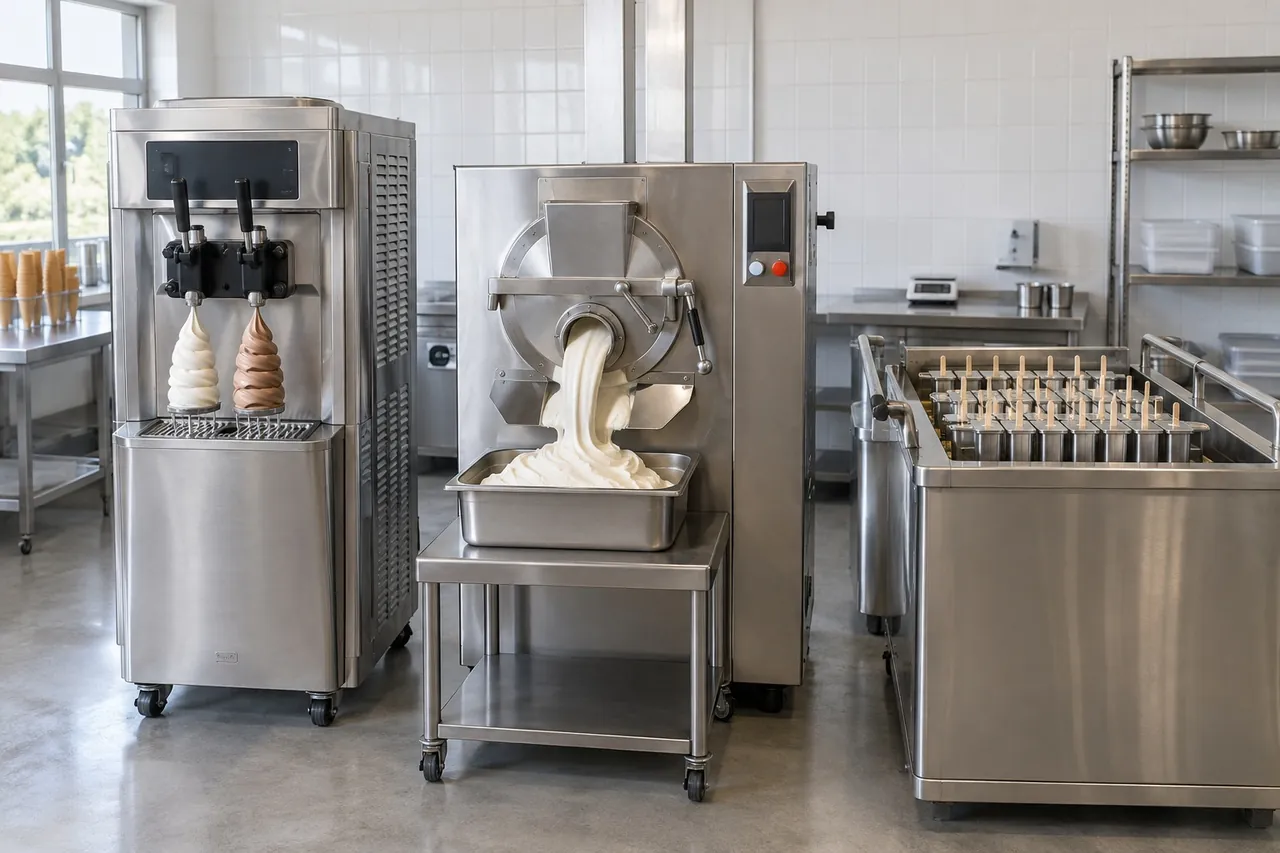
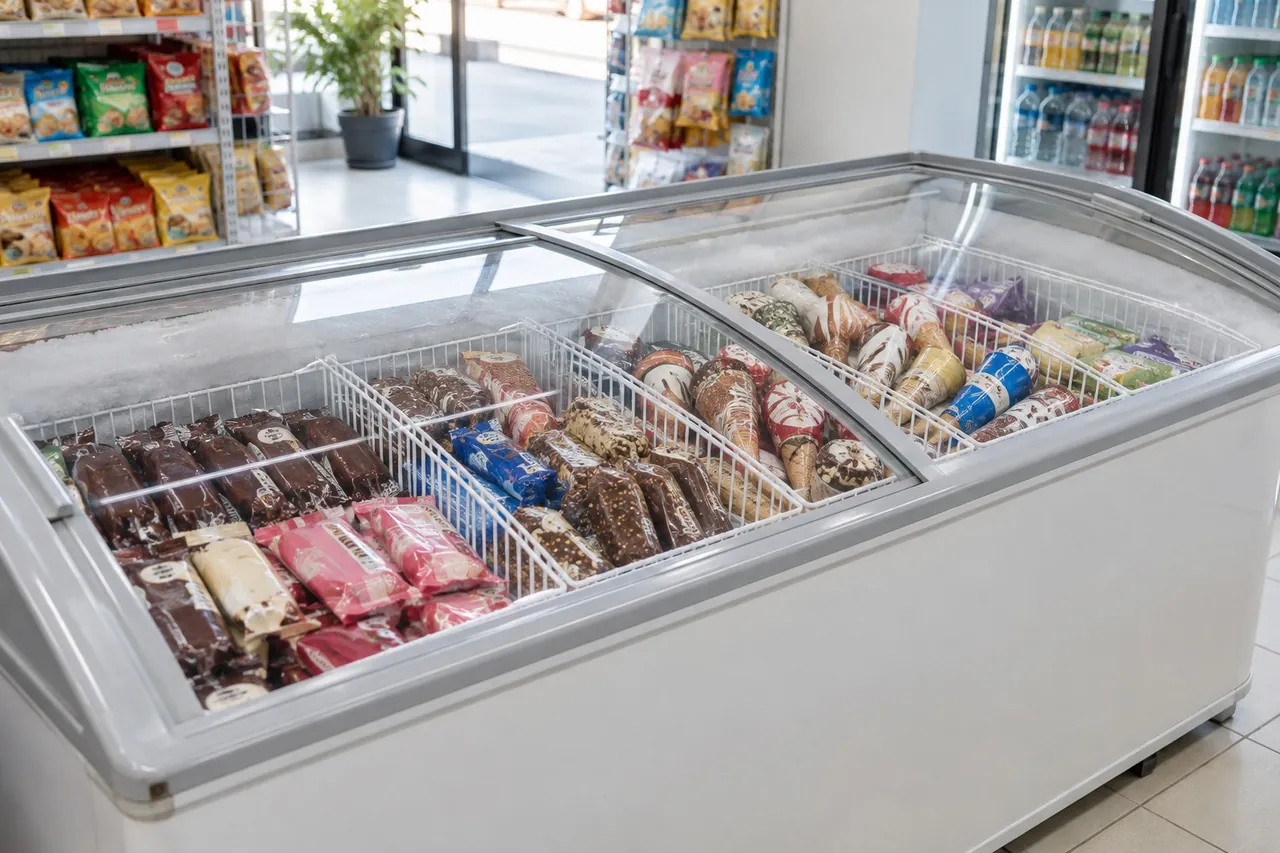
Be There supplies commercial popsicle machines and stainless steel popsicle molds as matched sets, plus display freezers for selling finished pops; see the wider ice cream machine range if you also need soft serve or batch freezers. Tell us your target output, shapes and cavity sizes and we will quote the machine, molds and stick holders together, FOB, CIF or DDP.