Short answer
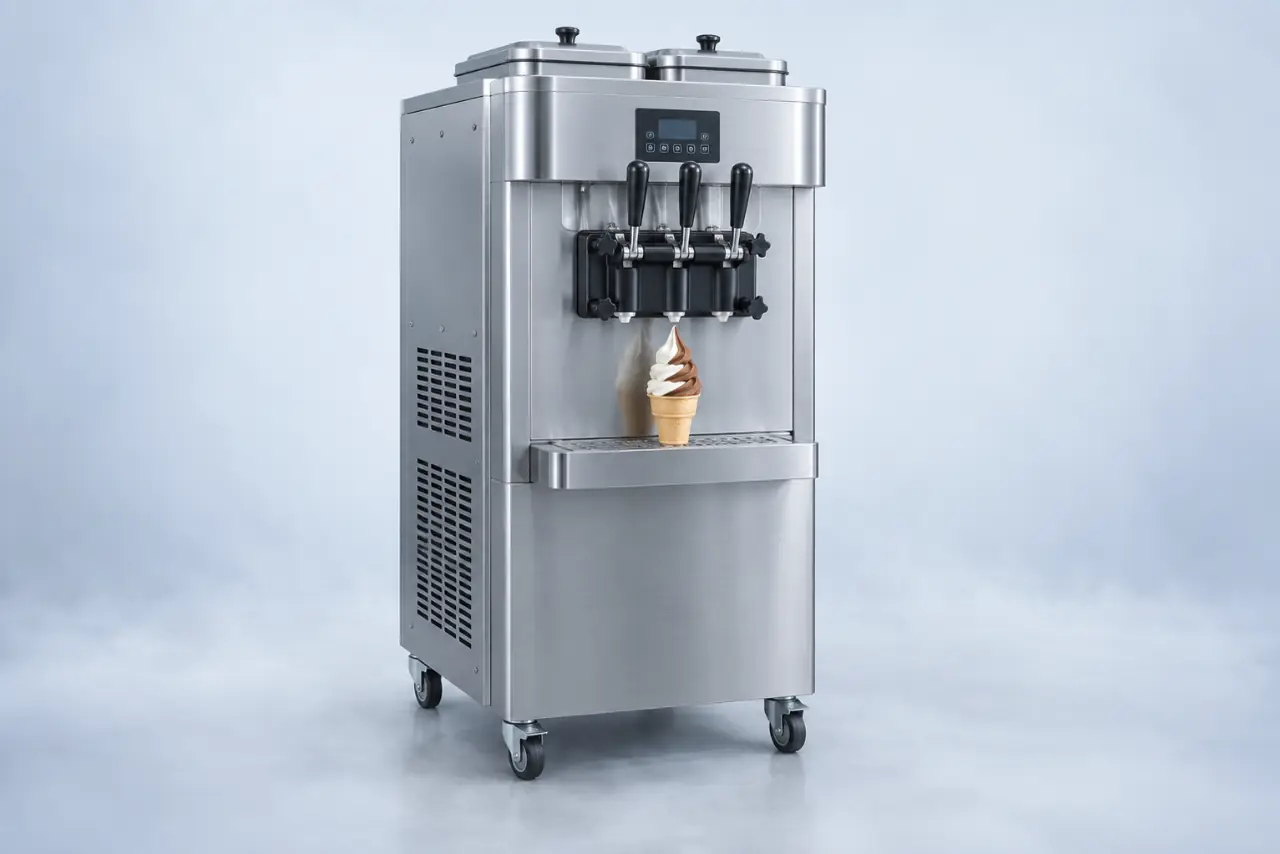
A commercial ice cream machine freezes pasteurised mix while stirring in air. Soft serve machines dispense at −6 °C to −4 °C (21–25 °F) at 18–36 L per hour; batch freezers make hard ice cream, gelato and sorbet in 6–12 minute batches; brine-tank popsicle machines freeze 40-stick molds in 15–25 minutes. Choose by product, peak hourly output and power supply.
Key takeaways
- Commercial soft serve machines produce about 18–22 L/h (tabletop) or 25–36 L/h (floor) and serve at −6 °C to −4 °C (21–25 °F).
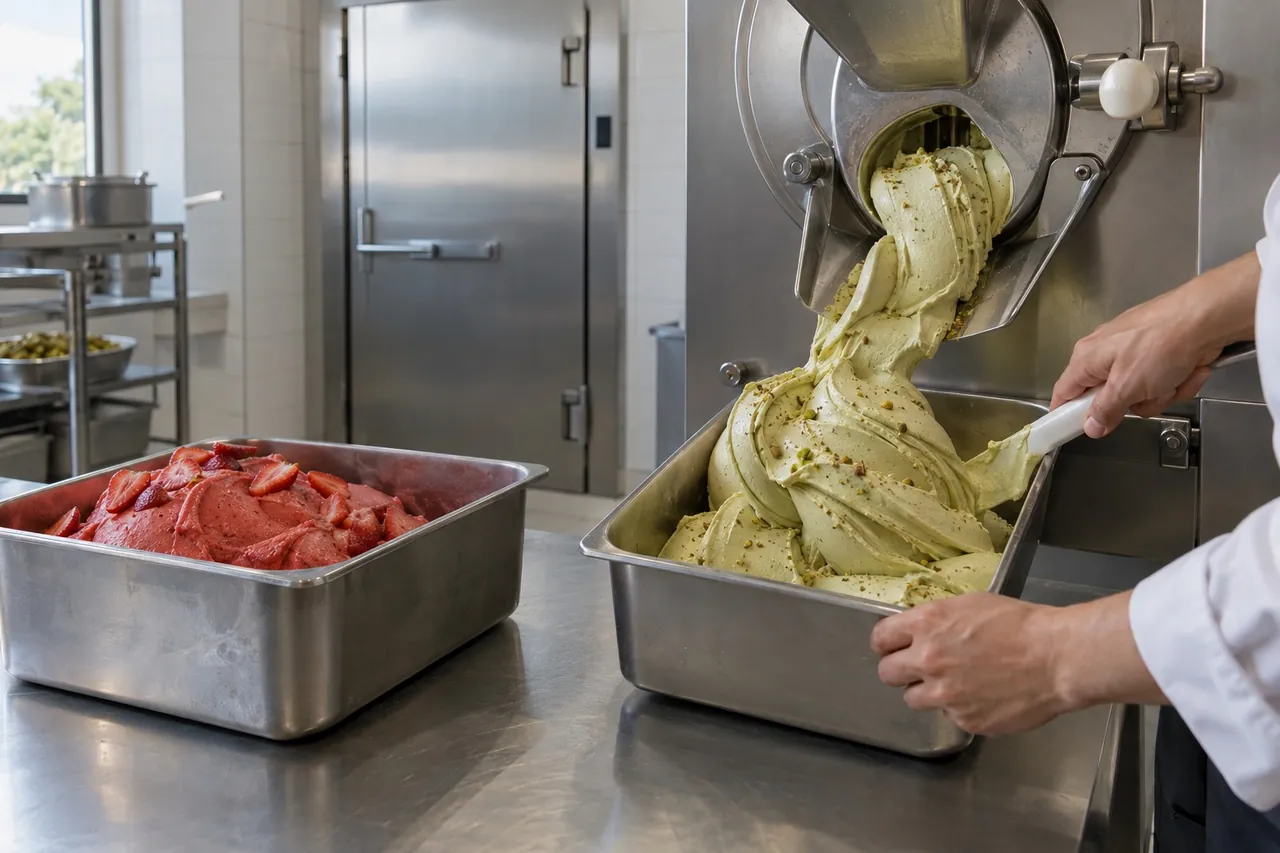
- Batch freezers make hard ice cream, gelato, sorbet and Italian ice in batches that take roughly 6–12 minutes.
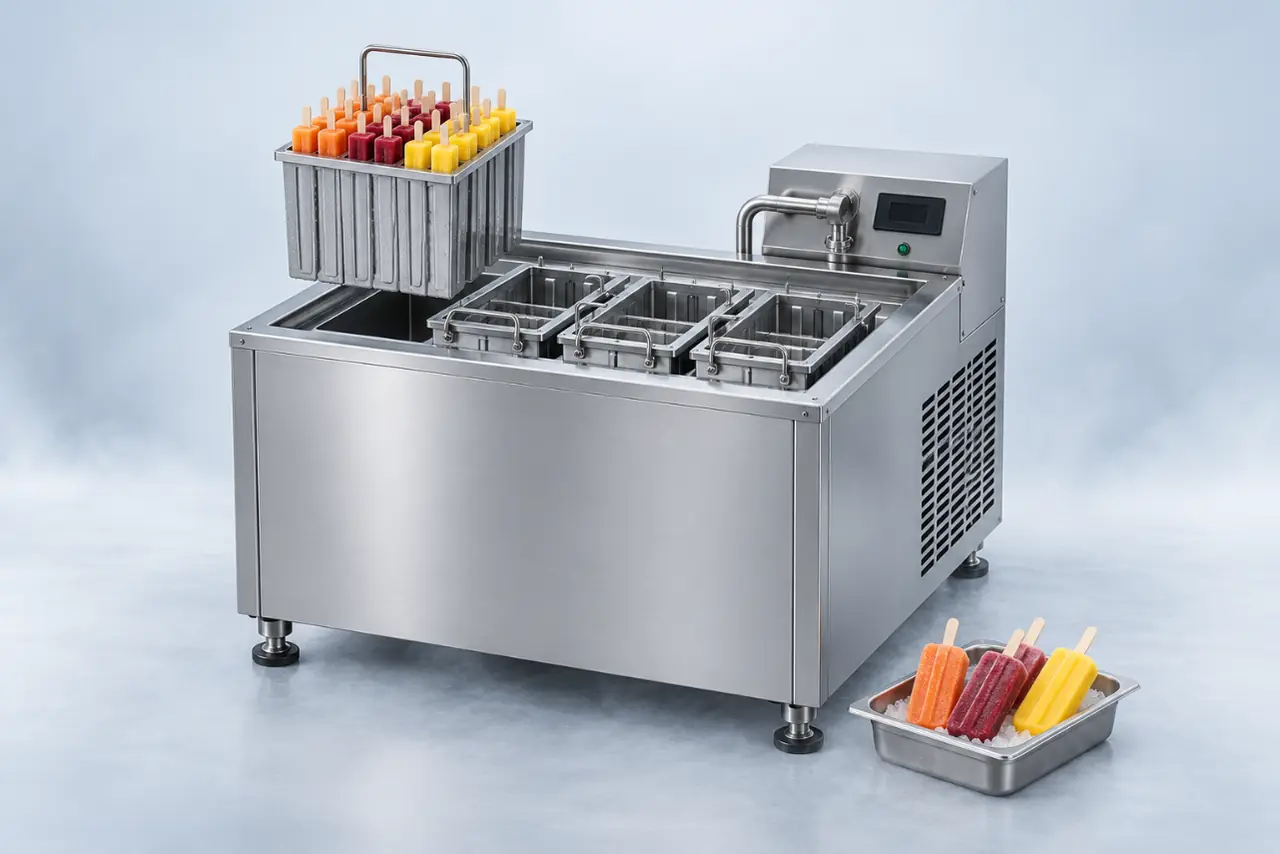
- A brine-tank popsicle machine with four 40-stick molds makes about 400–600 popsicles per hour.
- Hard ice cream must be hardened quickly and stored at −18 °C (0 °F) or colder; scooping cabinets run a few degrees warmer.
- Home ice cream makers churn 0.5–2 L batches in 20–60 minutes and are not built for continuous commercial service.
What is a commercial ice cream machine?
A commercial ice cream machine is refrigeration equipment that freezes a liquid mix of milk, cream, sugar and solids while stirring, so that the ice crystals stay small and air is whipped in. Every type does those two jobs; what differs is whether it dispenses continuously, freezes in batches or freezes in molds, and how cold the finished product is.
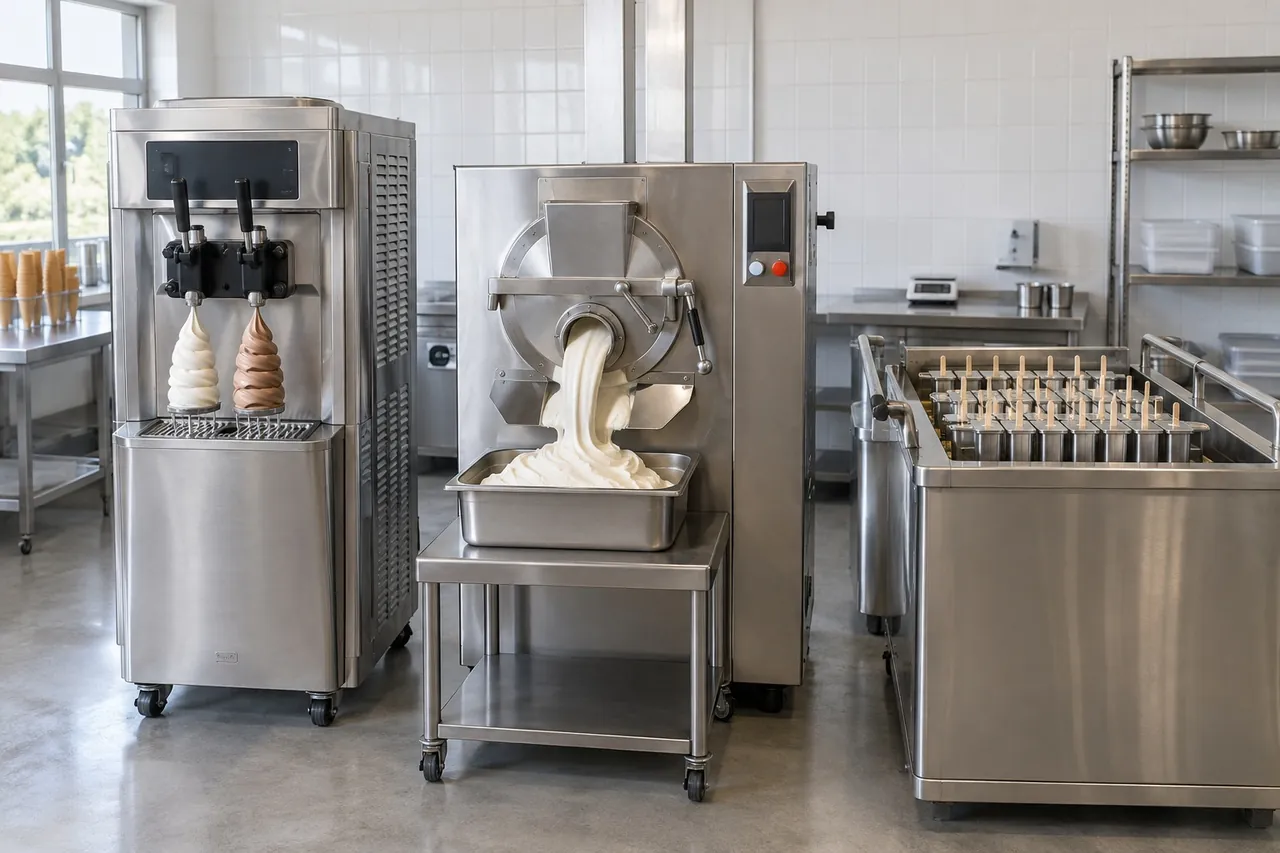
There are three main families for shops, restaurants and small producers:
- Soft serve and frozen yogurt machines: mix is held in a refrigerated hopper and dispensed on demand as soft ice cream.
- Batch freezers: a measured batch is frozen and extracted into pans for hard ice cream, gelato, sorbet and Italian ice.
- Popsicle machines: stainless molds are dipped in cold brine to make stick ice lollies and ice cream bars.
Factories add continuous freezers, which pump mix through a freezing cylinder nonstop, and hardening tunnels. Be There supplies all three shop-scale families; see our commercial ice cream machines for soft serve, batch freezers and popsicle equipment.
Whatever the type, the machine is only one part of the cold chain. You also need cold mix storage, a way to harden and store finished product at −18 °C (0 °F) or colder, and a display that keeps it at serving temperature.
How does an ice cream maker work?
All ice cream makers, from an old-fashioned bucket ice cream maker to an industrial freezer, follow the same physics. Mix touches a very cold metal wall, a thin layer freezes, and a moving blade (dasher or beater) scrapes it off and folds it back into the mix. Repeating that thousands of times creates millions of tiny ice crystals, and the stirring traps air bubbles. Small crystals give smoothness; air, called overrun, gives lightness.
How the wall is cooled is what separates the types:
- Ice and salt. A traditional ice cream maker or manual ice cream machine surrounds a metal canister with crushed ice and rock salt, which melts into brine colder than ice. You crank by hand or with a small motor for 20–40 minutes.
- Pre-frozen bowl. A small electric ice cream maker uses a double-walled bowl filled with coolant that you freeze for 12–24 hours first. One batch, then refreeze.
- Built-in compressor. Home compressor machines and every commercial ice cream maker use a refrigeration circuit with refrigerant evaporating around the freezing cylinder, so they can run batch after batch.
A commercial ice cream maker machine adds refrigerated mix storage, powerful motors, consistency controls that stop the freeze at the right stiffness, and stainless parts that can be broken down and sanitised every day.
Types of commercial ice cream machines compared
Use this table to match a machine type to your product. Figures are typical; confirm each on the quotation.
| Machine | Products | Output (typical) | Product temperature | Overrun |
|---|---|---|---|---|
| Tabletop soft serve | Soft serve, frozen yogurt, shakes base | 18–22 L/h (about 200–250 servings) | −6 °C to −4 °C (21–25 °F) | 30–60% |
| Floor soft serve | As above, higher volume | 25–36 L/h | −6 °C to −4 °C (21–25 °F) | 30–60% |
| Batch freezer | Hard ice cream, gelato, sorbet, Italian ice | About 10–80 L/h by size | About −7 °C to −10 °C (19–14 °F) at extraction | 20–35% gelato; more for ice cream |
| Brine-tank popsicle machine | Ice lollies, ice cream bars | About 100–150 pops per mold per hour | Frozen solid in brine at −25 °C to −30 °C | Low |
| Continuous freezer (industrial) | Packed ice cream, cones, bars | Hundreds to thousands of L/h | About −5 °C to −6 °C at outlet | Up to about 100% |
For detailed sizing see our guides to the soft serve machine, gelato machines and batch freezers and popsicle production.
Home ice cream maker vs commercial ice cream maker
Searches for the best home ice cream maker, a small ice cream maker, a small ice cream machine or an electric ice cream machine mostly return household units. They make good ice cream, but in small amounts and with long gaps between batches.
| Point | Home ice cream machine | Commercial ice cream machine |
|---|---|---|
| Batch or output | About 0.5–2 L per batch | 18–36 L/h soft serve; 1.5–15 L batches in a batch freezer |
| Time per batch | About 20–60 min | About 6–12 min (batch freezer) or continuous |
| Cooling | Pre-frozen bowl, ice and salt, or small compressor | Commercial compressor, air- or water-cooled |
| Duty | Occasional | All day, every day |
| Hygiene | Hand-wash bowl | Stainless parts, refrigerated mix storage, daily breakdown cleaning |
| Certification | Household appliance | Commercial marks such as CE, UL/ETL, NSF where required |
An ice cream machine for home is a sensible tool for recipe development, and some restaurants use a large home or countertop machine for a few portions of dessert a night. Once you sell more than a few litres a day or serve a queue, a commercial machine is cheaper per portion and easier to keep compliant with food safety rules.
How to make ice cream commercially: what you need
If you are asking how to make ice cream for sale rather than at home, the process has five steps, and each needs equipment.
- Mix. Combine milk, cream, sugar, milk solids and stabilisers, or buy a ready ice cream mix for the machine.
- Pasteurise. Heat the dairy mix to a legal time and temperature, for example 69 °C (155 °F) for 30 minutes under the US Pasteurized Milk Ordinance, then cool quickly. Ready liquid mixes are already pasteurised.
- Age. Hold the mix at +2 °C to +5 °C (36–41 °F) for several hours so it whips and freezes smoothly.
- Freeze. Run it through a soft serve machine, batch freezer or popsicle machine.
- Harden and store. Hard ice cream goes into a blast freezer to harden quickly, then into storage at −18 °C (0 °F) or colder.
Can you make ice cream with whole milk or heavy cream alone? Yes, for a simple recipe, but commercial mixes balance fat, sugar and solids so that the product scoops and stores consistently. Most small businesses start with a bought-in ice cream machine mix and only build their own recipes once volumes justify a pasteuriser.
Industrial ice cream machines and ice cream making equipment
An industrial ice cream maker or industrial ice cream machine for a factory is a different class of equipment from a shop machine. Continuous freezers pump aged mix and air into a scraped-surface cylinder and deliver product at about −5 °C to −6 °C (23–21 °F) to fillers for tubs, cones or bars. Downstream sit hardening tunnels or rooms at about −30 °C to −40 °C (−22 °F to −40 °F) and frozen storage.
Between the shop and the factory is the small producer: a café supplying wholesale, a gelato lab feeding several outlets, or a popsicle brand selling to supermarkets. These businesses usually scale with:
- Larger batch freezers or several batch freezers in parallel.
- Multi-mold popsicle machines with 4–8 molds plus a mixing tank.
- A blast freezer and a walk-in freezer room at −18 °C to −25 °C (0 °F to −13 °F) for finished stock.
- Packing equipment, labelling and a refrigerated delivery vehicle.
Be There focuses on shop and small-producer equipment: soft serve machines, batch freezers, popsicle machines, blast freezers, cold rooms and display freezers. For a full continuous production line, send us your target output and we will tell you honestly which parts we can supply.
How much does a commercial ice cream machine cost?
Ice cream machine price varies more with type and specification than with brand. The main cost drivers are:
- Type and output. A tabletop soft serve machine costs far less than a large floor batch freezer or an 8-mold popsicle machine.
- Features. Air pumps, heat-treatment cycles, standby modes, digital consistency control and pasteurising functions all add cost.
- Condenser. Water-cooled versions cost more than air-cooled.
- Power. Three-phase and non-standard voltages may change the compressor and price.
- Certification. UL/ETL, NSF or CE testing for your market.
- Import costs. Freight, duty, inspection and installation.
Cheap ice cream machines often save money on compressors, motors and steel thickness, which shows up as slow recovery in a rush and short service life. Compare quotations on the same output, at the same ambient temperature, on the same Incoterm. Be There quotes each order FOB, CIF or DDP, with specifications confirmed on the proforma invoice. Ice cream machine reviews rarely cover this, so ask the supplier for a run-test video at your voltage and a written spare parts list before you pay.
How to choose: checklist and next steps
- Product. Soft serve or froyo points to a soft serve machine; scooped ice cream, gelato or sorbet to a batch freezer; stick pops and bars to a popsicle machine.
- Peak output. Count servings, litres or pops at your busiest hour and size to that, with headroom.
- Storage and display. Plan hardening, storage at −18 °C (0 °F) or colder, lidded ice cream storage containers or pans, and a display freezer or scooping cabinet. This is the ice cream restaurant equipment most often forgotten in budgets.
- Power and cooling. Confirm voltage, frequency and phase, and whether the room needs a water-cooled machine.
- Certification and service. Ask for the marks your inspector needs and a spare parts kit with seals, blades and gaskets.
When you are ready, send us your product list, peak volumes and power supply. We will quote matched commercial ice cream machines plus display freezers and cold rooms in one shipment, and reply within one working day.